

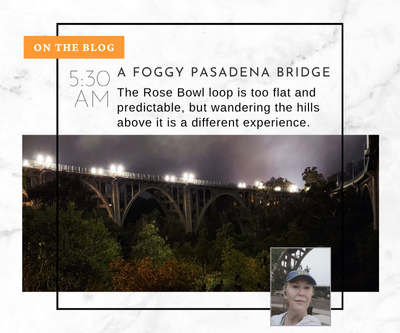
Three mornings a week, I’m up before dawn and heading to the Rose Bowl by 5:30 a.m. Not to walk the loop — that’s too flat and predictable — but to wander the hills above it. Those quiet neighborhoods just north and east of the Bowl have the perfect mix of incline, trees, and stillness. On this particular morning, the sky was heavy with fog, the kind that softens sound and turns every streetlight into a hazy glow. Instead of turning toward the trails — too dark for comfort, especially when you know the local wildlife might be stirring — I decided to follow the streets that curve toward the 134 Freeway overpass.
Crossing the bridge over the freeway, the hum of early commuters below, I stepped onto Orange Grove Boulevard. To my right rose one of Pasadena’s grand old landmarks — the stately building that now serves as the Richard H. Chambers U.S. Court of Appeals. Many know it as the federal courthouse, but long before that, it was the Vista del Arroyo Hotel. Built in the early 1900s, it grew into a Spanish Colonial Revival masterpiece by the 1930s — a luxurious resort where guests could sit on terraces overlooking the Arroyo Seco. During World War II, it even served as a hospital before being converted into a courthouse in the 1980s. Today, it stands as a reminder that even buildings can have second acts — graceful ones, at that.
As the courthouse lights dimmed with the rising sun, I continued west along Orange Grove toward one of Pasadena’s most recognizable icons — the Colorado Street Bridge. I’ve always called it “the big bridge,” but most people know it by its darker nickname, “Suicide Bridge.” Its real name, of course, is the Colorado Street Bridge, a Beaux-Arts-style concrete arch bridge that has spanned the Arroyo Seco since 1913. Designed by Waddell & Harrington and built for just over $191,000, it curves gracefully across the ravine — that curve wasn’t just for looks, but to anchor its foundations in stable ground. When it opened, it was hailed as a triumph of engineering and beauty. Today, it’s listed on the National Register of Historic Places and designated a Historic Civil Engineering Landmark.
But beauty has always lived beside sorrow here. The first recorded suicide from the bridge was in 1919, and by the 1930s, its reputation was sealed. Over the years, Pasadena has worked to protect both people and history — installing fences, then designing new barriers that maintain the bridge’s character while discouraging tragedy. Standing there that morning, the fog rolling over its arches, I could see why people are drawn to it: it’s hauntingly beautiful, especially when the light shifts between night and day.
There’s something poetic about a place that can be both haunting and hopeful — where architecture holds memory, and morning fog blurs the lines between history and heart.
Instead of crossing, I decided to take the path down below. The fog hung low as I descended into the Arroyo Seco and wandered into a small park tucked directly beneath the bridge — the Desiderio Neighborhood Park. Many locals don’t even know it’s there. Completed around 2015, it’s a quiet green space built on the site of a former National Guard armory. Standing in that park, you look up and see the bridge’s massive concrete ribs stretching overhead — 150 feet above, arches layered like ribs of a cathedral. The play of fog, light, and concrete was mesmerizing. It’s the kind of place that humbles you a bit — architecture meeting earth, shadow meeting sky.
If you ever find yourself under those arches, look up. The bridge feels alive — breathing through mist, memory, and morning light.
To one side, you can see the courthouse’s tower peeking through eucalyptus branches. To the other, the Arroyo’s trails wind off toward the Linda Vista Bridge — the smaller span that connects toward the Rose Bowl area. It’s all part of a network of bridges that tell Pasadena’s story: elegant, practical, enduring. I lingered long enough to take a few photos — the kind of morning light that turns everything into a soft watercolor — before heading back up along Arroyo Boulevard toward my starting point.
By the time I reached the Rose Bowl parking lot again, my watch read a little over four and a half miles. The bridge behind me had faded into fog, its streetlamps still glowing faintly in the distance. It’s funny how a walk meant for exercise turned into a lesson in history, architecture, and quiet reflection — all before most of Pasadena had poured its first cup of coffee.
• Morning walks have a way of revealing the layers of our community — the stories beneath the bridges, the history in our landmarks, and the quiet beauty right in our own backyard.
Email Robbyn Call Robbyn
Backlinks & Resources
- Wikipedia – Colorado Street Bridge
- National Park Service – Historic Listing
- City of Pasadena – Bridge Project
- GSA – Richard H. Chambers Courthouse
- Transiting Los Angeles – Desiderio Park
- Pasadena Now
- Crescenta Valley Weekly
- City of Pasadena
- Rose Bowl Stadium
- The House Agent Website
- Google Business Page
- Zillow Profile
Robbyn Battles | The House Agent | JohnHart Real Estate | La Crescenta, Montrose & Pasadena Area Realtor | 35+ Years of Local Experience | Colorado Street Bridge Pasadena | Vista del Arroyo Hotel | Desiderio Neighborhood Park | Arroyo Seco Walks | Pasadena Historic Landmarks | Rose Bowl Morning Walk | The House Agent | Robbyn Battles Realtor | Pasadena Real Estate | Early Morning Walks Pasadena | Pasadena Architecture | Community Stories | Local History Pasadena