

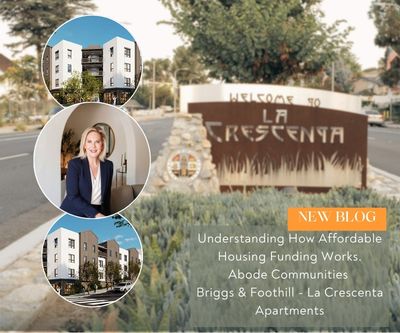
Robbyn Battles, The House Agent, a long-term La Crescenta resident and realtor, digs deep into the details of how Abode Communities’ 100% affordable housing project at Briggs & Foothill, known as the La Crescenta Apartments, carries a $67 million price tag just to build.
I’m Robbyn Battles, The House Agent. In this blog, we examine why it is an absolute oxymoron to call the 2413 Foothill Boulevard project “affordable housing.” After all, the cost just to acquire the land and build the structure will hit approximately $67,000,000. I plan to share from beginning to end how a project like this actually gets funded.
Learn exactly how Abode Communities finances and spends that massive budget. In addition, we will discuss the financial incentives put in place for big bank investors. Lastly, our community must look at what it truly means when LA County “approves funding.”
This primary $67,000,000 construction price tag does not include the long-term costs to handle rent subsidies. Nor does it include property management and physical building maintenance over its 55-year lifecycle. Then there are the rent subsidies. So, sit back, get ready, and let’s learn how your tax dollars fund affordable housing projects from start to finish and beyond.
The Affordable Housing Blueprint for 2413 Foothill Boulevard
Abode Communities placed the housing layout at 2413 Foothill Boulevard & 4521 Briggs Avenue. This location is the site of the former La Crescenta Motel. Because the developers listened to local community feedback, they modified the design plans. The current proposal features a 5-story building serving low-income families and transitional youth.
- The Scale Down: Originally, the developer proposed 80 units for the site. However, planners scaled the footprint for the Abode Communities Briggs and Foothill build down to 66 units. This final tally includes 32 one-bedroom, 17 two-bedroom, and 17 three-bedroom homes.
- Target Demographics: The affordable housing development at 2413 Foothill Boulevard will serve households earning between 30% and 70% of the Area Median Income (AMI). Within this matrix, management earmarks 25 of the one-bedroom apartments for Transition Aged Youth (TAY). These units specifically benefit young adults aged 18–24 who are exiting the foster care system.
- Operating vs. Development Capital: First, you must separate the cost to build affordable housing from the cost to operate it. The financing packages requested for 2413 Foothill Boulevard cover strictly acquisition and construction. Therefore, they do not fund long-term operations. Instead, rental income collected from tenants and federal Section 8 housing vouchers pays for ongoing operating expenses. These revenues cover standard utilities, landscaping, building repairs, and security.
Running the Numbers: The Million-Dollar Math Matrix
To evaluate the true scale of the Abode Communities Briggs and Foothill project, we must look directly at the real estate metrics. The total estimated capital required to buy the land and construct this 66-unit structure at 2413 Foothill Boulevard is roughly $67,000,000.
The Cost-Per-Unit Calculation:
Take the total construction and land acquisition cost of $67,000,000 and divide it by the 66 units:
$67,000,000 divided by 66 units = $1,015,151 per unit
Consequently, this means every individual apartment inside the Abode Communities Briggs and Foothill development costs just over $1 million to deliver.
The Price-Per-Square-Foot Calculation:
Assume a standard multi-family industry average design layout where an average unit sizes out to roughly 1,000 square feet. Next, we divide the cost per unit by the square footage:
$1,015,151 divided by 1,000 square feet = $1,015 per square foot
To place these figures in perspective, standard private commercial multi-family residential construction in Southern California generally runs between $350 and $500 per square foot for construction. Therefore, crossing the $1,000 per square foot mark reveals a startling fact. Affordable housing at 2413 Foothill Boulevard is significantly more expensive to construct than traditional private development.
The Oxymoron: Affordable Housing Is Not Affordable to Build
It sounds completely backward. This is an article about how affordable housing is funded. The ultimate oxymoron centers entirely on the build cost. While the public calls it “affordable housing,” the reality is that it is incredibly expensive and completely unaffordable to actually build. This happens because “affordable” refers exclusively to the final rent price charged to the tenant. It does not mean the cost of the brick, mortar, labor, and land is cheap. Government bureaucracy and policy mandates drive the baseline development costs up for the Abode Communities Briggs and Foothill initiative:
- Prevailing Wage Mandates: Any project using public funding or county bond assistance must legally pay workers “prevailing wages.” These mandates require union-scale wage structures and benefits packages. Consequently, this requirement instantly adds 20% to 35% to physical labor costs compared to standard private sector builders.
- Layered Financing Costs (The Paperwork Tax): A private developer typically secures one primary bank mortgage and utilizes cash equity. In contrast, a subsidized affordable housing project combines anywhere from 5 to 10 distinct public and private funding pipelines. Each independent source brings a team of attorneys, asset managers, escrow accounts, and strict compliance audits. As a result, developers spend millions of dollars on administrative overhead before physical labor even begins.
- Stringent Environmental & Structural Rules: State-funded affordable housing must comply with high-tier green building mandates, such as LEED Gold or Platinum tracking. They must also include solar installation requirements and meet strict energy-efficiency laws. Finally, comprehensive compliance with the Americans with Disabilities Act (ADA) adds heavy structural expenses that standard entry-level apartment builds do not carry.
Land Bidding: How Premium Market Purchases Inflate the Budget
A common misconception is that nonprofit groups receive deep charity discounts when buying real estate to build affordable housing. In reality, entities like Abode Communities buy their property at full market value. Furthermore, they often overpay to lock down competitive sites. For instance, Abode paid over $6,000,000 to acquire the former La Crescenta Motel site at 2413 Foothill Boulevard.
Because a nonprofit developer does not rely on private personal equity, the company does not target a specific commercial profit margin. Consequently, they are largely insulated from the financial pain of high acquisition costs. If the land costs more, they simply adjust the math upward on their funding requests for state tax credits and county conduit bonds. Thus, this process creates an artificial market distortion. Public-backed entities armed with multi-million dollar grant structures outbid traditional private developers who operate under real financial guardrails. The public pocketbook ultimately absorbs the land premium for the Abode Communities Briggs and Foothill location.
Why Private Developers Can’t Build Affordable Housing Independently
Private, for-profit builders operate on clear financial logic. Their rental income must outpace their construction debt service and operational overhead. However, the restricted rent numbers of a 100% affordable housing building break this business model entirely.
For example, suppose a private builder buys land at top-of-market prices. They construct a standard building using commercial bank loans. To survive, they must charge market-rate rents of $2,800 to $3,800+ depending on unit size to pay off the bank and cover local property taxes. If the government forces them to drop those rents down to restricted affordable housing limits ($700 to $1,200 per month), the asset fails. It instantly stops generating enough cash to meet the monthly bank payment, leading to immediate foreclosure. Private builders only participate if they receive massive density bonuses to cross-subsidize cheaper units with premium luxury units. Otherwise, they leave 100% affordable housing pipelines entirely to subsidized nonprofits.
Deconstructing the Money / Grants, Loans, and Bonds
To cover the $67,000,000 development package for the Abode Communities Briggs and Foothill project, planners utilize a series of distinct public financial silos through Los Angeles County. Here is the breakdown of how this affordable housing project is funded:
| Financing Component | Dollar Target | Capital Classification | Primary Function |
|---|---|---|---|
| Affordable Housing Trust Fund (AHTF) | $4,500,000 | Direct Subsidy Loan | Fills the final structural financing housing gap. Paid back only from residual project cash flow. |
| Multifamily Housing Bonds | $40,000,000 | Conduit Tax-Exempt Debt | Upfront capital for physical construction phase; issued via county but paid by Abode. |
| LIHTC Equity / Private Capital | $22,500,000 | Tax Credit Equity Investment | Permanent capital from corporate entities used to pay down the construction bond debt. |
What is the Affordable Housing Trust Fund (AHTF)?
The $4,500,000 request from the Los Angeles County Development Authority (LACDA) is a specialized low-interest loan. Officials stock this trust fund using local property tax diversions, state allocations, and federal housing grants. It operates as a “residual receipts loan.” This means the developer only pays it back if the building has extra cash left over after covering its standard operational bills at the end of the year.
How Do the $40 Million Conduit Bonds Work?
LA County does not hand Abode $40,000,000 in cash from the general tax fund. Instead, the County acts as a structural middleman to issue Multifamily Housing Mortgage Revenue Bonds for 2413 Foothill Boulevard. Because a government body originates the bond, the interest paid out to investors remains completely tax-exempt.
Private institutions purchase these bonds to generate an immediate $40,000,000 cash pile for construction. Meanwhile, Abode remains entirely responsible for paying back the bondholders via building revenues and incoming equity partners. If Abode defaults, the private bond purchasing institutions take the loss, not the local municipal taxpayer.
The Monthly Rent Matrix: Who Actually Pays?
Now that we understand how the building is physically constructed, let’s look at how the monthly rent checks actually work. Because this is a 15-year or 55-year deed-restricted property, the law strictly controls the rents. They do not depend on market demand. Instead, the state mathematically ties them to the Area Median Income (AMI) of Los Angeles County.
Based on current affordable housing rent schedules for families and individuals earning between 30% and 70% of the AMI, here is the approximate baseline breakdown of what the restricted monthly rents look like for this specific project:
- 1-Bedroom Units: Roughly $650 to $1,300 per month (depending on the exact income tier of the tenant).
- 2-Bedroom Units: Roughly $750 to $1,550 per month.
- 3-Bedroom Units: Roughly $850 to $1,800 per month.
How the Rent is Subsidized
When you hear that the Abode Communities Briggs and Foothill development is “100% affordable housing,” it does not mean the building magically costs less to operate. The utility bills, building insurance, security guards, property management staff, and repairs cost the exact same as they do for a luxury building down the street.
Because the tenants are only paying a fraction of the actual cost to run the unit, the remaining balance must be filled by operational subsidies. These funds do not come from the tax credits we discussed earlier, since tax credits only pay for the initial construction phase. Instead, they come from an entirely different bucket, specifically Project-Based Section 8 Vouchers and local housing authority funds.
Here is how a $1,200 apartment check actually gets paid every month:
- The Tenant’s Share: The low-income tenant or transitional foster youth pays a legally capped amount based on their personal income. This usually equals exactly 30% of their monthly earnings. Let’s say that equals $300.
- The Subsidy Share: The local housing authority steps in next. They cut a monthly check directly to the nonprofit developer for the remaining balance of $900.
The Second Taxpayer Layer
This layout means your initial intuition is exactly right. The public does not just fund the construction of the building. Through these monthly housing vouchers and rent subsidies, the public also directly pays a significant portion of the ongoing monthly rent to keep the building at 2413 Foothill Boulevard financially solvent.
Tax Credit Equity: How Affordable Housing Is Funded by Banks
The core engine of affordable housing in the United States is the Low-Income Housing Tax Credit (LIHTC) program, created by Congress under the Tax Reform Act of 1986. Congress recognized that the federal government was poorly equipped to build and manage public housing directly. Therefore, they designed an incentive to redirect private corporate income tax into housing development.
A Step-by-Step Scenario:
Let’s look at how this works using a simplified, real-world baseline example:
- The State Issues Credits: First, the State of California awards Abode Communities a designated batch of federal tax credits based on their project design. Let’s say it’s worth $1,000,000 per year.
- The Non-Profit Trades the Credits: Because Abode is a tax-exempt 501(c)(3) nonprofit, they do not pay corporate income taxes and cannot use these credits. Consequently, they look for a Limited Partner—typically an institutional bank like Bank of America, Chase, or Wells Fargo.
- The Transaction: The bank gives Abode upfront cash to construct the building. In exchange, Abode installs the bank as a Limited Partner in the project’s legal corporate structure, handing them the tax credit coupons.
- The 10-Year Return: For 10 consecutive years, when that bank files its corporate federal tax return, it subtracts exactly $1,000,000 off the final bottom-line dollar amount it owes the IRS. The bank’s return doesn’t come from building rent. Instead, it comes from the fact that they bought $10,000,000 in future tax reductions for an upfront cash payment of $8,500,000. The bank keeps the difference as a tax savings, and the neighborhood gets an injection of construction capital that never has to be paid back.
The Corporate Architecture of the Nonprofit
Because Abode Communities operates as a 501(c)(3) nonprofit corporation, it does not answer to shareholders. Furthermore, corporate rules bar the entity from distributing profits to private individuals. Every dollar generated must remain inside the organization to advance its affordable housing mission.
However, running a multi-million dollar real estate and asset management firm requires a corporate structure. According to their public IRS Form 990 filings, Abode manages a large workforce across architecture, property management, and development. Their annual revenue sits around $21.7 million, with $22.5 million in reported functional expenses. This paper deficit is standard in real estate and is driven by asset depreciation (the calculated loss of a building’s paper value over time), rather than actual cash loss.
Executive Salaries: The Market Reality
The executive compensation structure at Abode often draws attention during local community discussions:
- Holly Benson (President & CEO): $374,469 Base Salary (plus $29,689 in additional benefits)
- Rick Saperstein (Executive VP / Assistant Treasurer): $275,712 Base Salary
- Jerry Gonzales (Executive VP): $254,562 Base Salary
While these numbers look out of place for a charity, the organization competes directly with the commercial real estate market to hire top talent. They need executives capable of overseeing large-scale assets, negotiating institutional bonds, and ensuring compliance with complex housing legislation. The IRS requires that these salaries be reasonable and mutually comparable to organizations of similar scope and size. These salaries are paid from corporate administrative overhead, which represents roughly 10% to 15% of Abode’s operational spending. They do not come directly out of the construction loans.
Safeguards: What Happens If Funding Dries Up or Operations Fail?
A primary point of discussion is long-term sustainability. If local or state budgets run deep deficits and future funding lines tighten, what happens to the building’s physical maintenance and its residents? Fortunately, the structural framework of affordable housing includes specific protections against sudden failure:
- Mandated Upfront Reserves: Before construction is completed, lenders and tax credit investors force Abode to capitalize two distinct, locked bank accounts. These include an Operating Reserve to absorb rent shortfalls and a Replacement Reserve. This second account is funded monthly to cover structural repairs like roofs, boilers, and painting 15 years down the road.
- Self-Sustaining Rental Baseline: The restricted rents paid by tenants, combined with Section 8 federal vouchers, are calculated to meet the baseline operational costs of property management, trash, utilities, and minor repairs. Therefore, the building is designed to run independently on its own cash flow without needing constant injections of new state cash.
- The 55-Year Land Clause: Abode signs a strict Regulatory Agreement recorded directly against the land deed, requiring the property at 2413 Foothill Boulevard to remain 100% affordable housing for 55 years. If Abode experiences an organizational bankruptcy, the county or a court-appointed receiver steps in, forecloses on the property, and transfers the asset to a stable nonprofit operator. The physical building and affordability mandate stay bound to the land, regardless of corporate changes.
The Political Paradox of Housing Incentives
This financial journey highlights a deep irony in modern housing policy. A prominent talking point among many civic representatives focuses heavily on eliminating “corporate tax loopholes,” “Wall Street write-offs,” and “financial tax breaks for conglomerates.”
The primary tax incentive funding affordable housing is the Low-Income Housing Tax Credit (LIHTC), which Congress created under the Tax Reform Act of 1986. Yet, the LIHTC structure represents the single largest corporate tax incentive program in the United States code. If lawmakers successfully eliminate these corporate tax credits and write-offs in the name of corporate accountability, major banks will instantly stop funding these equity structures.
The financial engine that accounts for roughly 90% of all deed-restricted affordable housing construction across the country would dissolve, freezing developments like the Abode Communities Briggs and Foothill project entirely. Our current public housing framework depends completely on the very corporate tax incentives that are frequently targeted in political discussions.
Conclusion: The Bottom Line for the Taxpayer
When we pull back all the complex financial layers, the acronyms, and the multi-tiered financing silos, we must look honestly at who pays the final bill. When local, state, or federal representatives announce a new affordable housing project, they often speak as if the funding is a gift discovered in a government ledger. But we need to be fundamentally honest with ourselves: Every single cent of this housing network is subsidized by the taxpayer.
Taxpayers pay to acquire the premium-priced land at 2413 Foothill Boulevard. The public pocketbook subsidizes the high-interest construction bonds. Additionally, working citizens cover the corporate tax cuts given to Wall Street banks. Finally, through monthly housing vouchers, the local taxpayer subsidizes the ongoing rental income required to keep the building running.
Affordable housing is not a product of private charity or corporate generosity. It is a systemic public infrastructure project funded entirely from the pockets of ordinary citizens, from the first shovel in the ground to the monthly rent checks paid over the next 55 years. Understanding this reality allows our community to have an honest, educated conversation about how our public funds are being used.
A Quick Resident Perspective & Some Hard Questions
To be completely clear, writing this article is not about saying our community doesn’t want or need affordable housing. Instead, this conversation is about transparency. It is about understanding exactly how much public money is used. Furthermore, we are pulling back the curtain on the corporate incentives driving these developments. As a local resident, this setup forces me to think about several difficult questions.
Yes, standard market rents are incredibly high, but we are currently subsidizing these new units directly on the backs of individual taxpayers. At the same time, we listen to our County Supervisors and elected officials constantly repeat the talking point that we desperately need more affordable housing inventory. However, the sheer cost to construct these projects under the current system is outrageous. It forces us to ask: *Affordable for whom?*
What is the true, sustainable solution to making local housing genuinely cheaper if our current system relies on giving away massive tax write-offs to big banks? Furthermore, structures like the Abode Communities project essentially lock people in as renters for life, while requiring continuous public subsidies to stay afloat. At what point can our representatives begin to curate this money differently to get it off the backs of the individual taxpayers? I do not pretend to have the perfect solutions to our housing crisis. However, I do know that this is an extraordinary amount of money, and our community deserves to have these questions answered openly.
About the Author
Robbyn Battles is a lifelong Foothills resident and local real estate professional known affectionately across the community as The House Agent. With decades of local experience, she frequently monitors and writes about housing density laws, state zoning legislation, and local development pipelines across our neighborhoods. To read more of her deep-dive educational series, view market reports, or track upcoming public community hearings, visit her local real estate blog.
Public Accountability & Transparency Sources
- Los Angeles County Development Authority (LACDA) – Affordable Housing Trust Fund Guidelines: https://www.lacda.org
- California Tax Credit Allocation Committee (CTCAC) – LIHTC Program Regulations: https://www.treasurer.ca.gov/ctcac
- IRS Exempt Organizations Business Master File (Form 990 Database): https://www.irs.gov/charities-non-profits
- California Department of Housing and Community Development (HCD): https://www.hcd.ca.gov