

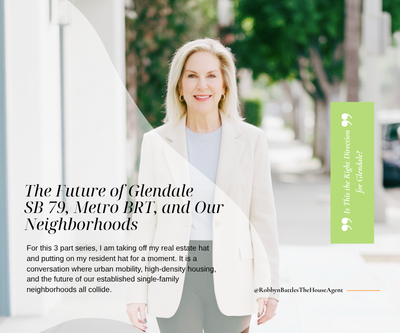
 A Shift in Our City: Mobility, Density, and the Future of Glendale. Over the years, Glendale has evolved in many ways, but one of the most significant shifts in our city’s history is happening right now. It is a conversation where urban mobility, high-density housing, and the future of our established single-family neighborhoods all collide.
Lately, there has been a great deal of conversation about the Glenoaks corridor and the proposed Metro Bus Rapid Transit line, and the ripple effect it could have if the state housing law SB 79 is triggered. This is not just a Glenoaks issue. The proposed BRT line, stretching from North Hollywood to Pasadena, runs through the heart of Glendale, which means the impact reaches far beyond one street and into surrounding neighborhoods, housing, and infrastructure throughout the city.
For this series, I am taking off my real estate hat and putting on my resident hat for a moment. The goal here is not to pick a side, but to understand what is being proposed, how SB 79 works, and what these changes could mean for the people who live in Glendale, La Crescenta, and Montrose. I have worked in real estate for over 38 years, but I have lived and worked in these communities for over 60 years. I grew up here. In fact, one of my first jobs, other than working for my parents, was at Ralphs in Glendale near Glendale High School many years ago. Staying informed is one of the most important ways we can participate in what happens next.
Part 1: The Half-Mile Impact
The first article explains the half-mile radius and why it matters. SB 79 is a California housing bill that encourages higher-density housing near major transit stops. In Glendale, a single transit stop does not just affect that one intersection. It creates what planners call a half-mile radius, about a 10-minute walk in every direction. When multiple stops are placed along a corridor, those half-mile circles begin to overlap, creating a continuous zone that can stretch across large sections of the city. In Glendale alone, this could impact thousands of acres over time, changing zoning from low-density single-family areas to significantly higher-density housing in certain locations.
Part 2: The Numbers and the Dedicated Bus Lane
The second article looks at the difference between regular bus service and a dedicated bus lane, and why that distinction matters. A dedicated lane can help a transit line qualify as high-quality transit, which is often the legal trigger tied to SB 79 and higher-density housing allowances near transit. This section also looks at ridership numbers, including projections that increase daily ridership from around 5,000 riders to potentially 30,000 riders per day, and why planners closely watch certain ridership thresholds when planning future housing and transit corridors.
Part 3: The Bigger Picture for Our Neighborhoods
The third article looks at the bigger picture and the long-term effect on neighborhoods and infrastructure. When higher-density housing is introduced into areas that have historically been single-family neighborhoods, it changes more than just the skyline. It can affect traffic, parking, schools, sewer systems, electrical systems, and the overall feel of a neighborhood over time. The question many residents are asking is how to balance the need for housing with the need to protect infrastructure and neighborhood character.
A Community Conversation
I have lived and worked in these communities for over 60 years, and I believe staying informed is one of the most important things we can do as residents. Planning decisions like SB 79, transit expansion, and housing policy will shape what Glendale looks like over the next 10 to 20 years.
So the real questions become:
Is this the right direction for our transportation planning?
Is the trade-off for higher density worth it?
How do you feel about the changing face of Glendale’s neighborhoods?
What do you want Glendale to look like in the future?
This is a community conversation, and the voices of the people who live here matter.
This Glendale SB 79 and transit series is part of ongoing conversations about long-range planning, housing policy, zoning changes, and transit-oriented development affecting Glendale and surrounding communities. While this series focuses on Glendale, planning decisions like SB 79, mobility plans, and housing policy will shape neighborhoods throughout Los Angeles County over the next 10 to 20 years. Glendale just happens to be one of the cities currently in the middle of these planning discussions.
About the Author
Written by Robbyn Battles, local resident and real estate broker focusing on Glendale housing, La Crescenta real estate, Montrose neighborhoods, and long-term planning trends affecting local communities. Get to know more about Real Estate Insights and the work of Robbyn Battles, The House Agent.