

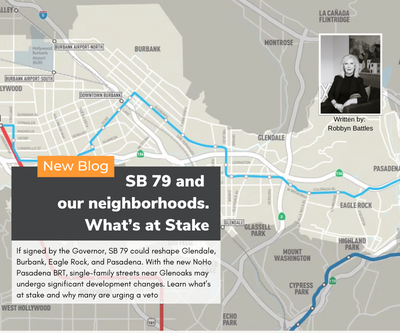
 If signed by the Governor, SB 79 could reshape Glendale, Burbank, Eagle Rock, and Pasadena. With the new NoHo–Pasadena BRT, single-family streets near Glenoaks may face big development changes. Learn what’s at stake and why many are urging a veto. SB 79 is poised to reshape zoning near transit stops, with major implications for Glendale, Eagle Rock, Burbank, Pasadena, and surrounding neighborhoods. Let’s look at the big picture. SB 79, authored by State Senator Scott Wiener (D-San Francisco), is the latest in a long line of housing bills he has pushed through the California Legislature (think SB 35, SB 50, and SB 9). SB 79 builds on that record by targeting development near transit. It narrowly passed the Legislature — 41-17 in the Assembly and 21-8 in the Senate — and now sits on Governor Gavin Newsom’s desk. By October 12, 2025, the Governor must decide whether to sign or veto the bill, weighing both the legislative votes and the many letters of opposition (and support) flooding into his office.
What triggers an SB 79 project?
SB 79 (the Abundant and Affordable Homes Near Transit Act) applies around a major transit stop — either a rail station or a bus stop with routes running at least every 20 minutes during peak times. If you live within a ¼ mile or ½ mile of one of these stops, your zoning could be affected.
Importantly, new transit designations can be triggered in the future. If Metro or another transit agency increases bus frequency or adds a new BRT or rail line, a stop can suddenly become a qualifying “major transit stop.” Communities are notified through Metro Service Council hearings, environmental review, and City Council meetings—but SB 79 itself does not give residents a veto. It simply sets the rules once transit frequency meets the threshold.
A local example: Glenoaks Boulevard BRT Project
Glenoaks is one of the clearest examples because it will soon carry the NoHo–Pasadena Bus Rapid Transit (BRT) line, a 19-mile corridor connecting North Hollywood, Burbank, Glendale, Eagle Rock, and Pasadena. The project includes 22 new stations, with bus-only lanes planned along Glenoaks Boulevard, Central Avenue, and Broadway in Glendale. Dedicated bus lanes are also planned in Burbank and Eagle Rock, making this one of the region’s most significant new transit investments. Once those high-frequency stations are in operation, they will automatically qualify as “major transit stops” under SB 79.
For Glendale, the implications are direct. A likely station area is near Glenoaks and Central Avenue, a hub that already carries heavy ridership and is undergoing lane reductions for bus-only lanes. That means neighborhoods within ¼ to ½ mile of Glenoaks—such as Kenilworth Avenue, Highland Avenue, and Concord Street—would fall into SB 79’s development zone. Imagine this in practice: a single-family block with typical 6,500-sq-ft R-1 lots could suddenly see a five-story multifamily project replace one of those homes if the parcel is within the qualifying radius. And because the BRT extends well beyond Glendale, residents in Burbank, Eagle Rock, and Pasadena will see the same rules apply, reshaping long-standing residential streets across multiple communities.
The broader NoHo–Pasadena Transit Corridor
Metro’s North Hollywood to Pasadena Transit Corridor (BRT) spans 19 miles, connecting North Hollywood, Burbank, Glendale, Eagle Rock, and Pasadena with frequent service and 22 planned stations. Dedicated bus lanes are part of the design through each community, meaning all parcels within ¼ to ½ mile of these stations would qualify as “major transit stops” under SB 79 once the project opens. Neighborhoods from the San Fernando Valley through the Verdugos and into Pasadena could all see new multifamily projects under the same rules that would apply along Glenoaks in Glendale.
Who has written letters to the Governor opposing SB 79?
It’s not enough for a city council to pass a resolution—the Governor only counts formal letters sent to his office. Here’s who has taken that step:
- Mayor of Glendale – Ara Najarian (letter to Governor to veto)
- Crescenta Valley Town Council – representing unincorporated La Crescenta-Montrose (letter to Governor to veto)
- Mayor of Los Angeles, Karen Bass (letter requesting veto)
- City of Beverly Hills (letter of opposition)
- League of California Cities (Cal Cities) – statewide association of nearly every incorporated city in California (see membership)
Other cities—including Burbank, Pasadena, and Glendale—have passed resolutions on record opposing SB 79, but unless they also send a letter to the Governor, their opposition doesn’t directly land on his desk.
How to contact Governor Newsom
- Email via portal: Contact (Subject suggestion: “Request for Veto – SB 79”)
- Email (Legislative Affairs) No attachments: [email protected]
- Mail: Governor Gavin Newsom, 1021 O Street, Suite 9000, Sacramento, CA 95814
- Fax: (916) 558-3160
- Deadline: October 12, 2025
How did Glendale’s own representatives vote?
Here’s the rub. While Glendale’s Mayor and Town Council have told the Governor to veto SB 79, our state representatives in Sacramento voted differently:
- Asm. Nick Schultz (AD 44, includes most of Glendale, Burbank, La Crescenta) – Absent on SB 79 final Assembly vote.
- Asm. Jessica Caloza (AD 52, includes South Glendale) – Voted YES.
- Sen. Sasha Renée Pérez (SD 25, covers Glendale, Pasadena, La Cañada) – Voted YES in the Senate.
This disconnect is striking: local councils say “no,” but our state representatives voted (or failed to oppose) “yes.” It raises the question—why aren’t Sacramento representatives reflecting the concerns voiced by the communities they represent?
Cal Cities: collective opposition
Instead of listing every city, know that Cal Cities (League of California Cities) sent a statewide opposition letter. Cal Cities represents nearly all California cities (check the membership list here). That means opposition isn’t just Glendale or Pasadena—it’s a chorus of cities across California saying this bill goes too far.
Resolutions vs. Letters: the difference
Cities like Burbank, Glendale, and Pasadena have passed resolutions opposing SB 79. That’s important for the public record. But unless they also send a formal letter to the Governor, their opposition may not be counted. Residents should encourage their councils to go further: pass a resolution and send a letter.
Why SB 79 is so controversial
Opponents aren’t anti-housing—they’re against the scale, location, and lack of local control. Valid concerns include:
- Neighborhood impacts: Long-time homeowners who bought near single-family blocks could suddenly face five- to seven-story buildings next door. Privacy, safety, and traffic are real worries.
- Not truly “affordable”: Only a handful of units in a project must be affordable. Developers and cities reap most of the benefit.
- Infrastructure strain: Roads, sewers, schools, and fire evacuation routes in Foothill communities aren’t designed for sudden large-scale density.
- Loss of local voice: Transit agencies and state rules, not cities, decide where and how development happens.
- Car reality: SB 79 assumes fewer cars, but California isn’t ready. Traffic and parking impacts will hit first.
As many put it, this isn’t smart housing—it’s building gone wild. Residents who have lived in their homes for decades—or just bought into a quiet block—shouldn’t have to wake up to a tower in their backyard with no real say in the matter.
Let’s protect our neighborhoods—together.
As a local real estate professional, I believe it’s vital to understand the impact of new housing laws—when they help and when they harm. SB 79 raises serious neighborhood and infrastructure concerns. If you want clear guidance or to discuss how this could affect your street, I’m here to help.
Backlinks & Resources
-
- SB 79 – LegiScan bill text
- LA Metro – NoHo–Pasadena Transit Corridor (BRT)
- Glendale Fact Page – BRT Project
- Assembly District 44 – Asm. Nick Schultz
- Assembly District 52 – Asm. Jessica Caloza
- Senate District 25 – Sen. Sasha Renée Pérez
- City of Glendale
- Crescenta Valley Weekly
- Crescenta Valley Town Council
- League of California Cities (Cal Cities)
- State of California
- Office of Governor Gavin Newsom
- TheHouseAgent.com (Robbyn Battles)
- Zillow – Robbyn Battles
- Google Business – The House Agent (Robbyn Battles)
SB 79 California, SB 79 housing bill, Glendale SB 79 impact, Burbank SB 79 opposition, Eagle Rock SB 79 development, Pasadena SB 79 neighborhoods, NoHo–Pasadena BRT project, Bus Rapid Transit Glendale, Glenoaks Boulevard development, Glendale zoning changes, Crescenta Valley Town Council SB 79, Ara Najarian SB 79 letter, League of California Cities SB 79 opposition, Governor Newsom SB 79 veto, California housing legislation 2025, Glendale single-family zoning changes, transit-oriented development Glendale, Robbyn Battles Glendale Realtor, La Crescenta REALTOR, The House Agent, Robbyn Battles, Robbyn Battles The House Agent, Glendale REALTOR, Pasadena REALTOR, Eagle Rock REALTOR, Burbank real estate, Pasadena housing near transit, Eagle Rock housing near transit, La Cañada Flintridge, Montrose, Sunland-Tujunga, Highland Park, Glassell Park, Mount Washington, Atwater Village, San Fernando Valley, Verdugos.