

 Insurance poses major challenges in real estate transactions. First-time buyers struggle with coverage costs, seniors face high Cal Fair Plan premiums, and parents are questioning the viability of investing in California property. In this episode of I’m Just Sayin, Let’s Get to the Point, I spoke with Robert Feldman Wows Insurance, to gain insights that transformed my perspective on every listing. Robert, CEO and co-founder of a wholesale insurance agency, has 27 years of experience. His company operates in 13 Western states, offering coverage up to $50 million per home, with over $100 billion in capacity through London syndicates. Robert Feldman of Wows Insurance, is an authority who speaks at the California Association of Realtors (C.A.R.). But here’s what really got my attention: during the Palisades fire, Wows Insurance had only a 4% loss ratio. Robert Feldman confirmed this loss ratio on The Malibu Podcast, noting that his company’s full actuarial reports validated their performance. They lost zero homes in the Palisades fire itself and just one in Altadena.That’s not luck. That’s fire hardening at work.
How We Got Here: The California Homeowners Insurance Crisis
I grew up in this business, and I’ve never seen a shift like the one we are experiencing with California fire insurance. Robert Feldman explains that major carriers left the state due to “aggregation”—writing too many policies in one area. As he noted: “Insurance companies don’t lose money. If they lose money, they do two things: pull out of the area or raise rates drastically.” Robert is a wholesale expert who is actively bringing new global capacity back to California, providing a much-needed alternative to the Cal Fair Plan. In 2024, he went on record about State Farm canceling 1,626 homes in the Palisades, and his insights are vital for anyone wondering what the future of homeowners insurance looks like for their property.
Fire Hardening: Increasing Your Home Survival Rate by 73%
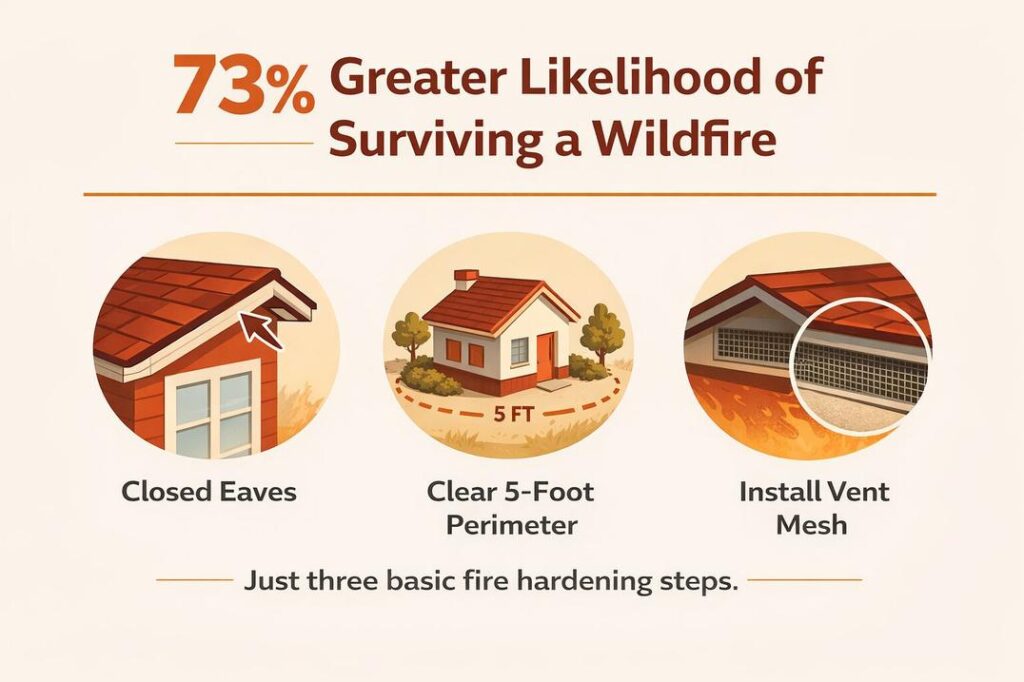
The most powerful takeaway from this episode is that fire hardening isn’t just a legal requirement for sales (like AB 38); it is the key to your home’s survival. Basic measures give your home a 73% greater likelihood of surviving a wildfire. This includes:
- Closing your eaves
- Clearing zero to five feet around your home
- Installing a 16-inch ember-resistant mesh over your vents,
- and addressing the “Zero Zone” the five-foot perimeter around your home.
What really put it in perspective for me was when Robert explained how most homes actually burn.
“Most consumers don’t realize that the majority of people who lose their homes aren’t because a fire approaches the house. It’s the embers. They fly through the air, land near combustible things within five feet of the structure, drop into unprotected vents, and that’s what takes the house. The fire doesn’t have to touch your home to destroy it.”
I’ve watched homes burn in the Station Fire, the Woolsey Fire, and now these latest ones. Everything Robert said matched what I’ve seen on the ground. For a deeper understanding of fire hazard zones and defensible space requirements, read my detailed guide to Understanding Fire Hazard Zones.
For more detailed fire hardening guidelines, Cal Fire’s website has a resource called “Lean, Clean, and Green” that walks homeowners through exactly what needs to be done at each distance from the house.
Why Insurance Companies Left California—And What Brings Them Back
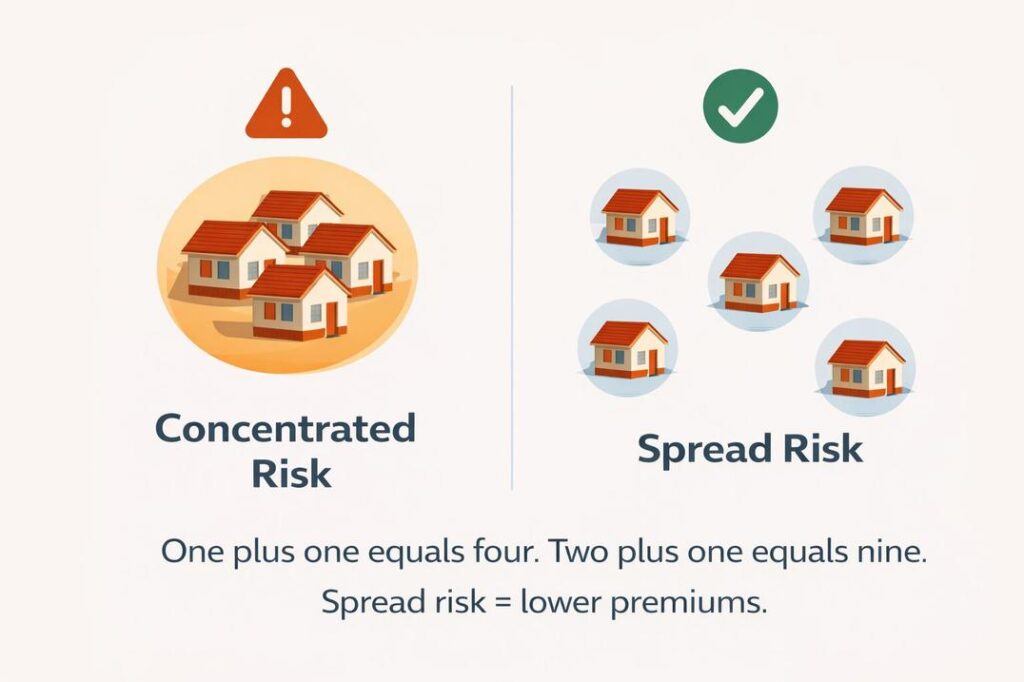
I asked Robert point-blank why California doesn’t have more insurance options. His answer was simpler than I expected. Aggregation. He used an analogy that stuck with me. A kid left unsupervised in a candy store. Major carriers wrote too many policies in concentrated areas. When you have too many homes on the same street with the same insurer, risk doesn’t grow linearly. It grows exponentially.
One plus one doesn’t equal two. It equals four. Two plus one equals nine.
“Insurance companies don’t lose money. If they lose money, they do two things: pull out of the area and stop writing policies, or they raise rates drastically to offset. Meaning to be able to be profitable like any business does.”
The key to a safer insurance model is spreading risk across many companies rather than allowing one to dominate. Distributing risk throughout California lowers reinsurance costs, enabling carriers to offer lower premiums while remaining profitable.
The good news? Wows Insurance is actively bringing new carriers into California. Robert mentioned Princeton, a lesser-known company providing up to $4 million in coverage, which has partnered with Munich Re. They are now approved by the Cal Fair Plan Clearinghouse to help reduce the number of participants in the Cal Fair Plan.
To understand how reinsurance works and why it affects your premiums, the Reinsurance Association of America offers excellent educational resources on this topic.
The Truth About Cal Fair Plan That Nobody Tells You
Here’s something I didn’t know before this conversation. Cal Fair Plan might actually be the safest policy in California from a financial stability standpoint. But there’s a catch.
“Cal Fair Plan has the right to assess all other policyholders in California if it runs short on funds. That means if you’re living in San Diego, haven’t experienced a fire, and you’re on Cal Fair Plan, they can send you what’s essentially a bill to cover losses elsewhere in the state. Like an HOA special assessment, but for insurance.”
This is why Robert’s team is aggressively working to move people off the Cal Fair Plan. Many people don’t realize they have options. His company now has the list of every California home and is actively helping brokers find Cal Fair Plan alternatives for homeowners who thought they were stuck. If you’re currently on the Cal Fair Plan and want to explore options, Robert encouraged people to email him directly at [email protected]. You can also visit the Wows Insurance contact page to find a broker in your area.
For more on California’s insurance challenges, check out my interview series on homeowners insurance, covering the FAIR Plan, non-renewals, and homebuyer considerations.
For more information about the California FAIR Plan and its current status, the California Department of Insurance provides regular updates and consumer resources.
The Three Parts of a Catastrophe—And What You Can Actually Control
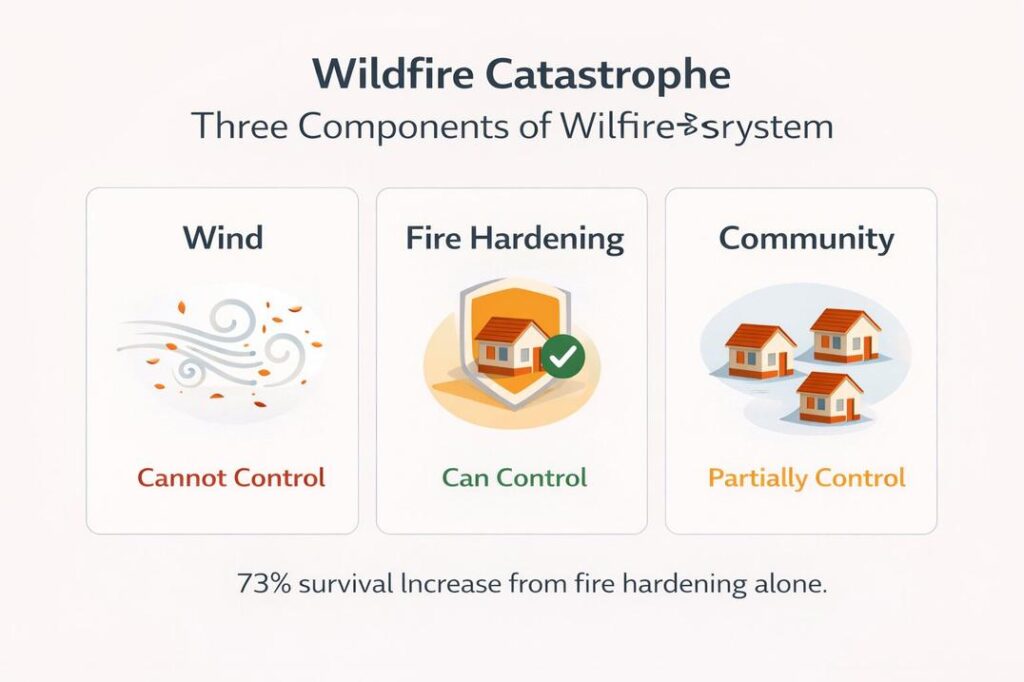
Robert broke down wildfire catastrophes into three components. This framework completely shifted how I think about fire risk.
1. Wind (Cannot Control)
During high-wind events, embers can travel as far as three miles. If the wind is blowing 80 miles per hour, air support goes away. Firefighters can only react, not prevent. This is the variable we cannot change.
2. Fire Hardening (Can Control)
This is where homeowners have complete agency.
Robert Feldman Wows Insurance did it himself. He went on Amazon, bought a roll of 16-inch mesh for about $30, and packed it inside his attic vents. That’s wildfire home protection California homeowners can implement today for less than the cost of dinner out. Simple. Affordable. Effective.
Beyond vents, there are now products like:
- Mighty Firebreaker’s mulch that looks normal but actually extinguishes embers
- Citron, an EPA-friendly chemical that can be sprayed on and around homes
- Fire-resistant deck stains and paints
- Metal vent covers that fit between deck boards to prevent ember intrusion
“Just doing basic fire hardening—closing your eaves, clearing out the zero to five feet, and closing your vents with 16-inch ember-resistant mesh—gives you a 73% more likelihood to survive a fire. Just those three things.”
3. Community (Partially Controllable)
As neighborhoods become Firewise certified, pressure builds to remove hazardous vegetation, clear brush, and take collective action. You can’t force your neighbors to cut down their cypress trees. But community standards are changing, and legislation is following.
Landscaping and The Zero Zone Controversy
The requirement to clear all combustible items within five feet of your home—the Zero Zone—has many homeowners “up in arms.” However, Robert Feldman explains that insurance carriers now view landscaping as an enforcement mechanism.
The Trees That Are Destroying California Homes I learned something in this conversation that I now share with every client. The species of trees on your property can determine whether your house survives a fire.
The worst offenders:
- Palm trees – They don’t just burn. They explode. The nest at the top catches fire and shoots embers in all directions like a grenade. Robert called them worse than flamethrowers. He said they’re more like grenades.
- Eucalyptus – Highly flammable, fast-burning, and everywhere in California.
- Cypress trees – Robert shared a video where a 90-foot cypress bent over in high wind, punched a hole in a house, and acted like a flamethrower. It took out four or five homes before anyone could react.
On the flip side, oak trees generally don’t burn. Christmas Tree Lane in Altadena, lined with oaks, didn’t burn.
Robert told me about a client with a 7,800 square foot home. Her renewal came in $30,000 higher than what Stand Insurance was proposing. The sticking point? Two palm trees right on top of the house.
When Robert asked her directly if those two trees were worth $30,000 annually, she agreed to remove them. Stand even gave her a mitigation credit to pay for the removal.
That’s the shift happening right now. Insurance companies are becoming the de facto enforcement mechanism for fire resistant home improvements because fire departments simply cannot inspect every home.
Transferable Policies—The Future of Real Estate Transactions
Here’s an innovation I didn’t know existed.
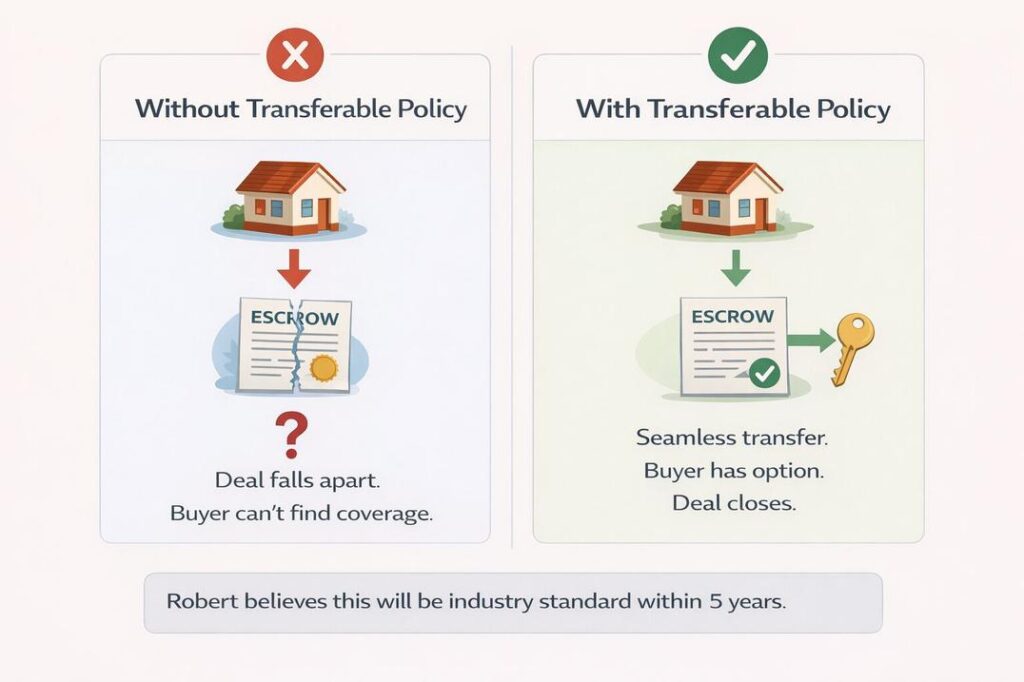
Robert’s company made their policies on larger homes fully transferable from sellers to buyers.
Think about what this solves. Right now, I have clients who can’t find insurance because the seller’s carrier has stopped writing new policies. The insurance doesn’t transfer. The buyer can’t get coverage. The deal falls apart.
With transferable policies, the buyer doesn’t have to take the existing insurance. But they have the option.
Robert believes this will become industry standard within five years. When you watch this conversation in the future, he said, you’ll wonder why we were even discussing this as an innovation.
For sellers, this is a significant value proposition. A fully fire-hardened home with transferable insurance is simply easier to sell than one where the buyer has to scramble for coverage during escrow.
What Changed for Me After This Conversation
Before talking to Robert, I saw the California homeowners insurance crisis as an obstacle. Something is happening to the clients that I couldn’t fix.
After talking to him, I see it as a puzzle with solutions that already exist.
“We have the wins. We have the way out to win and change the tide. It’s already set up. We already have the reinsurance. We already have the directional changes. It’s now just getting the information out.”
The capacity is there. Over $100 billion in capacity through London syndicates. New carriers like Princeton and Stand are actively writing policies. Programs exist to depopulate the Cal Fair Plan.
What’s missing is information.
Homeowners are often unaware of options that could protect their homes, such as using $30 mesh from Amazon or removing two palm trees to save $30,000 in annual insurance premiums. This perspective shifts how I evaluate listings, considering factors like fire-hardening and transferable insurance eligibility. A home that can’t be insured risks significant price reductions during sale.
Robert told me he’s available to help anyone with questions. He helped between 300 and 500 families after the fires, who couldn’t even find their insurance brokers. That’s not customer service. That’s community service. You can also connect with Wows Insurance on LinkedIn or follow them on Instagram for ongoing updates.
Watch the full episode of I’m Just Sayin with Robbyn Battles and Robert Feldman to learn how fire hardening can protect your home’s future..
FAQ Section
1. What is fire hardening, and why does it matter for insurance?
Fire hardening involves modifications to your home and property that make it more resistant to wildfire. Key steps include clearing vegetation within zero to five feet of your home, closing eaves, and installing 16-inch ember-resistant mesh over vents. These basic measures can increase your home’s likelihood of surviving a wildfire by 73%, which directly impacts your ability to obtain affordable coverage.
2. Can I get off the Cal Fair Plan?
Yes. Wholesale agencies like Wows Insurance are actively working to help homeowners find Cal Fair Plan alternatives. Many people don’t realize they have options because their retail brokers may not have access to all available programs. Contact a wholesale-appointed broker or reach out to Robert Feldman Wows Insurance directly at [email protected] to explore your options.
3. What trees should I remove for fire safety?
The most dangerous trees for fire risk are palm trees, eucalyptus, and cypress trees. Palm trees can explode when they catch fire, spreading embers like grenades. Cypress trees are highly flammable and can act like flamethrowers in high winds. Oak trees, by contrast, generally don’t burn and are considered fire-safe. Removing hazardous trees can significantly reduce your insurance premiums and may qualify you for mitigation credits.
Apply to Be a Guest on the I’m Just Saying, Let’s Get to the Point Podcast
Real estate is changing faster than ever. Insurance is reshaping transactions. Fire hardening is becoming a requirement, not a suggestion. If you’re working in real estate, insurance, fire mitigation, or any industry that’s adapting to California’s new reality, I want to hear from you. Share what you’re seeing on the ground and what’s actually working.
“And of course if you have any other topic you are passionate about Let’s get to the point and have you on the Robbyn Battles podcast “I’m Just Sayin’ “. Let’s get you scheduled.