

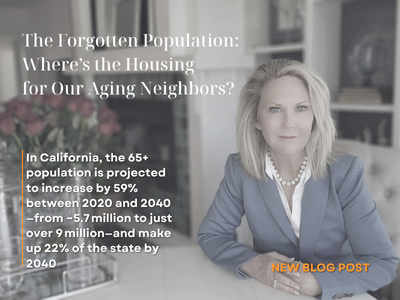
 The Forgotten Population: Where’s the Housing for Our Aging Neighbors? There’s a lot of buzz about building massive housing projects and encouraging density—but in La Crescenta, Montrose, Glendale, Pasadena, Burbank, and the surrounding Foothills, we’re missing something essential: housing for our aging population, who’ve already invested in these neighborhoods.
Let’s think bigger. What if thoughtful, right-sized homes—still single-level, comfortable, private—could let these residents stay local, not end up in retirement center style housing or forced out by rising bills?
A Population That’s Growing—and Overlooked
• In California, the 65+ population is projected to increase by 59% between 2020 and 2040—from ~5.7 million to just over 9 million—and make up 22% of the state by 2040 (up from 14% in 2020) CalMatters.
• In contrast, the population aged 20 to 64 is expected to grow just 3%, and the child population (under 20) is projected to decrease by 24% , according to the Public Policy Institute of California.
• Just between 2023 and 2024, California’s 65-and-older population rose by about 25,300, reaching more than 6.62 million. According to the Governor of California.
That growth isn’t just happening, it’s accelerating. Yet most housing policies focus on younger families, transit-oriented developments, and higher-density rental units. Who’s talking about the retirees who already live here?
Utility Costs Are Forcing Decisions
• Electricity rates in California have nearly doubled in the past decade, driven by wildfire mitigation investments, aging infrastructure upgrades, and the transition to renewable energy—making them among the highest in the nation Wall Street Journal.
• Nationwide, utility subsidies for seniors are being cut, tightening income thresholds or phasing out help entirely, meaning older adults on fixed incomes face painful choices as bills rise rapidly.
For many homeowners over 65, especially those on fixed retirement incomes, these rising costs are pushing them to consider selling out of necessity—not by choice. But they don’t want to leave their neighborhood, their doctors, their friends. They just wish to have options that make sense financially and emotionally.
Downsizing with Dignity—If We Only Built It
Imagine if local developers—and nonprofit or public funding—were supported or incentivized to build:
• One-level homes of 1,200–1,500 sq ft on small lots,
• Modern duplexes or cottage-style homes, privately accessed,
• Aesthetic designs that fit Foothill character—no view-blocking towers, no transit corridor monotony.
Homes where older residents could roll their equity, take advantage of Prop 19 tax protections, and stay rooted in the neighborhoods they helped grow.
Instead, dense, so-called affordable housing developments are pushed upon all of us. There is no interest in filling a need within our neighborhoods, just filling a need for their incentivized pocketbook with the help of our tax dollars. For homeowners over 65, there’s nowhere to move within the same neighborhood.
There’s also something bigger we’re not talking about.
If our aging population isn’t the focus, and younger families are choosing different lifestyles, who exactly are we building all these dense, transit-oriented projects for?
In neighborhoods with limited commerce like the Foothills, why are we imposing massive design instead of encouraging thoughtful, walkable alternatives that suit people of all ages?
How many older homeowners would gladly move into smaller homes if given the option—and how many family-sized homes would that free up for the next generation?
If we’re building for one group, shouldn’t we also be building with the people who are already here in mind?
Unlocking a Win-Win for All Ages
On one hand, articles and policies emphasize family affordability, transit use, and dense urban housing. That’s important—but it’s only part of the equation.
On the other hand, creating welcoming, modern homes for older homeowners would:
• Provide them with comfort, lower utility burdens, and less upkeep,
• Enable them to use their built-up equity,
• Keep them close to longtime roots, doctors, and neighbors,
• Free up larger single-family homes for younger generations.
Final Thought
I walk these neighborhoods every day. I know the 65+ homeowners. They don’t want to leave. They just need options: homes that fit their lives now—and let them stay where they’ve always been part of the community.
Let’s stop overlooking the generation that built these neighborhoods—and start building thoughtful housing that lets them stay, contribute, and age with dignity.
Thank you for reading,
Robbyn Battles
Always looking out for a population that has contributed so much to our local Foothill neighborhoods.
I’d love to hear your thoughts—what would a housing development for our 65+ generation look like to you?
📞 818-388-1631
📧 [email protected]
🌐 www.thehouseagent.com