

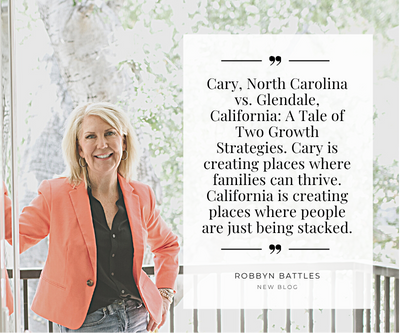
 Cary, North Carolina vs. Glendale, California, a tale of two growth strategies. Over the past four years, I have spent time visiting family in North Carolina. Two areas stand out to me, Cary, just outside Raleigh, and Clayton, about forty minutes away and more rural. Both are growing, but it is Cary’s Old Town downtown redevelopment that has caught my eye. Clayton is focused on middle class single family homes for sale and for rent, with a boom in commercial to handle growth. It is a clear contrast to how growth is handled here in Southern California.
In Cary, they are building with intention. You will see luxury condos, large parking structures, commercial space, restaurants, and walkable areas. They have added green belts, water recapture systems, setbacks lined with trees, and a central park anchored by a library. Older historic buildings are relocated and repurposed, blending old and new. The result is a community hub that feels vibrant, designed for all ages, and yes, it still accommodates cars, parking, and families on bikes, without adding painted bike lanes.
Compare that to Glendale and Pasadena, where projects are increasingly defined by lane reductions, disappearing parking, and density without design. The message seems to be, get out of your car, get on a bus, or ride a bike. That may sound good in theory, but here is the problem, the green space is gone, the parking is gone, and there is no thoughtful town center drawing people together. Instead, we are left with stone cubes, no style, no greenery, and no sense of place.
Another striking difference, schools and traffic. In Cary, kids ride school buses. Families still bike to school, but you do not see the endless stream of cars clogging neighborhood drop off lanes. It is a small detail, but it speaks volumes about how the community is designed to function smoothly, versus forcing congestion into every corner.
California’s housing math is also hard to ignore. If a project is not one hundred percent affordable, only fifteen percent of units are reserved for low to very low income households. That is not enough. The middle class is left out because for sale housing is not being built. It becomes rental after rental, equity is not created, and wealth does not build.
Even funding measures like Measure ULA, the so called mansion tax, promised to help families buy homes. But if developers are not building for sale projects, how can families use that funding to actually buy anything? The cycle feels less about lifting people up and more about pushing people out.
And who benefits? Not local builders or local construction crews. Only large developers with the resources to navigate red tape, tax credits, and complex financing. That means the jobs, the investment, and the control leave the neighborhood too.
At the end of the day, Cary is showing that growth can preserve green space, parking, commerce, and livability. Glendale and other California cities are leaning toward density at all costs, and in the process, they are forgetting the one thing that makes people want to stay, a place that feels like home.
Resources
La Crescenta realtor, Glendale realtor, Robbyn Battles, The House Agent, Glendale housing element, Glendale planning updates, La Crescenta homes for sale, Montrose shopping park, Cary North Carolina redevelopment, Old Town Cary park and library, Glendale lane reduction, parking in Glendale, green space planning, California low income housing fifteen percent set aside, Measure ULA homebuyer assistance, density without design, water recapture systems, walkable commercial districts, Glendale and Pasadena growth comparison, Crescenta Valley real estate insights