

 La Crescenta Water Costs: Patrick Atwater Explains
Patrick Atwater joins Robbyn Battles on I’m Just Sayin’ to discuss local water costs and the proposed Crescenta Valley Park stormwater project.
Why is water so expensive in La Crescenta? Why do our neighboring communities have so many different water providers? And could capturing more rainwater at Crescenta Valley Park help reduce our reliance on imported water? On this episode of I’m Just Sayin’, I’m Robbyn Battles, The House Agent, and my guest Patrick Atwater explains how those questions connect—from the water running through the Verdugo Wash to the cost of maintaining the system that delivers water to your home.
Patrick grew up in La Crescenta and has worked in water management, infrastructure financing, and water data. Since our interview, he has won his first election to represent Division 5 on the Foothill Municipal Water District board. One of his campaign commitments was to advance the Crescenta Valley Park stormwater project. Our conversation explores why he believes local groundwater deserves more attention, what has held the project back, and where residents can learn more. You’ll also find his stormwater petition below.
Recording update: This interview took place before the November 2026 election. Patrick is now director-elect for Foothill Municipal Water District, Division 5. The county’s posted results remain unofficial as of November 11, 2026.
Who is Patrick Atwater, and what connects him to La Crescenta?
Patrick grew up in La Crescenta, graduated from Crescenta Valley High School, and played football there. During our conversation, he shared that he had returned to the community with his wife and two young daughters. His interest in local water is both professional and personal: these are the systems serving the community where he is raising his family.
He also discussed helping start the California Water Data Collaborative and working on local groundwater recharge efforts. His professional experience gives him a view into how water agencies operate, while his local ties keep the conversation focused on practical questions. Where does our water come from? Why does the system cost so much? And what could we do differently?
Why is water so expensive in La Crescenta and the Crescenta Valley?
Your water bill pays for more than the water flowing through your meter. Purchasing supplies, pumping and treating water, maintaining reservoirs and pipes, and replacing aging equipment all contribute to the cost of service. Even when customers conserve, the system still needs to operate and be maintained.
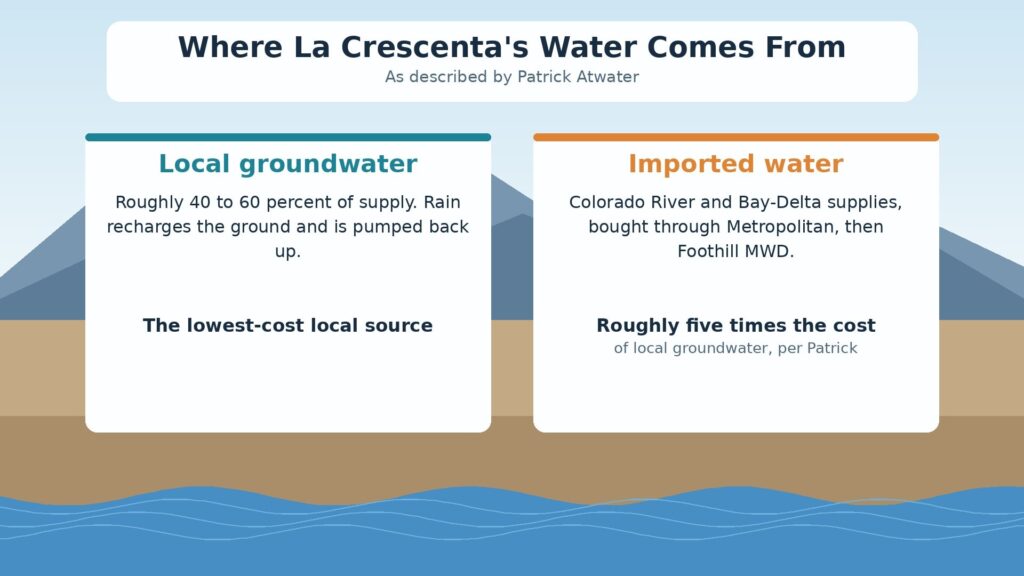
Patrick emphasized the cost difference between local groundwater and imported water. During our interview, he estimated that imported water could cost roughly five times as much as locally pumped groundwater. His comparison concerned the cost of the water supply, rather than the total amount on a household bill. That distinction matters because capturing more local water could reduce purchasing costs while other expenses remain.
He also believes water agencies should challenge assumptions about project costs. Engineering, permits, and oversight have important roles, but Patrick wants agencies to ask whether a simpler approach could accomplish the same goal. For residents paying the bills, the question becomes: what are we spending, what are we receiving, and where could better coordination save money?
Where does La Crescenta’s drinking water come from?
For Crescenta Valley Water District customers, Patrick described a combination of locally pumped groundwater and imported water purchased through Foothill Municipal Water District. He estimated that local groundwater supplies roughly 40 to 60 percent, depending on conditions. The mix changes, so that range should not be treated as a fixed percentage for every year or every La Crescenta address.
Imported water reaches Foothill through the Metropolitan Water District of Southern California. Metropolitan’s supplies include water from the Colorado River and Northern California through the State Water Project. Foothill then delivers purchased water to its member agencies, which serve local customers.
Groundwater recharge adds another piece to the picture. When water can soak into suitable ground, the water replenishes an underground aquifer. Local wells can later draw from that supply. Patrick’s argument is that allowing more of our runoff to replenish local groundwater could help the community purchase less imported water.
Why do La Crescenta, Glendale, and La Cañada have different water agencies?
During our conversation, I asked Patrick to untangle the names residents hear: Crescenta Valley Water District, Foothill Municipal Water District, Glendale Water & Power, and the providers serving La Cañada Flintridge. Some agencies supply water wholesale; others deliver water directly to homes and businesses. Understanding that distinction makes the system easier to follow.
- Crescenta Valley Water District serves customers in the La Crescenta–Montrose area and purchases imported water through Foothill.
- Foothill Municipal Water District supplies imported water to member agencies serving La Crescenta–Montrose, La Cañada Flintridge, and Altadena.
- La Cañada Irrigation District, Liberty Utilities, and Valley Water Company are the three La Cañada Flintridge providers listed by Foothill.
- Glendale Water & Power operates a separate city system, combining local groundwater with imported water purchased from Metropolitan.
Your mailing address or community name may not tell you which agency serves your property. The provider listed on your water bill is the place to start when reviewing rates, asking about service, or following a project.
Separate agencies can focus on their own customers and local conditions. Shared supplies and infrastructure, however, require cooperation. Patrick sees opportunities for agencies to clarify responsibilities earlier and share resources where doing so would improve service or reduce costs. You can learn more on Foothill Municipal Water District’s service-area page.
Could Crescenta Valley Park help capture more local water?
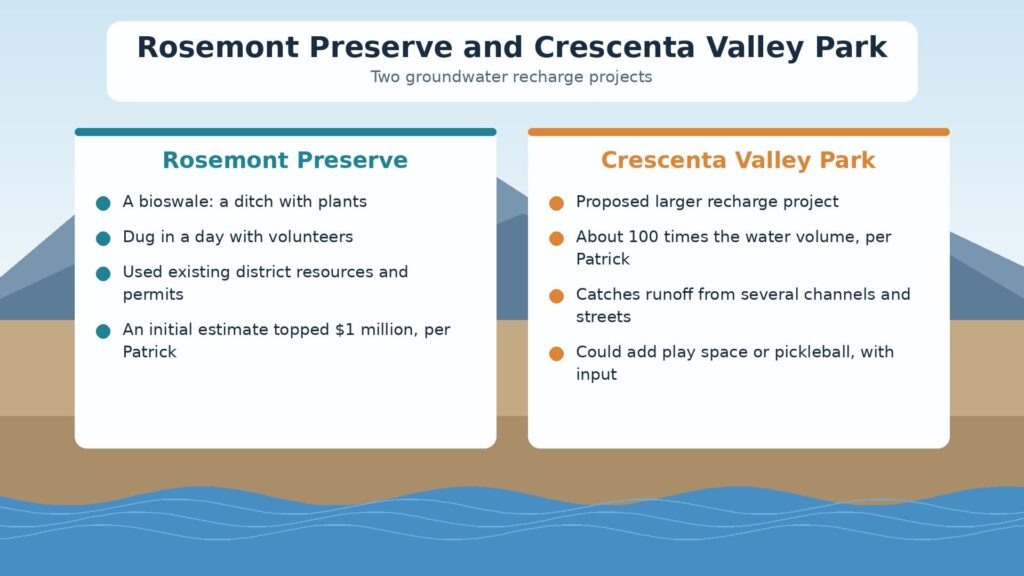
The proposed Crescenta Valley Park Stormwater Capture Project would divert runoff from the Verdugo Wash and Dunsmuir Channel and allow water to soak into the ground, replenishing the Verdugo Aquifer. The park offers an opportunity to capture water moving through the area and put that water toward local supply.
A Safe, Clean Water Program project summary identifies an estimated average recharge benefit of 500 acre-feet per year and lists Crescenta Valley Water District as the project lead. That figure is a planning estimate; actual capture would depend on rainfall, the final design, and operating conditions.
Patrick campaigned on moving this project forward. His election gives residents another reason to follow the proposal, but completing the project will require cooperation among the agencies involved, along with the necessary approvals and funding. The potential benefit is a larger local groundwater supply and less dependence on imported water.
What has held up the Crescenta Valley Park stormwater project?
Patrick described a water-rights dispute as a major obstacle. According to his account, the Los Angeles Department of Water and Power has asserted rights affecting runoff in the Verdugo Wash and sought replacement water in exchange for local capture. Patrick argues that requiring the community to purchase replacement water undermines the financial benefit of capturing runoff locally.
LADWP was not part of our interview, so Patrick’s explanation represents his account of the disagreement. His position is that the agencies and government leaders with authority over the issue need to resolve the impasse so the project can move forward.
For residents, the conversation raises a practical question: if capturing local stormwater could add to our groundwater supply, what agreements are needed to make the project possible? Patrick’s petition outlines the actions he wants local and state leaders to take.
Where can you read Patrick Atwater’s stormwater petition?
Patrick’s petition calls on government leaders to help resolve the obstacles facing the Crescenta Valley Park project. Residents can read his explanation, review the specific requests, and decide whether to add their names.
Read Patrick Atwater’s Crescenta Valley stormwater petition.
The proposal focuses on capturing stormwater to replenish groundwater. Our podcast conversation provides the background for understanding why Patrick has made this project a local priority.
What did the Rosemont Preserve project show about capturing rainfall?
Patrick shared a smaller example at the Rosemont Preserve, where he helped with a bioswale—a planted depression that slows runoff and helps water soak into the ground. He described using volunteers, existing resources, and coordination with the local district engineer and the nonprofit managing the preserve to accomplish the work.
For Patrick, the example shows why the approach to a project deserves attention alongside the engineering. Who can participate? Which resources are already available? Could an existing agreement help the work move forward?
A larger facility at Crescenta Valley Park would have different requirements. Still, Patrick believes agencies should ask those practical questions at every scale, especially when ratepayer dollars are involved.
Could local parks and schoolyards capture water while improving community spaces?
Our conversation also explored places residents use every day. Patrick sees opportunities for schoolyards with extensive blacktop to incorporate trees, planted areas, and features that slow runoff. Depending on the site and design, a project could combine water capture with shade and more welcoming outdoor spaces.
At Crescenta Valley Park, he mentioned possibilities such as play equipment or pickleball alongside water infrastructure. Those were ideas for discussion, rather than an approved design. His point was that residents should help shape improvements to a park they already use.
That community input matters. A project may have a water-supply purpose, but neighbors will also want to understand how construction, landscaping, recreation, and ongoing maintenance would affect the park.
What did the Eaton Fire reveal about coordination among water providers?
We also discussed Altadena and the challenge of rebuilding water infrastructure after the Eaton Fire. Patrick described the difficulty of coordinating among separate providers while pursuing recovery funding. His comments reflected the circumstances at the time of our recording, rather than a current accounting of recovery commitments.
He shared another example involving equipment used by Crescenta Valley and Foothill. According to Patrick, considerable troubleshooting went into determining which agency’s equipment needed attention before the problem was identified as a blown fuse. He saw the experience as an example of how unclear responsibilities can consume time and money.
His broader concern is preparation. When supplies, pumping equipment, power, and emergency response cross agency boundaries, he wants the organizations involved to establish clear working relationships before a failure or disaster places the system under pressure.
Why does Robbyn Battles want homeowners to understand local water costs?
As a La Crescenta real estate broker and longtime resident, I pay attention to the ongoing costs and local decisions that come with owning a home. Water service belongs in those conversations alongside maintenance, insurance, and other household expenses. Buyers comparing homes in La Crescenta, Glendale, or La Cañada Flintridge should know which agency serves each property and review the relevant bills and rate information.
For current homeowners, understanding the system also makes public proposals easier to evaluate. A project at Crescenta Valley Park could involve questions about neighborhood recreation, construction, public spending, and long-term water supply. Residents deserve clear explanations of the benefits, costs, and decisions still ahead.
That is why I wanted Patrick on the podcast. His interview connects a familiar concern—the water bill—to the larger choices being made about our community’s infrastructure.
How can Crescenta Valley residents learn more and get involved?
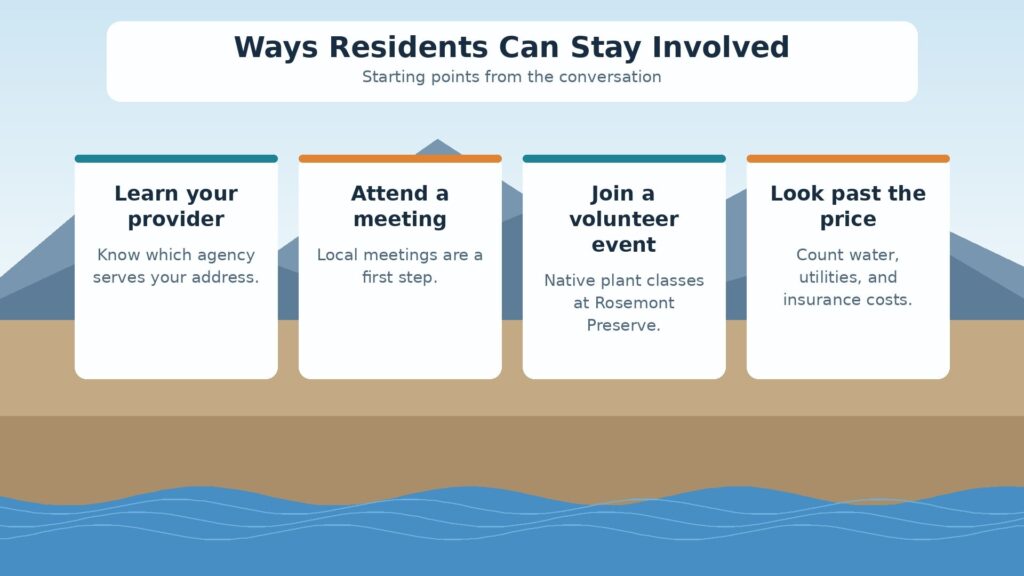
Start with the provider listed on your water bill. Review its meeting agendas, rate information, and project updates, especially when a proposal could affect your costs or neighborhood. Patrick’s stormwater petition offers another way to understand his priorities and the actions he is requesting.
Residents interested in local landscapes and water capture can also explore volunteer and educational opportunities at the Rosemont Preserve. Whether you attend a meeting, read a project proposal, or volunteer, learning how the system works gives you a stronger basis for asking questions.
Where can you watch my full podcast with Patrick Atwater?
If you have ever wondered why our water costs so much, why neighboring communities have different providers, or what happens to the rain running through the Verdugo Wash, this conversation is worth watching. Patrick and I discuss how those issues connect and why he believes the Crescenta Valley Park project deserves action.
Watch my full I’m Just Sayin’ interview with Patrick Atwater, or use the video near the beginning of this post. You can also read Patrick’s writing on Substack or follow Patrick on Instagram.
For more local conversations and homeowner resources, visit Robbyn Battles, The House Agent, or follow me on Instagram. If you are considering buying or selling in La Crescenta, La Cañada Flintridge, Glendale, or a nearby community, call me at 818-388-1631.
Would you like to be a guest on I’m Just Sayin’?
If your work helps residents understand local housing, infrastructure, or community issues, I’d love to hear from you. Our conversations give listeners an opportunity to understand the decisions affecting their homes and neighborhoods—and ask questions they may not have known to ask.
This podcast is produced by the Icons of Real Estate – #1 Real Estate Podcast Network. If you are a real estate professional, apply to be a guest speaker across the network.