

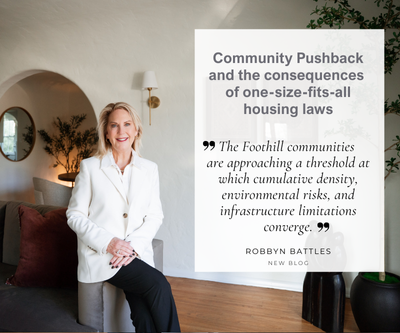
Over the past several weeks, a series of events and expert warnings have converged to create a clear and increasingly urgent picture of what State mandated density is creating in the Foothill communities. A recent Los Angeles Times column examined wildfire risk, evacuation failures, and population pressure through the work of meteorologist Edgar McGregor, whose professional focus includes fire behavior and climate driven extremes click here.
Two Letters to Supervisor Barger and One Important Meteorologist Fire Activity Article
- Amid catastrophic loss, the unshakable allure of the San Gabriel Mountains
click here - Robbyn Battles letter and attachments to Supervisor Kathryn Barger
click here - Crescenta Valley Town Council letter and findings
click here
At the same time, widespread community opposition documented by the Glendale News Press click here and a rapidly growing community petition opposing the proposed 80 unit Abode Communities project at Briggs and Foothill click here further highlight the scale of concern tied specifically to this location.
Then, in a real time demonstration of the corridor’s fragility, a major waterline burst directly across from the proposed project site. One rupture flooded Foothill Boulevard, disrupted businesses for more than 24 hours, eliminated parking access, and exposed how tightly packed aging water, gas, electrical, and fiber infrastructure has become.
Across La Cañada Flintridge, Montrose, La Crescenta, Glendale, Sunland, and Tujunga, nine major multifamily housing projects are already approved, under review, or under construction. Together they add 485 long term apartments and 16 short term suites, totaling 501 new dwellings and an estimated 1,500 to 2,000 additional residents. A new 30 unit condominium proposal in La Cañada increases this total further. These figures do not include the 221 single family homes planned at Canyon Hills, located deep within a Very High Fire Hazard Severity Zone. Read more about these projects.
Every one of these developments sits in or adjacent to a State designated Very High Fire Hazard Severity Zone. Every one relies on the same constrained evacuation network. At the same time population is increasing, the City of Glendale is advancing lane reductions on La Crescenta Avenue and Verdugo Road, two of the corridor’s primary north south evacuation routes.
The wildfire analysis discussed in the referenced article explains why this matters. Extreme fire weather days in California have doubled since 1980. Wind driven fires now move faster than traditional evacuation assumptions allow.
Foothill Boulevard remains the only continuous east west lifeline for the region. Feeder roads including Briggs, Lowell, La Crescenta Avenue, Pennsylvania, Rosemont, and Verdugo Road already reach capacity under normal conditions.
●
This issue is not about opposing housing. It is about protecting lives, evacuation access, and the long term safety of our Foothill communities.
Backlinks and Source Documents
- Los Angeles Times wildfire analysis click here
- Alternate article access without subscription click here
- Robbyn Battles letter to Supervisor Kathryn Barger click here
- Crescenta Valley Town Council letter and findings click here
- Glendale News Press community meeting coverage click here
- Community petition to deny funding click here
- Robbyn Battles Blog Poast 9 Foothill Housing Projects: click here
SEO Keywords:
Robbyn Battles, Foothill communities housing, La Crescenta wildfire evacuation, Montrose fire hazard zones, La Cañada Flintridge density housing, Sunland Tujunga fire risk, CEQA evacuation analysis, Very High Fire Hazard Severity Zone development, Briggs and Foothill housing project, Abode Communities Foothill Boulevard, Glendale lane reductions evacuation routes, California density bonus law impacts, wildfire evacuation corridors Los Angeles County, Crescenta Valley Town Council, 2413 Foothill, 80 unit housing, affordable housing in La Crescenta, density housing.