

Estate planning isn’t just about preparing for death; it’s about making sure your loved ones don’t have to deal with California’s default plan. In California, every adult automatically has an estate plan. If you haven’t made one, the state has made it for you, and it favors creditors and courts over your family. This plan benefits creditors and the government, not your loved ones. Sadly, many people don’t know about this until it’s too late.
I sat down with Cecilia Amo of Amo Law Legacy Planning, a 20-year estate planning attorney with a remarkable background. She started her career under Shawn Chapman Holley at Johnnie Cochran’s firm, where she learned high-stakes litigation. Now she’s applying that same intensity to help families design outcomes, not just sign documents.
Curious what actually happens to your home and your medical decisions if you never set up a plan? Here’s a quick preview of this conversation:
From Courtroom Tragedy to Legacy Planning: Why This Conversation Mattered to Me
I have spent more than 35 years selling an inherited property here and there, and lately it feels like every other listing. I see the grief, the sibling friction, and the paperwork surprises up close. So I wanted an attorney who could explain why some families glide through these transitions while others end up in court.
Cecilia is that attorney. She started her career at Johnnie Cochran’s firm, hired by Shawn Chapman Holley, and spent years in high-stakes litigation representing families after catastrophic injuries and wrongful deaths. Eventually she asked herself a different question. Instead of helping families after the worst day of their lives, could she help them plan so that day becomes less terrible?
That question became Amo Law Legacy Planning. She calls her work life and legacy planning because she treats estate planning as designing outcomes, not printing documents. Every plan she builds includes a no-cost review every three years, because life changes, the law changes, and a plan that sits in a drawer stops matching reality. As a California estate planning attorney, she serves families across Orange, Los Angeles, San Bernardino, Riverside, and San Diego counties.
Watch the full conversation here:
California Already Has an Estate Plan for You, and It Was Not Written for Your Family
Cecilia told me almost 70 percent of Americans have no estate plan. It’s not because people don’t care. Life gets busy, the task feels heavy, and it stays on the back burner until something happens. Often that something is watching a friend suffer through probate, and by then it can be too late for their own family.
Then she said the thing I made her repeat on air. You may not have created your own estate plan, but one already exists for you. Here it is in her words.
“You don’t need to own anything, any property, to need an estate plan. Every adult over the age of 18 should have something in place in the event of your death or incapacity. And if you don’t do it, you wind up with the state’s default plan. Most people think, ‘Well, I’ll get to it, I’ll do this thing that I gotta put in place,’ but they don’t know that the state of California has already created a plan for them that kicks in in the event of their death or incapacity, and it’s not for the benefit of their family. It’s for the benefit of creditors. It’s for the benefit of the government. It’s like guaranteeing that your family is in a lawsuit for at least a year, fighting to keep their inheritance against creditor claims, fighting against predators who are data mining public records to look for vulnerable families to prey on. It’s a really terrible system. So when we create our estate plan, we are opting out of that default plan that the state of California has created for every single person.”
Her timeline is not an exaggeration. According to the California Courts self-help guide, formal probate in California typically takes nine to 18 months and often longer, with statutory fees carved out of the estate along the way.
The predator point hits home for me. Probate filings are public record, and I’ve watched grieving families get buried in solicitation letters and lowball cash offers the same week a filing hits the system. That flood is the default plan working exactly as designed, just not for you.
Incapacity, Conservatorship, and the Unmarried Partner Problem Nobody Plans For
I gave Cecilia a scenario. A 23-year-old with college debt and no assets suffers a catastrophic accident. What changes with a plan? Her answer surprised me. Estate planning for incapacity is the piece young people skip entirely, because they assume plans are about property. They’re about power. Who makes your medical decisions if you spend eight months in a coma?
Without documents, a judge decides, and judges usually pick the closest living relative. Cecilia shared a story about a colleague’s friend who put off her paperwork, then suffered an incapacitating accident. Her estranged mother was the only person the court would recognize. She woke up months later in her old home state, her apartment gone, her independent life dismantled, under the care of a parent she hadn’t spoken to in years.
Getting your rights back can be harder than losing them. We talked about Britney Spears, and Cecilia explained that proving you have capacity is oddly more difficult than being placed under a conservatorship in California, because the system was built with the elderly in mind and rarely runs in reverse. This is exactly why she pushes clients to consider when parents should start legacy planning, which is always before the emergency, never during it.

Then there’s the misconception I hear constantly. People believe that living together long enough in California creates a common law marriage. It does not. California has no common law marriage, which means an unmarried partner has no default legal rights at all.
Cecilia’s example still bothers me. A father died in an auto accident. He wasn’t married, but he lived with his partner and their children. His estranged mother held all legal authority over his remains, and she chose not to tell his partner or his children when or where the funeral would be. The law is the law, and without documents, the law picked the mother.
My takeaway for fellow agents is simple. If your clients are unmarried partners, blended families, or solo adults, that conversation needs to happen before the transaction, not after tragedy forces it.
The Three Ways Living Trusts Fail California Families
I asked Cecilia about the living trust mistakes she finds after someone passes or gets hurt, when families believe everything is in place. I work with plenty of senior homeowners preparing to sell a long-time home, and I meet all three of her failure categories at the listing table.
“From all the plans that I’ve reviewed and all the things that I’ve seen, there are really three major categories of plans going wrong. One category is the assets not being in alignment. So maybe they pay for a trust and they never title the house in the name of the trust. You’ve probably seen when that happens. And then probate court still needs to happen because they’ve basically purchased a container and not put anything in the container. They’ve rented a moving van, but they’ve not put anything in the moving van, so that’s one big category. Another category is it just being out of date and not being in alignment with reality. There is this tendency for people to look at an estate plan as just documents, so they get them done, they sign them, they check it off their to-do list, and they stick it in a drawer. And then life changes, and then the law changes, and then their assets change, and then their plan has nothing to do with the reality that they’re living in and can sometimes make things worse when something happens.”
Her out-of-date example was painful. A woman called about her father’s plan, 20 years stale. The named successor trustee was his former best friend, a stranger to her, living in another state, collecting trustee fees and refusing to give up control. The trust had no safety nets to remove him.
The third category is plans that are simply wrong. Cecilia reviewed a trust for a family with two children and two properties, where one child was meant to receive the rental and the other the primary residence. A missing offset clause meant one child got everything 50/50 plus the rental. One misplaced sentence rewrote the parents’ intent.
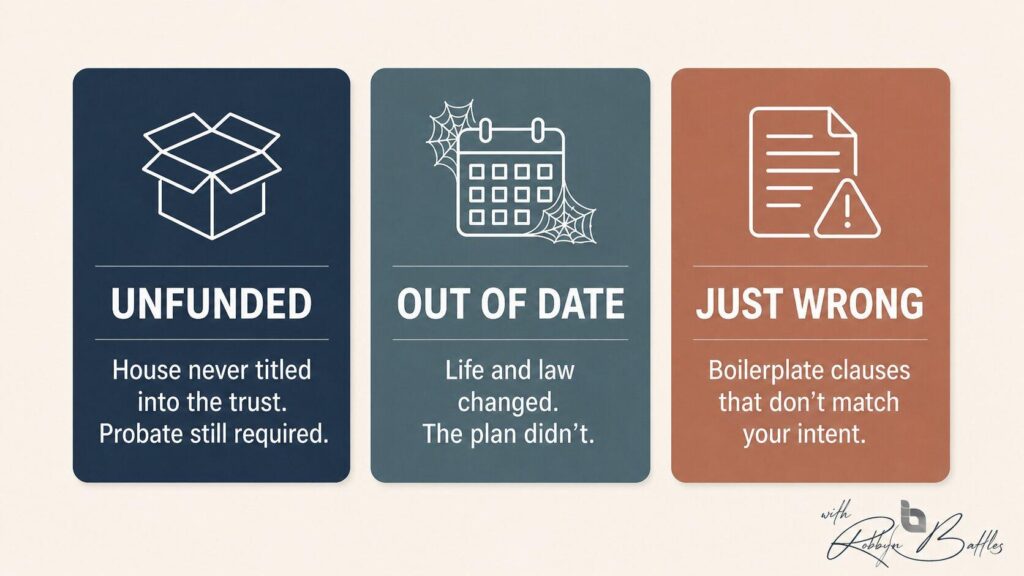
The refinance trap belongs in every agent’s checklist. Lenders sometimes pull a home out of the trust to process the loan, and nobody ever deeds it back in. The owner passes, and the family still needs a court procedure to move the house where it was supposed to be all along. I now ask about this on every trust listing, and Cecilia’s article on how trusts simplify property transfers for families is one I’ll be sharing with clients.
Her own safeguards impressed me. Clients get 60 days to live with their decisions after signing, so they can change their minds. They get a full-color diagram of the whole plan, which my visual brain loves. And when parents insist on naming two children as co-trustees, which she bluntly calls a very bad idea, she builds in pressure release valves like an independent trustee or mediation so disagreements don’t drain the trust in court.
Prop 19, Stepped-Up Basis, and Why Deeding Your House to Your Kids Backfires
I begged Cecilia to address something I watch clients do constantly. The house goes in the trust, out of the trust, and then someone decides to just put a son or daughter on the deed. Her answer started with a phone call she’d received from a man who said he had three properties and three children, so what’s so hard about that? Everything, it turns out. Different values, different tax treatment, different rental situations.
“People have this idea that, why is it so complicated? And then that leads to them going, ‘I’ll just put my child on it.’ And that’s poor man’s estate planning, right? I don’t have to set up a trust, I can just put my child on it. But unfortunately then if the child wants to sell the property, they are stuck with a ton of capital gains tax, which people just don’t know. One of the only good legal things that happens when you die is that there is this adjustment in tax basis that happens where, if your children want to sell their inherited property, they’re not selling it and they’re not getting the taxes on it from when you first bought it. They’re getting very little capital gains tax, and that’s another thing that people just don’t know.”
This is the single most expensive mistake in the episode. Under IRS rules on the basis of inherited property, an heir’s basis generally steps up to fair market value at the date of death. Add a child to the deed during your lifetime and you hand them your decades-old basis instead, which can mean a six-figure tax bill at closing.
Then we got into Prop 19 property tax reassessment, which Cecilia calls California’s new death tax. Since it took effect in 2021, inherited property gets reassessed to market value unless it was the parent’s primary residence and the child moves in within the required window. Every rental and vacation property loses its old tax base automatically. The income properties that built generational wealth for so many California families no longer transfer with low taxes, and we both wondered aloud how much revenue the state has collected since. The official Proposition 19 guidance from the California State Board of Equalization confirms the primary residence rules, the move-in requirement, and the value cap.

It gets more technical. Cecilia is seeing county assessors request detailed distribution paperwork, and if siblings can’t show an equalized split, the county can call it a sibling-to-sibling transfer and reassess half the property. Trust loans have become a common equalization tool for exactly this reason. One family ignored her roadmap, and six months later the child who moved in called about a reassessment they couldn’t afford. Situations like these are why she built a practice around real estate trust and property transfer planning rather than one-time documents.
We also talked about the silver tsunami. Boomer wealth is about to transfer to the next generation, and Cecilia sees laws like Prop 19 as textbook attempts to intercept as much of it as possible first. I’m a self-confessed housing policy junkie, and I write about these shifts often, including my own step-by-step guide to inheriting a property under Proposition 19 with the exact forms and deadlines heirs must hit. I share those breakdowns regularly on my Facebook page and Instagram as well.
How I Now Handle Trusts, Trustees, and Family Meetings in My Own Business
I shared a current story with Cecilia. A mom lives with her caretaker daughter, a trust is in place, but a mortgage means mom has almost nothing left each month despite huge equity. It took a year to get the home listed because the son couldn’t accept the sale. His sister finally named it: he thought we were selling his inheritance. I had to explain, respectfully, that there is no inheritance if mom can’t afford to stay.
Cecilia’s answer is early, transparent family conversations. Assumptions breed conflict, and children should be able to ask questions while their parents are still here to answer them. She holds a formal family meeting with all adult children invited, acting as a neutral buffer for the emotions. I realized I run my own version before every senior listing. The attorney holds one meeting, the agent holds another, and families need both.
On choosing a successor trustee, her criteria are refreshingly practical. Pick the child who handles conflict, not the people pleaser, because not everyone will be happy and someone has to absorb that. One client made it easy: the lawyer daughter took legal, the doctor daughter took medical. My brother and I did exactly that when our mom passed. He’s an EMT, so he handled medical, I handled legal, and having assignments kept us from ever fighting during the hardest moments. She also flags sentimental items, because the worst sibling wars are over Dad’s tool set, not the bank accounts.
Cecilia puts all of this, from estate planning myths to why you should never let a chatbot draft your trust, into her book, Your After-Credits Scene: A Nerd’s Guide to Wills, Trusts, and Legacy, which became a number one new release on Amazon. She teaches through Harry Potter, Star Wars, and Marvel references, an approach born from handing out estate planning pamphlets at Comic Cons. She even includes a legacy interview with every plan, an hour on Zoom capturing a client’s life story. You can explore her legacy planning approach for California families on her site, or follow her practical tips on Facebook, Instagram, and LinkedIn. I share my own client stories and market insights over on my LinkedIn too.
My biggest shift after this conversation? I now insist trust families loop in their estate attorney before we ever touch title. A pre-listing phone call costs nothing. A partial reassessment or a probate detour costs plenty.
Want to hear the full conversation between me, Robbyn Battles, and estate attorney Cecilia Amo of Amo Law Legacy Planning on how to avoid California’s default estate plan and protect your family’s legacy? Catch the entire episode on YouTube below.
FAQ
Do I need an estate plan in California if I don’t own a home?
Yes. Every adult over 18 needs one because estate planning covers incapacity, meaning who makes your medical and financial decisions, not just property distribution. Without a plan, a judge decides, and courts usually default to your nearest relative regardless of your actual relationships.
How does Prop 19 affect property my children inherit?
Since 2021, inherited California property is reassessed at market value for property taxes unless it was the parent’s primary residence and the child moves in within one year and files the required claims. Inherited rentals and vacation homes lose the old tax base entirely.
What is the most common living trust mistake?
Failing to fund it. If the house is never titled into the trust, or gets pulled out during a refinance and never returned, the family still faces a court procedure, which defeats the trust’s main purpose.
Apply as a Guest on the I’m Just Saying Podcast
California real estate never sits still. Laws shift, wealth changes hands, and the professionals who explain it clearly are the ones families remember. If you’re an attorney, lender, investor, or agent solving real problems for real people, I’d love to hear your perspective on the show.