

Most people think wealth is about how much you earn. I have learned differently after 35 years in real estate. Real wealth is about how much you keep and how strategically you grow it. That is why I sat down with Dimitry Farberov, a Senior Wealth Advisor and Principal at Compound Planning, for a recent podcast conversation.
Here’s a preview of our conversation:
Dimitry Farberov from Compound Planning Wealth Advisory operates as a true independent fiduciary. He holds both CFA and CFP® designations and routinely manages portfolios for ultra-high-net-worth founders. But his approach to the foundational mechanics of money applies to everyone. I wanted to strip away the gatekeeping around high-level wealth management and bring his sharp, institutional insights to you.
Here is how to build real financial muscle, protect your equity, and maximize your net worth.
Tune in to the full episode:
Bridging the Gap Between Real Estate Equity and Total Net Worth Strategy
Being deeply involved in the real estate industry, I often observe families, buyers, and business owners fixated solely on the tangible aspects of property. They obsess over square footage and curb appeal. Meanwhile, they neglect the broader, moving parts of their financial engine. I have seen this play out across countless home-selling strategies over my career.
Real wealth generation isn’t just about collecting property titles. It is about understanding liquidity, cash flow, and behavioral psychology. I wanted to have this conversation because fiduciary wealth planning requires looking at the whole picture, not just the house at the end of the driveway.
Dimitry helps clients weigh the trade-offs between direct ownership and funds. You can explore this framework further in his comprehensive guide to investing in real estate. His approach has shaped how I now evaluate every transaction.
He also warns about a silent threat. If your capital is sitting idle, you are actively losing ground to what economists call the silent erosion of purchasing power. Historically, inflation chips away at your wealth at roughly 3% annually. That means you lose 30% of your purchasing power over a single decade.
For a deeper look at how top advisors structure their services differently, you can review how Compound Planning compares to a typical financial advisor.
Developing Radical Transparency and Building Your Financial Muscle
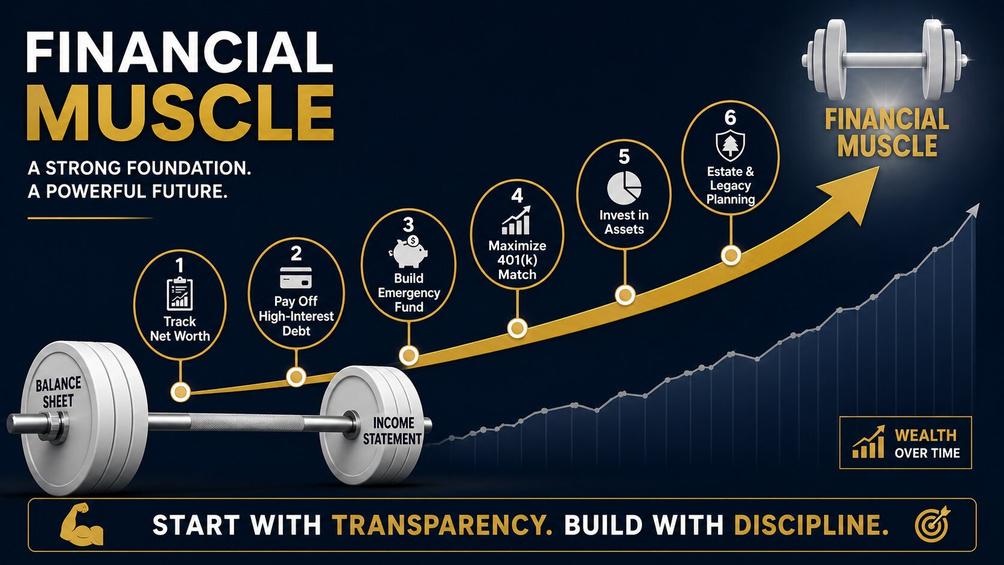
One of the first things that struck me during our dialogue was Dimitry’s emphasis on what he calls “building financial muscle.”
In my industry, I often see people dive headfirst into complex investments or high-leverage property acquisitions before they have mastered their baseline cash flow. Dimitry noted that you don’t walk into a gym and immediately try to lift a 400-pound barbell. Yet people try to execute advanced financial maneuvers without basic structural transparency. This is why financial muscle building starts with the fundamentals, not the complicated stuff.
The takeaway here for anyone trying to scale their wealth is simple. You must treat your personal finances like a business. That means establishing an absolute grip on two things: a transparent balance sheet (what you own versus what you owe) and a crystal-clear income statement (tracking your monthly cash flows). Without this baseline, attempting to out-invest your bad habits or inflation is a losing battle.
I have seen this struggle firsthand in the real-life stories behind listings and sales that I share from my own practice. The emotions are always the same, whether someone is selling a home or rebalancing a portfolio.
“Loss aversion is such a common theme for all human beings, whether you’re worth $100 million or whether you’ve got a negative net worth right now. There are psychological studies that have been done where people are more likely to talk about their private lives with their family than about their finances because there’s just so much sensitivity around it.”
This reluctance to face financial reality is a well-documented behavioral bias. Research on how emotions shape economic decisions shows that loss aversion affects everyone, regardless of net worth. When you transition from physical cash to digital wealth, money becomes an abstract number on a screen. That actually intensifies our psychological biases.
Key Takeaways for Wealth Accumulation:
- Acknowledge the Inflation Tax: If your capital is sitting idle, you are actively losing purchasing power.
- The Debt Threshold Rule: Before allocating capital to retirement accounts or real estate investments, audit the interest rates on your liabilities. Paying off a 25% interest credit card delivers a guaranteed return that no standard market investment can match.
- Leverage Modern Tracking Ecosystems: Utilize specialized budgeting platforms like Monarch or dedicated wealth portals to maintain continuous, real-time visibility over your asset allocation.
The only path to breaking the cycle of avoidance is creating structure through conversation. You must force transparency so that fear is replaced by data-driven execution.
When you pair this approach with real-time market data like pending sales rather than just past sold comps, you gain a powerful edge in both real estate and investing.
Overcoming the Psychology of Loss Aversion in Personal Finance
I asked Dimitry a question that has puzzled me for years. Why are people so inherently terrified to look closely at their numbers? Whether it is a buyer ignoring a credit report or a wealthy legacy client avoiding their portfolio during a market dip, the avoidance behavior is identical.
Dimitry illuminated this by digging into deep-seated behavioral finance principles that affect clients across every single wealth bracket.
When discussing where to put money first, he was very clear. “Always pay off any debts that are above that 3% threshold,” he advised. High-interest debt will kill your portfolio faster than a market crash.
However, there is a nuance regarding employer plans. If your company offers a 401(k) match, you should contribute just enough to capture that free money before aggressively paying down debt. It is a balancing act between guaranteed returns and free capital.
For those in the accumulation phase of their lives, Dimitry had a powerful reminder. Volatility is your friend. The more the market drops, the more of a discount you get when you buy high-quality assets that will appreciate over time. Do not let short-term fear be a driver of inaction.
Protecting Generational Estates and Navigating Legacy Transitions

In my real estate practice, I routinely see families inherit substantial properties. Too often, the entire inheritance devolves into bitter sibling rivalries, legal stalemates, or rapid wealth depletion. We are currently witnessing the largest intergenerational wealth transfer in history, with trillions of dollars set to pass from Baby Boomers to the next generation.
Dimitry validated this observation. The core vulnerability is a systemic failure to build financial muscle in heirs before the transition occurs.
To secure a legacy, you need a living family trust. This is an absolute baseline necessity irrespective of total net worth. It completely bypasses the costly, emotionally draining 10-to-12-month probate court process.
Furthermore, sophisticated wealth preservation requires structuring instruments that dictate exactly how capital flows. By transforming a revocable trust into an irrevocable vehicle upon a passing event, you can guarantee that assets are distributed as a controlled income stream. This safeguards the principal for generational wealth protection.
For high-net-worth families, advanced tools like a charitable remainder trust can also provide significant tax advantages while supporting philanthropic goals.
Eliminating Sibling Conflicts with Corporate Fiduciary Trustees
When an estate involves multiple heirs and highly illiquid assets—like a family home loaded with millions in equity—emotional decision-making can tear a family apart.
I probed Dimitry on how to structure a bulletproof plan that preserves both the capital and the family unit. His tactical advice centered squarely on removing emotional bias from the administration process entirely.
“I highly recommend getting a corporate trustee. You put their name on the trust, but they generally won’t charge you until they become the active corporate trustee. When there are siblings and when there’s potentially some sort of conflict that could arise—and even when you don’t think a conflict will arise, it most often does of some kind—having that impartial party is absolutely worth it. I recommend just going with a local independent fiduciary trustee.”
The corporate trustee advantages become clear in his words. An impartial party removes emotional bias from the equation entirely.
To understand why this matters, it helps to review the fiduciary responsibilities of a corporate trustee, which include duties of loyalty, impartiality, and prudence. Real-world examples also show why naming a corporate trustee prevents family conflict when emotions run high after a loved one passes.
Tactical Estate Strategies & Pitfalls to Avoid:
- The Mistake of Delegating Authority to Heirs: Do not force your children to make co-management decisions over complex assets while they are grieving. Appoint an independent corporate trustee to act as the objective executor.
- Explicit Lineage Clauses: Ensure your trust documents leverage specific “per stirpes” designations. This guarantees that if a primary beneficiary predeceases you, their share cleanly funnels down to their direct heirs (the grandchildren).
- Audit Your Beneficiary Designations: Remember that retirement vehicles like IRAs and 401(k) plans bypass the trust. They are governed completely by their individual forms, which must be updated independently.
The Shift: How This Conversation Reframed My Approach to Client Risk and Volatility
This dialogue shifted my perspective on how we evaluate risk and client readiness. I am used to analyzing mortgage rates and property valuations. But Dimitry’s framework reminded me that a client’s emotional landscape matters just as much as the math.
“If you’re having this conversation three years, five years, or 10 years from today, what needs to have happened during this period of time for you to say, ‘Wow, I made the right decision?’ Start with the goal in mind and then go backwards. For those who are in the accumulation phase of their lives, volatility is your friend. The more the market drops, the more of a discount you get when you buy high-quality assets that will appreciate over time. Don’t let that be a driver of inaction.”
I look at real estate deals differently now. I am no longer just thinking about the immediate transaction. I am evaluating whether a property acquisition matches a client’s long-term net worth trajectory and liquidity needs.
For small business owners, offering structured benefits makes a real difference. Research shows how retirement plans drive employee retention, with the vast majority of employees viewing a 401(k) as a must-have benefit. Implementing small business retirement benefits like a SEP IRA or a simple 401(k) doesn’t have to be expensive or complicated. When a prospective buyer evaluates your business, a stable, benefits-rich workforce protects your company’s valuation.
Moving forward, I encourage clients to integrate independent, fiduciary counsel early. You need an advisory team where the CPA, estate attorney, and wealth advisor operate in perfect sync. As Dimitry puts it, you don’t have to navigate this alone. You can reach him directly via his professional profile at Compound Planning or connect with him on LinkedIn.

FAQ Section
1. What is the difference between a traditional financial advisor and a fiduciary?
A fiduciary is legally and ethically bound to act solely in the best interest of the client at all times. Traditional advisors may operate under a “suitability standard,” meaning they can recommend products that are suitable for you but might carry higher commissions that benefit the advisor or their parent institution. The value a fiduciary wealth advisor adds goes far beyond just picking investments.
2. Should I prioritize investing in my company’s 401(k) if I currently have credit card debt?
If your consumer debt carries high interest rates (e.g., 15% to 25%), you should prioritize paying that off first, as clearing it delivers a guaranteed return equal to the interest saved. However, if your company offers a 401(k) match, you should ideally contribute just enough to capture that full match—which represents free money—and then aggressively direct all remaining cash flow toward wiping out the high-interest liability.
3. How does offering a retirement benefits package help a small business owner scale or sell their company?
Implementing structural benefits like a 401(k) or SEP IRA dramatically increases employee retention and loyalty. When a prospective buyer looks to acquire a business, they evaluate the stability of the workforce. If the employees are tied to the business via long-term, vested structures and comprehensive benefits, the company’s enterprise value is protected, paving the way for a smoother succession and a higher purchase price.
Apply to Be a Guest on the I’m Just Saying Podcast
Real estate is evolving. Capital is shifting. Markets are tightening. If you are actively working in the industry and solving real problems, whether in finance, construction, or development, we would love to hear from you.
**Compliance & Advisory Disclosure Notice: Compound Planning, Inc. (“Compound Planning”) is an investment adviser registered with the Securities and Exchange Commission and based out of New York. The statement, claim, commentary and/or content made herein and as found in Compound Planning’s websites, videos, podcasts, blog posts, articles and other publications or materials, as applicable (collectively, the “Materials”), provides general market commentary and information and/or expresses the personal opinion of the author or speaker which does not necessarily reflect the views or opinions of Compound Planning. The Material should not be interpreted as providing legal, tax, or investment advice or any professional advice for that matter, nor is it a solicitation to engage in any particular securities transaction. Compound Planning and its representatives may only transact business or provide investment advice in those states and international jurisdictions where it is registered, has filed the required notices, and/or is otherwise excluded or exempted from such registration and/or notice filing requirements.