


When a parent wants to remain in the home they love, how do you help without taking over? For many longtime La Crescenta homeowners and their adult children, the question is not simply whether the house is safe. It is whether the home can continue supporting independence, daily routines, and personal choice. Robbyn Battles, The House Agent, explores those decisions with Eve Hill, founder of Customized Aging and a Certified Aging-in-Place Specialist, on I’m Just Sayin’ | Let’s Get to the Point.
Our conversation moves beyond grab bars and renovations. We discuss the warning signs families miss, the language that makes parents feel dismissed, and how to decide whether adapting a home or moving would better support the next chapter. The starting point is straightforward: ask what the homeowner wants before proposing solutions. Watch a preview of our conversation.
What Does Aging in Place Really Mean for La Crescenta Homeowners?
Aging in place means continuing to live in a home and community of choice as needs change. It does not mean refusing assistance or remaining in the same house regardless of circumstances. Sometimes a few practical improvements make daily life easier. In other situations, stairs, narrow doors, isolation, or the ongoing cost of maintaining a property make another home worth considering.
In La Crescenta, Montrose, La Cañada Flintridge, and Glendale, many homeowners have spent decades in their houses. Their attachment is not limited to the building. Familiar neighbors, gardens, routines, and nearby services are part of the decision. A useful plan looks at both the emotional value of staying and the practical support required to do so.
What Did Eve Hill Discover When Her Father’s Home Stopped Working for Him?
Eve’s perspective changed while visiting her father during the pandemic. At about 85, he needed a walker but had stopped using the bathroom attached to his bedroom. The reason was surprisingly simple: his walker could not fit through the doorway.
The layout was creating a barrier that could make everyday activities harder and increase fall risk. Instead of viewing her father as the problem, Eve began asking how the environment could adapt to him. Her experience illustrates why a home assessment should examine the way someone actually moves through each room, not just whether a house appears well maintained.
How Can La Crescenta Families Recognize Ageism When They Are Trying to Help?
Eve described interpersonal ageism, including speaking to older adults in a childish tone or calling them “sweetie” without considering how they want to be addressed. She also discussed benevolent ageism: taking over tasks because we assume an older person cannot manage them. Even well-intentioned assistance can undermine confidence and independence.
Older age does not erase judgment, preferences, or the ability to contribute. Eve highlighted strengths that can grow through experience, including resilience, perspective, and the ability to navigate competing ideas. Her message to adult children was to speak with parents as adults, rather than treating aging as a reversal of the parent-child relationship.
Should You Modify Your La Crescenta Home or Consider Moving?
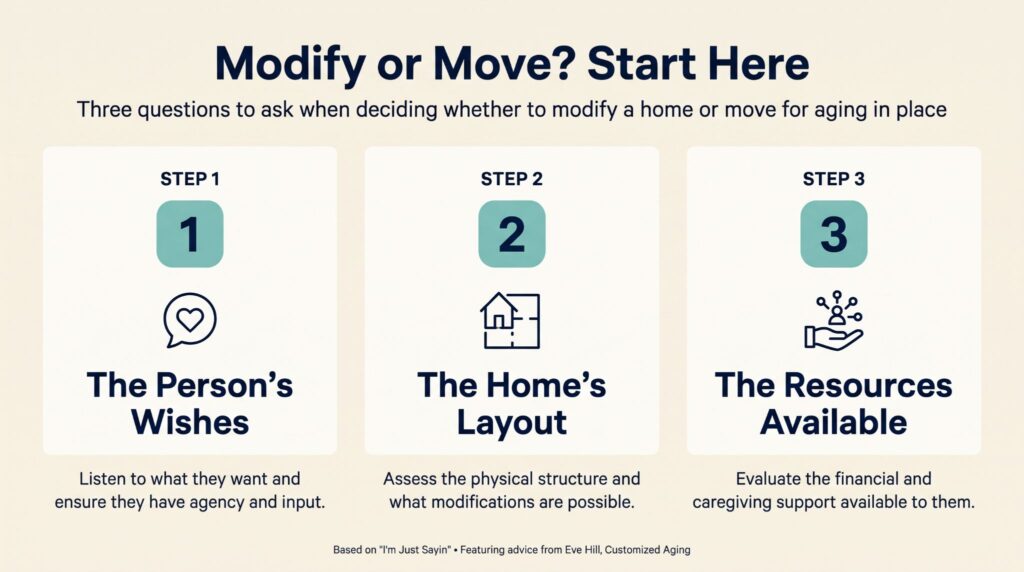
Eve starts with three questions: What does the homeowner want? How well does the current layout work? What financial, family, professional, and community resources are available? These questions are more useful than assuming that everyone should stay or everyone should downsize at a certain age.
For a La Crescenta homeowner, a single-story floor plan may make staying easier, but the number of floors is only one factor. Entry steps, bathroom access, lighting, driveway slope, outdoor maintenance, and the distance to daily support all matter. The decision should also account for the cost of improvements and whether the property will continue to work if mobility needs change.
Reasons to adapt the current home: Familiar surroundings, nearby relationships, and manageable improvements may outweigh the disruption and expense of moving. Reasons to explore a move: Extensive modifications, difficult upkeep, limited caregiving support, or a layout that cannot be changed economically may make another home more practical. Neither choice is a failure. The right decision is the one that supports the homeowner’s priorities and safety.
What Did Robbyn Battles Learn About Helping Without Taking Over?
I learned this lesson in my mother’s garden. I thought trimming an overgrown area would be a welcome favor. Her response was direct: “This is my house.” I had focused on completing a task without asking whether she wanted the work done.
That moment changed how I thought about offering help. A garden can represent years of decisions, memories, and personal control. Eve made a related point during our conversation: your parent is not your child. Listening first may take longer than doing the work yourself, but it respects the person whose home and life are affected.
Families can begin with a question such as, “What part of maintaining the house feels hardest right now?” That invites a conversation about specific needs instead of arriving with a list of changes someone else has already decided upon.
Which Home Modifications and Safety Tools Can Support Independence?
Small changes can sometimes make a meaningful difference. Eve called grab bars an unsung hero of home safety and noted that better-looking designs can make them more acceptable. Families can also review bathroom access, lighting, tripping hazards, entrances, and the usability of frequently visited rooms. A qualified professional should assess modifications where mobility or fall risks are involved.
Technology may add another layer of support. Eve discussed fall-alert devices, passive monitoring, voice assistants, smart locks, and automatic stove shut-off products. These tools serve different purposes and are not substitutes for a personalized safety plan.
| Option | Potential benefit | Question to ask |
|---|---|---|
| Grab bars and accessible bathroom changes | Support safer movement and everyday use | Are placement and installation suited to this person? |
| Wearable fall-alert device | Provides a way to request help | Will the person reliably wear and activate it? |
| Passive fall-monitoring technology | May detect certain events without pressing a button | What can it detect, and who responds to alerts? |
| Smart locks, voice controls, and stove safety devices | May simplify routines or reduce specific risks | Is the system understandable, reliable, and acceptable to the homeowner? |
For someone experiencing cognitive changes, decisions about monitoring also raise questions about privacy, consent, false alerts, and who will respond. The most sophisticated product is not necessarily the most useful one.
What Should La Crescenta Homeowners Review Before Spending Money on Improvements?
Before undertaking a major renovation, identify the specific daily difficulty the project is intended to solve. A wider doorway might address a mobility barrier, while a large cosmetic remodel may do little to improve independence. Ask whether the work is feasible, whether permits or professional evaluations are needed, and how long the proposed solution is likely to remain useful.
It is also worth comparing the cost of modifications, future maintenance, in-home support, and a potential move. If selling is a realistic possibility, understanding the property’s current condition and market position can prevent unnecessary spending on improvements that do not match the homeowner’s plans. A Strategic Home Pricing Plan can be one part of that broader conversation, without committing anyone to sell.
When Should Adult Children Begin Talking About a Parent’s Housing Plans?
Start before a fall, hospitalization, or urgent repair forces the discussion. Rather than asking for a final decision in one conversation, explore what matters most: privacy, access to friends, daily independence, proximity to family, and the ability to remain involved in decisions. Ask what kind of help would be welcome and what would feel intrusive.
For families in La Crescenta, La Cañada Flintridge, Pasadena, Altadena, and nearby Foothill communities, early planning leaves more room to compare choices. A homeowner might remain in place with targeted modifications, choose a smaller property, or move closer to support. Having options is often more valuable than rushing toward one answer.
How Does Customized Aging Help Families Plan?
Eve Hill, founder of Customized Aging, helps older adults and families identify resources, think through aging-in-place challenges, and approach sensitive conversations. In the episode, she explains that she shares basic information without charge and provides more extensive services for a fee. She also works with professionals who serve older adults and has contributed writing on ageism awareness to Aging in Place Conversations: The Caregiver’s Edition from the National Aging in Place Council.
Her work complements, rather than replaces, guidance from healthcare professionals, qualified home-modification specialists, financial advisers, and other professionals when their expertise is needed.
Frequently Asked Questions About Aging in Place in La Crescenta
How do I know if my aging parent can safely remain at home?
Begin with the parent’s preferences and a realistic look at how they manage daily activities. Doorways, bathrooms, stairs, falls, maintenance, and available help are relevant. A qualified assessment can identify risks that are easy to overlook.
Is downsizing always better than aging in place?
No. Staying can preserve routines and community connections, while moving can reduce maintenance or improve accessibility. Compare both options based on the person’s needs, wishes, costs, and support network.
How do I suggest home modifications without offending my parent?
Ask about difficulties they have noticed and which changes they would welcome. Present choices rather than directives. A parent’s participation in the decision matters as much as the proposed improvement.
Can smart-home technology replace in-person help?
No. Some devices can alert others or simplify specific tasks, but they depend on proper setup and a reliable response plan. They should be evaluated alongside human support and privacy preferences.
Should I renovate my La Crescenta home before deciding whether to sell?
Not necessarily. First determine whether the improvement supports continued living in the home or is intended to prepare for a sale. Understanding both the likely cost and the home’s market position helps avoid work that may not serve either goal.
Who can help with the decision to stay in a longtime home or move?
An aging-in-place specialist can help identify resources and possible adaptations. Healthcare and financial professionals can address individual needs. A local real estate professional can explain housing alternatives and property considerations without making the decision for the homeowner.
Where Can You Connect With Eve Hill and Robbyn Battles?
Learn more at Customized Aging or connect with Eve on LinkedIn. For local housing conversations and more episodes of I’m Just Sayin’, visit The House Agent or follow Robbyn Battles on Instagram.
Whether you are helping a parent in La Crescenta or reviewing your own long-term housing plans, the first step does not have to be a decision to sell or renovate. It starts with a conversation. No agenda. Just a conversation.
Would You Like to Be a Guest on I’m Just Sayin’?
If your work helps homeowners, older adults, or the families supporting them make informed decisions, I’d welcome the opportunity to hear from you.
This podcast is produced by the Icons of Real Estate – #1 Real Estate Podcast Network. If you are a real estate professional, apply to be a guest speaker across the network.