

The decision about your parents’ house usually gets made by a fall, not by your family. Tuesday’s blood pressure pill slips into Wednesday. Two on Wednesday, none on Thursday, dizzy, down. Now the house, the money, and the care are one rushed decision. On my Podcast, Jim McAleer President and CEO of Alzheimer’s Orange County and I sit down and talk about Alzheimers and The Conversation Families Wait Too Long to Have.
That is the moment Jim McAleer of Alzheimer’s Orange County spends his career trying to get ahead of, and what he told me about the years before it changed how I work with families. We walked through what families can settle years earlier, from care costs to the driving talk, so the house is never the thing forced to answer for everything at once.
Curious about this episode? Here is a quick preview of our dementia care conversation.
Why Senior Home Transitions Start Years Before Anyone Calls an Agent
With over 38 years in residential real estate, I often meet families at the last moment when their house needs to be listed, leaving them unprepared to make decisions. The house, being their largest asset, ties the housing and medical questions together.
Families treat them as two separate ones, which is exactly why senior home transitions so often turn chaotic. I have written before about what changes when a home has held one family for decades, and the same pattern shows up in every guide to selling a senior homeowner’s property I put together.
Jim McAleer President and CEO of Alzheimer’s Orange County has led the organization since 2004. It serves roughly 37,000 people a year through 47 support groups running in nine languages. He still carries a personal caseload of eight to ten families, and he told me plainly why. It keeps him close to what families are actually struggling with today.
That is why I wanted him on I’m Just Sayin. He is not describing a trend. He is describing his Tuesday.
Watch the full video here: the complete episode on planning ahead for senior care.
Alzheimer’s Can Sit in the Body Fifteen Years Before Anyone Notices
Dementia is an umbrella term like cancer, with Alzheimer’s being the most common form. Other types include Lewy body, frontotemporal, vascular, and alcohol-related dementias, each requiring different treatments. Jim noted that the pathology can exist for 15 to 20 years before affecting a person’s functioning.
Until then, it just looks like life. His organization keeps a plain-language explanation of how Alzheimer’s disease progresses that I now send to clients who ask.
The hallmark clinicians look for is change over time. Forgetting your keys at 20 and still forgetting them at 80 is not a change. Losing words you had last year is.

On genetics, Jim drew a hard line. Early onset before 65 has a clear genetic link. Traditional onset after 65 involves more than 30 known genes plus lifestyle.
A double APOE4 Alzheimer’s risk result raises risk. It does not hand down a diagnosis. Research from the National Institute on Aging shows that roughly 25% of people carry one copy of APOE4 and 2 to 3% carry two copies, which you can read more about in this study on how the APOE4 gene affects dementia risk. National Institute on Aging
He also pointed to the newer blood test. The FDA cleared the first blood test used in diagnosing Alzheimer’s disease for adults already showing symptoms, and it reports elevated risk rather than certainty. Jim’s advice was to skip mail-order genetic kits entirely unless you happen to be a geneticist.
Here is the number that stopped me. Roughly 15% of memory-impairing conditions are treatable and reversible. Medication interactions, depression, and social isolation are the first three things to have checked.
What Dementia Care Actually Costs Before the House Is Even on the Market
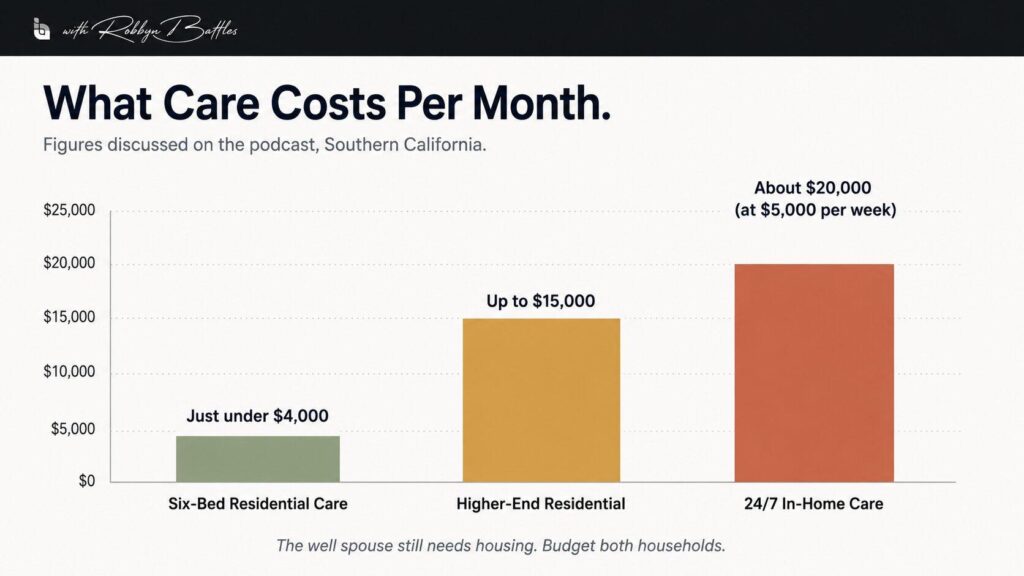
“There are also huge financial considerations. In-home care can run as much as $5,000 a week for 24/7 care. If you look at residential care, the very lowest, most modest, is just under $4,000 for a six-bed residence where your loved one is maintained there, and they can go as high as $15,000 per month. So the financial ramifications can be huge, because you’re also still trying to maintain the spouse/partner in their primary home, or maybe you have to sell the home to make all this happen, and that person is now faced with some type of supportive living, independent living, smaller lifestyle. So everything changes. Your whole world is rocked and changed while you’re watching someone that you have been a partner with for decades begin slowly to lose their ability to remember what’s going on and sometimes their ability to care for themselves.”
Two people need housing. Families budget for the care recipient but overlook the well spouse, causing sales to collapse. Care is paid monthly, but housing equity releases once, making timing crucial.
The wait is long—five to seven months for a neurology appointment in Southern California, leading to months of care costs without a diagnosis.
So run the math on dementia care costs across 24 months at each tier before you decide whether the house sells now, sells later, or gets held. Jim McAleer at Alzheimer’s Orange County frames it as one budget covering two households. Getting a real number on the property early is part of that, which is why I tell families to start with a straight estimate of what their home is worth today rather than a guess from a neighbor.
His team walks families through this side of it too. Their care consultation services for dementia caregivers pair you with a social worker who specializes in exactly these decisions.
The Housing Nobody Is Building for the Only Age Group Still Growing
I pushed him, insisting on the issue. Towers rise everywhere without accessible features. In Orange County, the 65+ population is growing while others shrink. It’s California’s third oldest county, with Alzheimer’s as the third leading cause of death.
Jim cited Laguna Woods Village, housing over 16,000 seniors, but stressed not all seniors can live in designated groups. Even wealthy families struggle to find suitable housing for those who can’t maintain large homes.
That thin inventory is why memory care planning and the housing search both need to start months before a listing goes live. I now scout accessible product long before a family says they are ready, and I write about those local shifts regularly in my real estate insights for senior homeowners and their families.
For families in that stretch where a parent needs structure but not placement, the adult day health services program in Orange County Jim described was built to keep people stable at home longer. Some participants have been in it more than ten years.
How to Bring Up the Keys Without Detonating the Whole Family
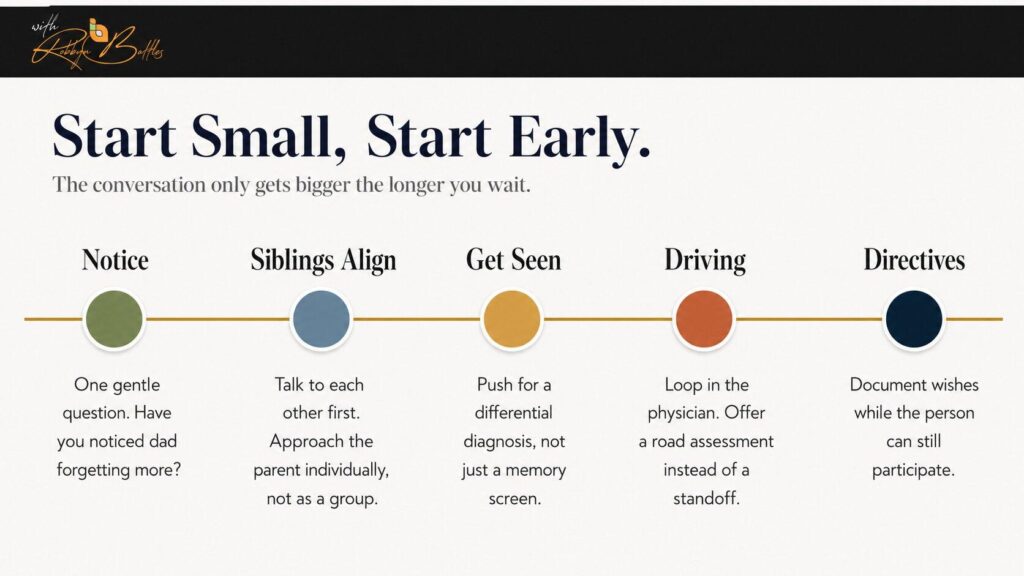
“So, honest conversations that are caring, gentle, and over time. You can’t sit mom down or dad down in an intervention and say We’ve got to take the keys, put dad in the home. You have to start the conversation as early as possible. Hey mom, have you noticed that dad seems to not be remembering so well? Maybe we need to get them looked at. You start there. You start with the very small, chewable bits that are not quite as scary, because 15% of memory-impairing conditions are treatable and reversible. So you start there. Let’s get them to a doctor. Let’s get a diagnosis. Let’s find out what’s going on. I strongly suggest siblings that can come together and talk about how to talk to their parent individually first, not collectively first. I encourage people to work with organizations like ours who can facilitate family meetings, so that there’s a neutral voice that is not as scary and who kind of does this for a living, because family drama is family drama in any family.”
Talking to aging parents about driving works better through their physician than through a standoff. California physicians are mandated reporters, and the state’s own rules on driving with a dementia diagnosis trigger a reexamination once that report lands.
Expect a pass on the first test. Good days happen, and he’ll behave well. Jim suggested a driving coach for a two- to three-hour road assessment. Framed as “if you test out fine, we leave it alone,” it often gets buy-in.
Late in the process, therapeutic fibbing beats correction. Jim McAleer with Alzheimer’s Orange County put the success rate around 60%, which he says is worth learning for a skill you will use weekly.
A few points to note:
Avoid “don’t you remember”—it only confuses without helping memory.
Don’t become a primary caregiver out of guilt. Desire and ability are crucial, as resentment leads to hostility.
Decline isn’t always due to disease. In older women, dehydration or UTIs can cause lethargy, irritation, or sudden rage. Keep inexpensive pH strips handy.
Lifestyle factors matter more than most families expect, and the research on modifiable dementia risk factors backs that up.
One more practical catch. When a parent is still packing their own pill box and manual dexterity is slipping, that is the fall waiting to happen. A dispensing machine that alerts you is cheap insurance.
What I Now Tell Every Family Before the Crisis Decides for Them
“It is never our job to tell a family what they have to do. What we can do is tell a family what we believe, based on our experience and education and background, that they should do. We can put a fair amount of informational pressure on a family, but at the end of the day, it is a family’s choice to keep someone at home past the point that it is healthy for that family, because there’s a long line in between what is not healthy and what is dangerous. So we try and get people as early as possible in the process so they can participate in the conversation, when it’s less scary, when it’s less facing you right in the face. We can talk about things like advanced care directives. How do you want to be physically cared for at the end of your life? Having that conversation early allows families to know what the person wants while they’re still able to participate in the conversation.”
No one can force a good outcome. Conservatorship is rarely granted in California and often complicates care.
What truly moves a family is alignment. Jim’s mother, at 89, left her home of 60 years after a broken hip because her children and doctor agreed.
This changed my approach. The starting point is discussing future possibilities, not listings.
Now, if a client mentions a parent’s decline, I provide the helpline before the market analysis. Families who want to compare notes with people living the same week often start with a caregiver support group that meets in their language, and those already facing the housing decision can work through the seller questions most families never think to ask.
You can reach his team through their dementia care resources and caregiver helpline at 844-373-4400, or connect with their nonprofit leadership on LinkedIn directly. Their daily caregiver education updates on Instagram and community program announcements on Facebook are worth following if you serve older clients.
My own senior transition and trust sale guidance is here whenever the housing piece comes into focus. I share listings and market shifts through my real estate updates on Instagram, neighborhood news on my community real estate page on Facebook, and industry commentary through my professional real estate network on LinkedIn.
Which brings me back to the line from Jim McAleer of Alzheimer’s Orange County that I keep repeating to clients. Call the helpline and find out what you do not know you do not know. You are underwater with a snorkel just trying to get by. Let the helpline be your snorkel.
Want to hear my full conversation with Jim McAleer of Alzheimer’s Orange County on what families get wrong about senior home transitions, dementia care costs, and the housing gap nobody is talking about? Listen to our podcast episode!
FAQ Section
What is the difference between dementia and Alzheimer’s?
Dementia is a broad term for conditions affecting daily function, like cancer. Alzheimer’s is the most common type, with others including Lewy body, frontotemporal, vascular, and Parkinsonian dementias. Each requires specific treatments, making a specialist’s diagnosis vital.
Does a positive APOE4 result mean a parent will develop Alzheimer’s?
Jim emphasized that APOE4 is among 30 genes impacting risk; two copies increase risk but don’t decide outcomes. Lifestyle factors like smoking, weight, social activity, and exercise are important. The new FDA-approved blood test indicates risk for concerned individuals but isn’t a diagnosis.
How much should a family budget for dementia care?
In-home care can cost $5,000 weekly, while residential care ranges from under $4,000 to $15,000 monthly. Consider costs for both households over two years before deciding on the home.
Apply as a Guest on the I’m Just Sayin Podcast
Every family in this position eventually meets one professional at the exact moment the decision is being made. The ones who do this work well are the reason those decisions do not go sideways.
If you work in senior care, elder law, estate planning, trust and probate, accessible housing development, or residential real estate, and you are solving problems families cannot solve alone, I want you on the show. Jim’s whole point is that the right conversation, early enough, changes the outcome. That is what this podcast is for, one guest at a time, so listeners hear it before they need it.