

The Breaking Point: Navigating California’s Fleeing Insurers and Rising WUI Risks
As a real estate agent near Los Angeles, I view properties daily through a risk-management lens, which has become increasingly stressful. We’re caught in a perfect storm: worsening climate conditions, expanding Wildland-Urban Interface building density, and traditional insurers leaving California.
I recently invited Jim Sprouse from EmberPro Wildfire Defense Systems onto the podcast because our industry is at a breaking point.
Here’s a preview of this conversation:
Jim, an NFPA Certified Wildfire Mitigation Specialist, educates real estate networks on navigating these challenges. You can view his wildfire mitigation specialist credentials or follow the EmberPro company page for fire defense updates.
Tune in to the full conversation:
Why Raw, Expert Guidance Matters Right Now
My goal for this discussion was simple: stop the neighborhood chatter, dispel the dangerous myths about fire mitigation, and get raw, expert guidance on how we can realistically protect our properties and keep real estate transactions from falling apart at the eleventh hour.
For more foundational context on how fire risk affects property sales, explore my real estate insights for California homeowners. You can also read my detailed guide on understanding fire hazard zones for foothill properties.
Demystifying the Off-Grid Technology of the EmberPro System
When many homeowners picture a wildfire defense system, they imagine a massive, ugly water tank taking up half their yard or a sprinkler system tied to municipal lines. Jim quickly set the record straight. Traditional water-based systems are functionally useless when a true, wind-driven disaster strikes. In high-stakes fire scenarios like the recent Altadena or Pacific Palisades blazes, municipal water pressure drops to zero, and the local utility companies cut grid power completely to prevent further ignitions.
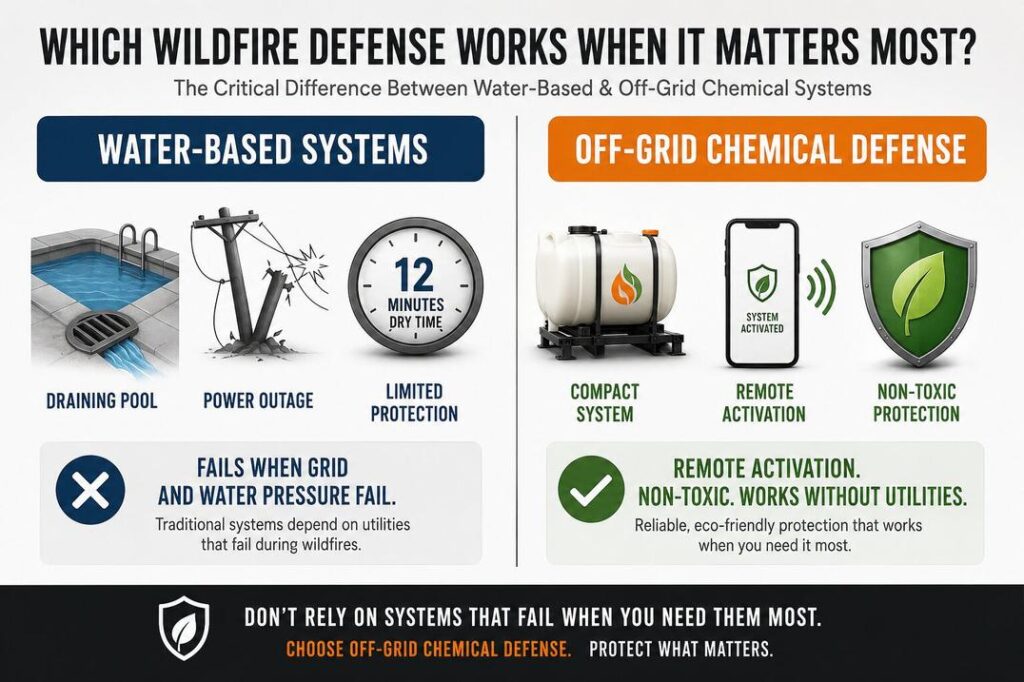
The system designed by Jim Sprouse at EmberPro Wildfire Defense Systems is fundamentally different because it operates entirely off-grid. The compact storage unit, similar in size to an outdoor air-conditioning unit, sprays an off-grid wildfire retardant spray directly onto copper plumbing along the eaves and perimeters of luxury homes.
It can be triggered remotely via a mobile app from anywhere in the world, allowing property owners to activate defense lines and safely evacuate long before the fire front arrives. According to the EmberPro frequently asked questions page, the fire inhibitor used has the same toxicity level as milk, making it safe for people, pets, and landscaping.
If you are navigating the legal side of rebuilding or selling after a disaster, you should also understand California SB 549 and the Resilient Rebuilding Authority.
Fire Science Realities: Why Embers and Radiation Do Not Care About Your Aesthetics
One of the largest perspective shifts Jim brought to the table centers on how a house actually catches fire during a wildfire event. It is rarely a massive wall of flames making direct contact with the siding. Instead, it is a combination of ember intrusion and intense radiative heat. Winds carrying fist-sized embers can travel up to two miles ahead of a fire line, seeking out weak points in a property’s construction.
Jim emphasized that California home hardening requirements are an all-or-nothing game. If you upgrade your roof to Class A material but leave standard attic vents un-retrofitted, those vents act like vacuums, drawing superheated embers directly into your crawlspace.
“When you harden a home, it’s almost all or nothing. You don’t do partially, like a quarter doesn’t make you as safe as a quarter. You’re almost 100% vulnerable. Half doesn’t make you safe. If you’d only do half your vents or whatnot, or, hey, I’ve got a class A roof, I’ve got wood siding or vice versa—it’s almost all or nothing when it comes to the home hardening.”
To combat this, structural home hardening must align perfectly with Wildland-Urban Interface defensible space management. Jim walked me through the strict physics of fire science, distinguishing how different zones protect against different elements of a fire’s anatomy.
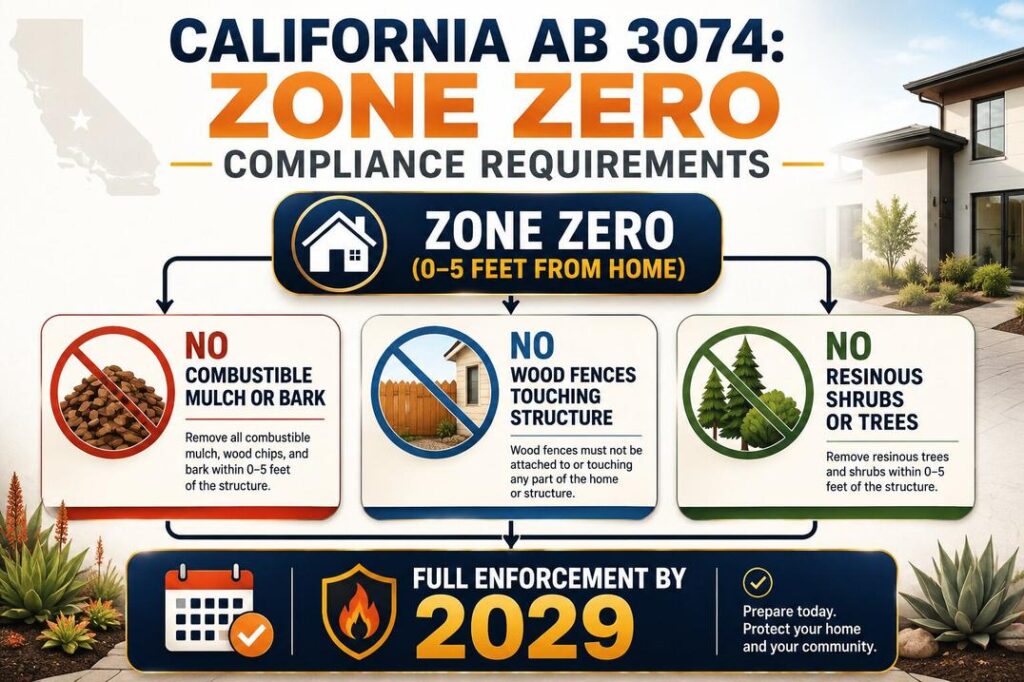
- Zone Zero (The 5-Foot Perimeter): This is the most critical area for stopping ember ignitions. There should be absolutely zero combustible materials—meaning no wood bark mulch, no wood fences directly touching the house cladding, and no highly resinous vegetation right under windows.
- Zone One (5 to 30 Feet): This buffer zone is specifically engineered to mitigate radiative heat. If you manage the fuel load within this thirty-foot space, the radiant thermal energy generated by burning trees cannot reach a high enough temperature to break double-paned windows or ignite structural walls.
The Tightening Noose of Regulatory Enforcement and Zone Zero Compliance
For years, many California property owners treated fire department clearing notices as friendly suggestions. Those days are officially over. The regulatory landscape is shifting from passive education to strict legislative enforcement, and it will deeply impact property valuations and transferability.
We looked closely at the rollout of the Zone Zero wildfire regulation AB 3074, which codifies strict perimeter rules across California. According to the official Zone Zero compliance information from the City of Glendale Fire Department, these regulations have been delayed but are actively being implemented. In jurisdictions like San Diego, local authorities are wrapping up educational grace periods and moving directly into code enforcement. By 2029, code mandates will require homeowners to completely remove any wooden boundary gates or privacy fences that structurally link to the home.
Real estate compliance varies regionally. Los Angeles County follows guidelines, while Ventura County mandates sellers fix all issues before transferring property titles.
Breaking the Luxury Myth: Grandma’s Prized Landscaping vs. Total Uninsurability
The biggest friction point Jim deals with on a day-to-day basis is entirely emotional. Homeowners move into scenic canyon and foothill neighborhoods because they love the lush, natural environment. They take pride in their dense Italian cypresses, thick palm trees, and sprawling flower gardens. However, Jim was beautifully blunt: from a fire science perspective, an unmaintained Italian cypress is nothing more than a giant candle wick waiting to explode next to your wooden eaves.
“Mitigation does hurt. I’ve had many people say, ‘There’s no way we’re gonna…’ Okay, then you’re not gonna get insurance. And I’m not gonna say from my perspective, ‘Well, we’ll just go and spray it.’ If you have insurance, if your insurance is in place, I will come out, and I will put a wildfire defense system on it. I’ll spray zone zero if you don’t remove your plants. I’ll leave it up to you… But to get insurance and keep insurance, it’s vitally important.”
The financial math behind ignoring these requirements simply does not add up anymore. High-net-worth individuals driving expensive luxury vehicles will completely balk at spending a fraction of that asset value to install an advanced protection system or clear out overgrown landscaping. They fail to look at the macro-level insurance ecosystem. Insurers in California operate at severe deficits, posting significant net income losses even before the latest destructive fire seasons. A recent study found that rebuilding to the IBHS Wildfire Prepared Home standard could reduce average annual losses substantially.
If a luxury homeowner refuses to modify their vegetation, admitted carriers will flat-out drop their coverage, forcing them onto the California FAIR Plan, which features coverage caps and astronomical premiums. According to Insurance Commissioner Lara’s official statement on FAIR Plan reforms, the plan has undergone recent changes, but it remains a costly last resort for many high-value properties.
Flipping the Script: Turning Fire Hardening From an Escrow Liability Into a Valuation Asset
This conversation completely changed how I view high-end listings and structural risk management in our market. Before sitting down with Jim Sprouse of EmberPro Wildfire Defense Systems, I looked at features like wrap-around wooden decks or dense perimeter hedges as standard aesthetic elements that buyers fell in love with. Now, I see them as massive transaction liabilities and literal fuses leading right to the main structure.
Hearing Jim detail the sheer volume of data points insurance underwriters use changed my perspective on the velocity of our market. We can no longer afford to treat wildfire preparation as something a buyer figures out after closing. It has to be an offensive, front-end negotiation strategy.
“When I have a listing, and if I know it’s in a high fire zone—which the whole thing is—and I know they have insurance problems, I want you guys to quote a system. As soon as a property hits MLS, I want an insurance quote. When insurance comes up in escrow, a client who was expecting maybe $2,000 or $3,000 a year might get a $15,000 or $17,000 premium. They fall off their seat—and then they back out. I have lost sales falling out of escrow because the insurance shock was in place.”
For agents and homeowners looking for proactive solutions, the professional wildfire mitigation services offered by EmberPro follow a three-step process: Assess, Harden, and Spray. Moving forward, I am completely changing how I manage listings in the foothills. I am advising my luxury sellers to bring in certified specialists for upfront mitigation assessments long before putting the home on the MLS.
By obtaining a pre-scoped home-hardening quote and an associated underwriter assessment, we can prevent severe real estate escrow insurance shock, using fire safety as a powerful asset rather than a scary surprise that blows up a transaction during the home inspection period. Jim also discusses the concept of neighborhood-scale fire protection strategies on his website, which is a powerful approach for communities like the ones I serve. You can also review the EmberPro business information on RocketReach for additional company background.
Want to hear my full conversation with Jim Sprouse on wildfire defense systems, insurance shock, and Zone Zero compliance? Listen to our podcast episode now.
FAQ Section
Can I use pool water or municipal lines to run a home wildfire sprinkler system?
No. Traditional water systems rely on grid power and city water infrastructure, both of which routinely fail or are intentionally shut off by utilities during a major wildfire. Furthermore, fire conditions evaporate water incredibly fast. A typical residential swimming pool distributed across a half-acre lot will dry out completely within approximately twelve minutes under high-wind fire conditions, leaving your home entirely unprotected.
Are the fire-retardant chemicals used in modern defense systems toxic to pets or landscaping?
The chemical formulas used by premium companies are completely non-toxic and environmentally friendly. They utilize EPA-certified agents and Forest Service-approved formulas that feature toxicity profiles equivalent to milk and water. These long-term retardants stick to building substrates and perimeter vegetation without damaging plant life or posing threats to household pets and local wildlife.
How does structural home hardening influence the actual market value of California real estate?
According to data compiled by CoreLogic and Penn State University across six million distinct real estate data points, executing verified home hardening strategies increases a property’s foundational market value by one and a half to two and a half percent. When paired with advanced off-grid asset additions, that real estate appreciation premium can reach as high as four percent.
Apply as a Guest Speaker
The California real estate market is undergoing a massive transformation. The intersection of severe environmental shifts, sweeping home-hardening legislation, and a volatile insurance landscape means that old methods of buying, selling, and protecting property are completely obsolete.
If you are an active professional in the industry—whether you are a broker, a real estate attorney, an insurance underwriter, an architect specializing in fire-resistant building materials, or an innovative developer solving construction challenges in the WUI—we want to highlight your expertise on our platform. Let’s work together to give our communities and our clients the insights they need to adapt and thrive.
For professional wildfire risk mitigation strategies from other industry experts, explore the work of wildfire risk mitigation expert Darlene Rini at Jensen Hughes. For community-level action and policy guidance, look into resources from the US Green Building Council California regarding home hardening programs.