At two in the morning in Altadena, the power went out. A woman who had stopped driving three years earlier couldn’t lift her garage door, and no official ever called her street. The person who got her out was the neighbor she plays ping pong with on Thursdays.
That single detail is why I sat down with Katie Brandon of Pasadena Village, and why I haven’t stopped thinking about it since. Katie is Executive Director of Pasadena Village, a nonprofit built entirely on neighbors showing up for neighbors, and this conversation changed how I think about what “aging in place” actually requires.
Curious about this episode? Here’s a preview of our conversation, straight from the source.
The Village That Started With No One Asking for Help
Pasadena Village, founded in 2012, initially struggled to attract help requests. The founders shifted their approach by organizing social activities like hiking to build relationships. This model emphasized trust through shared experiences rather than formal services, recognizing that genuine connections precede accepting help.
The idea itself traces back to the broader village movement for older adults, which started with a group in Boston in the early 2000s and has since spread to roughly 300 communities nationwide, all organized through the Village to Village Network, a resource I’d point any family toward if they want to see whether a similar community already exists near them. I’ve written before about what active aging and staying connected at home can look like in practice, and Pasadena Village is one of the clearest examples I’ve found of that philosophy actually working day to day.
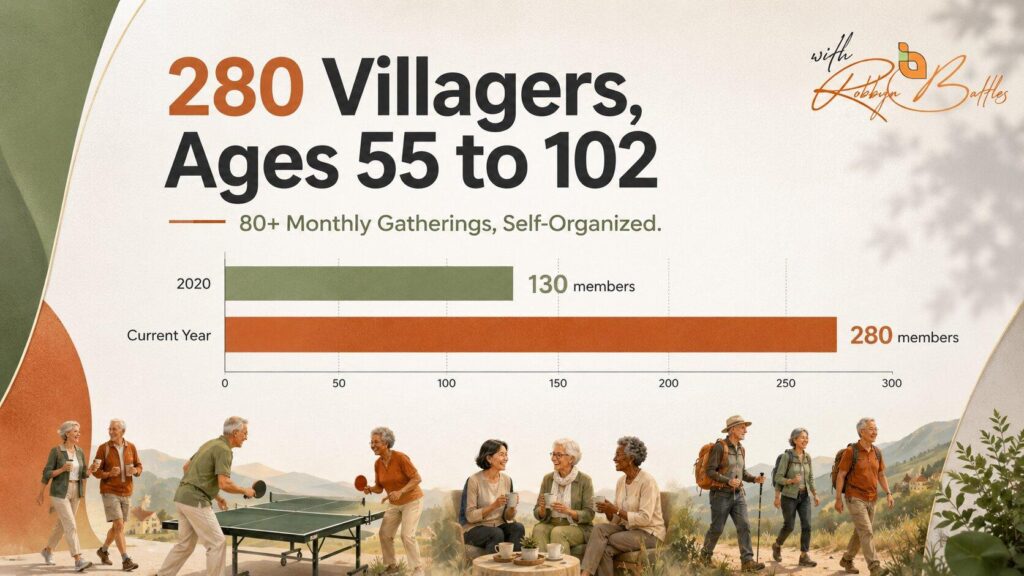
Today the group counts 280 members, ranging in age from 55 to 102, running more than 80 self-organized gatherings a month. Katie was direct about what the model is not. It isn’t a retirement community, and it isn’t a senior center.
Watch the full episode here:
Why This Isn’t a Senior Center, and Why That Distinction Matters
I asked Katie to explain the difference plainly, because I think a lot of families dismiss the village concept without understanding what it actually offers.
“For some people it can be a little hard to grasp that we’re not a senior living retirement place to move to. We’re not a senior center or a community center. We’re a supportive community. So we really try to let people know, you know, how it’s up to them to build the community that they want by joining Pasadena Village. We have 280 villagers who live independently in their own homes, maybe that’s the house they raised their family in, maybe it’s an ADU, a condo, or an apartment, and they get together through small group gatherings pretty much every day of the week.”
That distinction is worth sitting with. Members don’t move anywhere. They stay in the house they raised a family in, or an ADU, or a condo, and the community comes to them through a shared calendar of walks, discussion groups, and referrals. I’ve sat across the table from adult children before. They usually think there are only two options. Sell and move, or stay and manage alone.
I now bring up Pasadena Village aging in place community membership as a real third path. It’s worth raising for any client weighing that decision. Sometimes selling is still the right call. When it is, I walk families through preparing a longtime family home for a sale the right way.
If a client wants to look into what membership actually looks like on a practical level, Pasadena Village lays it out clearly on its membership benefits page.
The Night the Fire Alerts Never Came
This is the part of the conversation that stayed with me longest. On the night of January 6, 2025, the Eaton Fire moved through Altadena so fast that many residents were never formally notified. Katie was blunt about it: villagers found out from each other, not from any alert system.
Roughly 100 members evacuated that night. Villagers called each other, banged on doors, and offered spare rooms before official warnings arrived. Katie said it saved lives, and she meant that literally, describing neighbors who couldn’t drive or couldn’t open a power-dependent garage door on their own. The next morning, 20 volunteers made 200 check-in calls and found something remarkable. People already knew who needed help, because they’d been talking to each other throughout the night.

This is exactly why I think of Katie Brandon’s organization as an Eaton Fire senior support network in practice, even though that was never its original design. Emergency preparedness experts increasingly point to informal neighbor networks as a critical layer that formal alert systems can’t replace, a pattern the U.S. Surgeon General’s advisory on social connection also documents, noting that strong social ties measurably improve health and safety outcomes for older adults, well beyond the emergency context Katie described to me.
Every Displaced Homeowner Katie Has Talked to Was Underinsured
I’ve built a career around the financial side of senior home transitions, so this next part hit close to home. Katie told me something that should alarm every homeowner reading this, not just those in fire zones.
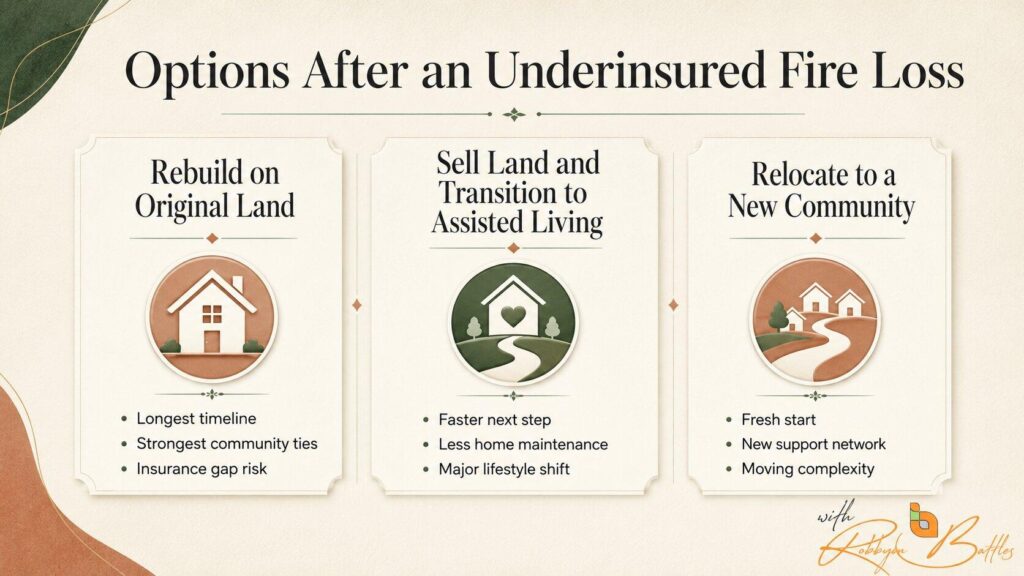
“Most of the older adults we’re working with are rebuilding. We’ve had many break ground, some that are even close to reoccupying their land, and some are in the very early stages of selecting an architect or builder and deciding what they want to do. Everyone is underinsured. Every single person we’ve talked to, no one says, ‘Well, my insurance is going to take care of this whole rebuild and then some and replacing everything I lost.’ So that’s pretty devastating because it’s a huge financial consideration on top of all the emotional stress and trauma they’re dealing with as well.”
That isn’t an isolated impression. Broader reporting on the Eaton and Palisades fires found that the large majority of survivors discovered their coverage fell far short of actual rebuild costs, a gap that Consumer Reports has continued tracking as families work through rebuilding decisions more than a year later. Some of Katie’s older members chose to sell their land rather than wait years to rebuild. Others are close to reoccupying homes they thought they’d lost. Neither path is wrong, but every family should run the insurance math now, not after a disaster forces the question.
How a Village Becomes a Trusted Referral Network
The last thing Katie described is something I recognized immediately from my own business, because it’s the same instinct that drives every good referral I give a client.
“They can ask for real-time referrals from fellow villagers through Pasadena Village. So they’ll say, you know, I live in Monrovia, and I really need a new house cleaner, or I just moved to Altadena, and I’m looking for a dentist- all kinds of referral requests. And that’s really nice because it’s real-time, it’s from someone in the village, so they’re hopefully a trusted source. It’s something they used recently, and it can be a great resource for them to talk to each other. We also offer other resource referrals, like we have an annual resource fair with the City of Pasadena every May, and that’s a real chance for everyone to come out and connect with about 50 exhibitors that are businesses and organizations serving older adults, like our wonderful real estate agents, estate planning attorneys, home care agencies, senior living, kinds of things like that, so that they can get a sense of who the friendly faces are that they can use in the future.”
I love that word, friendly faces. It’s the opposite of how most seniors end up finding a contractor or a caregiver, which is often through a random search or a stranger’s cold call. This kind of trusted neighbor referrals for seniors system is also, quietly, one of the best defenses against scams that target older homeowners, because the recommendation comes from someone who actually used the service. Anyone who wants to see the fuller range of support Pasadena Village coordinates, from transportation to technology help, can look at their member support programs directly, and volunteers looking to get involved can review their current volunteer opportunities.
Katie Brandon can be reached directly through Pasadena Village’s website, and you can also find her organization’s updates on Instagram and Facebook.
You’re welcome to follow my own conversations with guests like Katie on Instagram and Facebook, or reach me through my real estate insights archive, where I keep writing about the transitions that matter most to the families I work with.
Want to hear my entire conversation with Katie Brandon of Pasadena Village about how neighbor networks kept seniors safe during the Eaton Fire and helped them rebuild? Listen to our full podcast episode and discover why villages are changing how older adults age in place.
FAQ
What makes Pasadena Village different from a retirement community?
Pasadena Village is a membership network, not a facility. Members stay in their own homes, whether that’s a family house, an ADU, or a condo, and they organize their own peer-led activities with light support from staff for transportation, technology, and referrals. Annual dues run between $120 and $680 based on income, and prospective members can review the membership sign-up process directly on the Village’s site.
How did Pasadena Village respond during the Eaton Fire?
Roughly 100 members evacuated the night of January 6, 2025, largely alerted by fellow villagers before official warnings arrived. The next day, 20 volunteers made 200 check-in calls, and the organization continues supporting about 70 households who lost their homes.
How can someone find a village near them or their parents?
Pasadena Village is one of nearly 300 villages nationwide. Anyone can search the national map through the Village to Village Network to find a community near a loved one, wherever they live.
Apply to Be a Podcast Guest
Real estate touches every stage of life, and some of the most important conversations happen with people guiding others through a transition, whether that’s aging in place, caregiving, or rebuilding after a loss. If you work with seniors, families, or communities facing exactly the kind of decisions Katie and I discussed, I’d love to have you on the show.
Katie showed me that the strongest support systems are built long before anyone needs them, and that’s the same lesson I try to bring to every family I sit down with at a kitchen table. If your work gives you a similar view into how people actually prepare for what’s ahead, I want to hear it.