


Adding a child’s name to a property deed seems like a simple, loving gesture. I get it. But for most California families, that single act is one of the most expensive estate planning mistakes you can make. According to the State Bar of California, even legal professionals often fail to plan for incapacity and death. For California homeowners, this leads to costly probate fees and taxes. Protecting Families from California Probate.
In a recent episode of I’m Just Saying, Let’s Get to the Point, I interviewed Jenna Glassock, a founding partner of Laurel Trust Law LLP. Jenna, a UCLA Law graduate, founded her firm from empathy after losing her mother to cancer and facing a difficult probate process.
We talked through the legal and financial traps that quietly strip families of wealth. These are the assets they spent decades building. Let’s break down exactly what you need to know to protect your legacy.
Here’s a snippet of this episode:
Protecting My Clients Beyond the Real Estate Transaction
More than 35 years in real estate have shown me the same mistakes playing out on repeat. Well-meaning families move properties in and out of trusts carelessly during refinancing. Some record uninsured deeds. Others add family members to the title without understanding what that triggers. Every one of these creates costly obstacles for title companies and lasting complications for surviving family members.
These conversations have pushed me to go deeper. Getting the details right matters at every stage, whether it is ensuring a home that is held in trust or understanding how programs like California’s senior property tax relief interact with the estate plan before any transfer takes place. One missed step can undo years of careful planning.
That is why I brought Jenna onto the podcast. She holds a J.D. from UCLA School of Law and an M.B.A. from UCLA Anderson School of Management, where she graduated first in her class. Jenna Glassock founded Laurel Trust Law LLP after experiencing firsthand what an expensive, drawn-out probate process feels like.
When she lost her own mother to cancer, she navigated the court system alone. That experience became the foundation for how she protects California families today.
Watch the full Episode here:
Demystifying the California Revocable Living Trust and Asset Retitling
The first thing Jenna corrected was the misconception I hear most often. A will is not a complete estate plan. A will goes to the probate court. It gives the court instructions. A California revocable living trust, by contrast, gives your family the legal mechanism to bypass that court process entirely.
But creating the trust document is only half of the equation. Jenna was emphatic that the document alone does nothing unless every asset is physically retitled into it. Real property must be deeded to the trust. LLC interests must transfer into trust ownership. Checking, savings, and investment accounts all need to reflect the trust as the account holder. If anything still reads in a personal name, that asset falls outside the trust, and the family faces the exact court system they were trying to avoid.
This is exactly where most plans break down. An attorney can help with the real property and business transfers, but the client has to handle the bank accounts personally. That task gets skipped. People complete the difficult emotional work of drafting the trust and then leave the administrative retitling unfinished. The result is a well-designed document that cannot do its job. You can review the foundational steps of California estate planning to understand the full scope of what retitling involves before you begin.
According to California’s probate court system, any estate with assets exceeding approximately $208,850 requires formal court proceedings if assets are not properly titled. For the overwhelming majority of California homeowners, a single property already clears that threshold.

Why Relying Solely on Bank Beneficiary Designations Falls Short
A valid “pay on death” beneficiary designation does allow the listed person to collect funds directly from the bank without going through probate. That mechanism works. The problem appears when the rest of the estate is not structured cohesively around it.
Jenna explained the structural risk in detail:
“Beneficiaries don’t typically transfer over. So if you were ever to switch banks or have fraud on an account and have to move into a new account, it’s a higher risk that we lose those beneficiary designations. And then the second one is in your example: let’s say you have your trust, your trust owns your real property and whatever else, right? And you have a bunch of bank accounts that list a beneficiary. Those accounts go directly to those beneficiaries, which might mean that there’s no liquidity in your trust to help pay, maybe to help pay for the real property before we sell it or before we can rent it out or whatever it is, or to pay other expenses or to pay taxes. We’ve kind of now separated things into something that has expenses and the cash that we would normally use to pay it. So that will avoid probate. From a probate perspective, from a probate avoidance perspective, that’s a completely valid way of doing things. It just usually, if possible, is easier to have everything flow into the trust and be distributed out of the trust rather than have things kind of piecemeal.”
This scenario plays out regularly in the real estate I handle. A parent passes with their property held inside the trust, but all liquid assets flow directly to their children through beneficiary designations. The trustee is left managing property expenses and outstanding obligations with no centralized cash pool. That is a financial bottleneck at the worst possible moment for a grieving family. It does not destroy the estate plan outright, but it creates an administrative crisis that could have been avoided entirely.
The Danger of Adding Your Children to a Property Deed
This is the mistake I encounter most often. Parents want to simplify things for their children, so they add a child to the deed as a joint tenant. It seems like a logical shortcut. It is not.
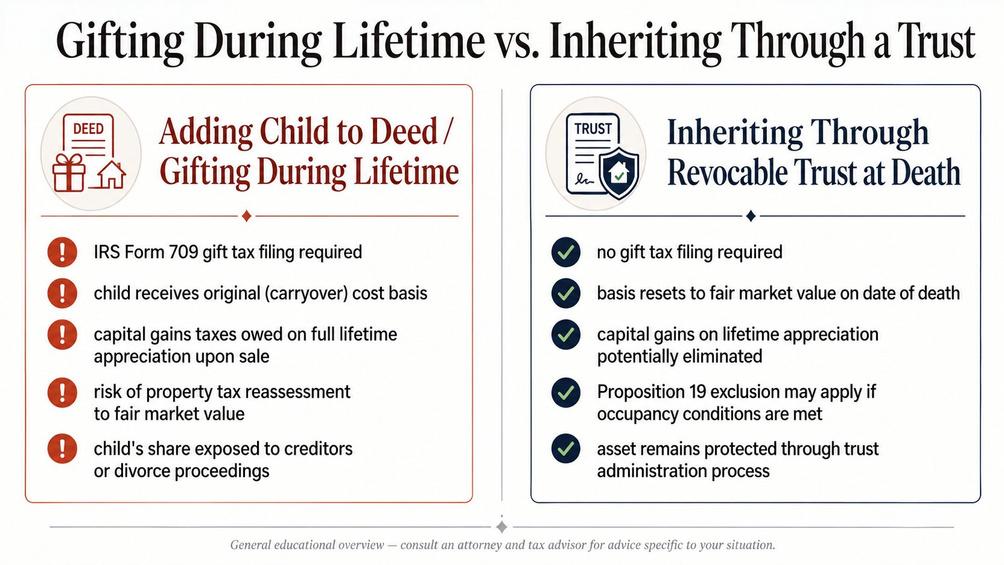
Adding a child to the title constitutes a lifetime gift of 50 percent of the property’s value. That triggers a legal obligation to file IRS Form 709, documenting the gift against the lifetime estate tax exemption. Many families execute this transfer without telling their accountant and discover the compliance gap well after the fact.
The financial damage goes further than the paperwork. Any portion of the property gifted during the owner’s lifetime carries the original purchase price as the cost basis. When the child eventually sells, they owe capital gains taxes on every dollar of appreciation accumulated since the property was originally acquired. That could represent decades of taxable gain on a Southern California property. If the property had instead been transferred through the trust at the owner’s death, that entire gain would have been permanently erased.
The third risk is property tax reassessment. California calculates property taxes on an assessed value that typically runs well below the current fair market value. Adding a co-owner during your lifetime can prompt the county assessor to trigger a full reassessment to market value. Annual property taxes can jump dramatically as a result, with no way to undo it.
Maximizing Wealth Preservation Through the Stepped-Up Basis Capital Gains Loophole
Stepped-up basis capital gains treatment is one of the most powerful and least-discussed advantages in California real estate. When a beneficiary inherits a property through a trust at the owner’s death, the IRS resets the property’s cost basis to its fair market value on the date of death. Every dollar of appreciation built up over the owner’s lifetime is erased from the tax calculation.
Jenna walked through exactly how powerful this benefit is, especially in California:
“The law says that at death, we get to take that basis, essentially what you bought it for, and reset it to be what it was as of the date of death. And so that means all of the gains that accumulated over your lifetime are forever wiped away for tax purposes. And we get to kind of start anew with that date of death value. It’s an incredible, incredibly powerful tax avoidance strategy under the law. It’s one of the areas where California tends to be actually preferred. We’re not usually preferred for tax reasons, but in California, because we’re a community property state, we typically get to step up that basis all the way to date of death value, both when the first spouse dies and when the second spouse dies for married couples. And so it’s just decreasing income tax, but specifically capital gains tax, which is kind of a subset of that, when you pass stuff on at death rather than gift it during your life.”
Consider what this means in practical terms. A home purchased for $300,000 appreciates to $2,000,000 by the time the owners pass. A child who inherits through the trust and sells immediately at the stepped-up value owes zero capital gains taxes on that $1,700,000 of appreciation. That is not a loophole in the pejorative sense. It is exactly what the law is designed to do when assets are held correctly.
As a broker, I use this understanding to slow clients down when they are rushing to sell a home while a seriously ill parent is still alive. Waiting until after the owner’s death can preserve hundreds of thousands of dollars for a family. It is a conversation that falls outside most people’s expectations of a real estate agent, but it is one I now feel responsible for having.
Navigating the Brutal New Realities of California Proposition 19 Property Tax Rules
While the stepped-up basis eliminates capital gains exposure, property taxes are governed by an entirely different set of rules. California Proposition 19 property tax law changed significantly in February 2021, and the impact on families planning to keep real estate across generations has been severe.
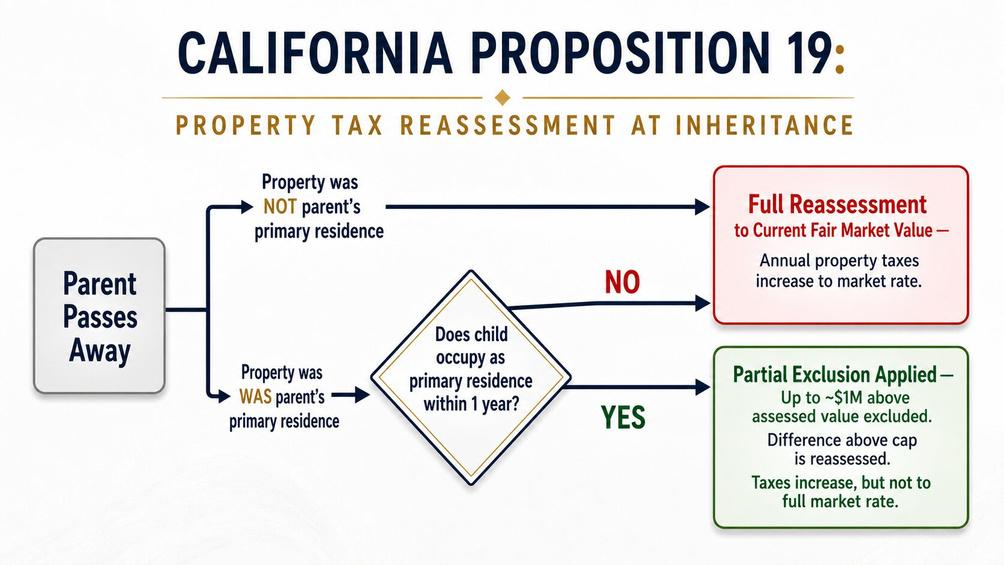
Before Prop 19, parents could pass down a primary residence and up to $1 million in assessed value on other properties to their children without triggering a reassessment. The current law is far more restrictive. The parent-child exclusion now requires two conditions to be met.
- First, the property must have been the parents’ primary residence.
- Second, the inheriting child must occupy the home as their own primary residence within one year of the transfer.
Even when both conditions are satisfied, the reassessment exclusion is capped at approximately $1 million above the current assessed value, and that cap adjusts periodically.
Here is what that means in a real scenario. If the parents’ home was assessed at $300,000 but carries a fair market value of $2,000,000 at the time of transfer, the assessed value is shielded only up to the cap. The portion above that cap gets reassessed. A family expecting to pay $3,000 annually in property taxes could find themselves paying $10,000 or more, depending on the gap between assessed value and market value.
For families navigating these rules right now, a step-by-step guide to inheriting property under Proposition 19 lays out exactly how the exclusion applies, case by case. The California Board of Equalization’s Proposition 19 guidelines are the definitive source for official thresholds and eligibility requirements.
The Compounding Delays and Skyrocketing Costs of Avoiding Probate in California
Avoiding probate in California is not simply about sparing your family the inconvenience of a court process. It is about shielding the estate from a statutory fee structure that is especially punishing for real estate owners.
When an estate with assets exceeding $208,850 enters the California probate system without a trust, state law calculates attorney and executor fees based on the gross asset value. Not the equity. The gross value. A home worth $1,000,000 with an $800,000 mortgage still generates probate fees calculated against the full $1,000,000. Under California law, both the probate attorney and the estate executor are each entitled to $23,000 in statutory fees at that value. That is $46,000 stripped from the family before court costs, appraisal fees, or any other administrative expenses are added.
There is also a timeline problem. Before an executor can legally sell or access real property, a court-appointed referee must complete a third-party appraisal and the court must formally grant authority. From the moment probate opens to the point where the executor can act, families typically wait three to four months, sometimes longer. A family hoping to sell quickly to cover estate expenses or care costs faces that delay on top of the fees.
Many families turn to online legal platforms to reduce upfront costs, but why DIY estate planning rarely provides adequate legal protection comes down to what gets left out. A trust with incomplete retitling instructions, missing successor trustee provisions, or unfunded asset schedules can create the exact probate scenario it was meant to prevent. The money saved on drafting frequently evaporates inside the statutory fees.
Shifting My Mindset on the True Urgency of Incapacity Planning Documents
Before this conversation, my thinking about estate planning stopped almost entirely at what happens after someone passes. Jenna reoriented that completely. The most immediate, personal financial risk most families face is not death. It is the period when someone is still alive but no longer able to make their own decisions.
Incapacity planning documents — financial powers of attorney, advanced healthcare directives, and HIPAA authorizations — are what give your family legal authority to step in during that window. Without them, a spouse, child, or trusted friend has no legal standing to pay your bills, access your accounts, or authorize your medical care. They would have to petition a court for conservatorship, which is expensive, time-consuming, and public.
Jenna made the stakes plain:
“The incapacity stuff is the stuff that affects you. It’s the stuff that can make sure that if something happens to you, illness, injury, age, whatever it is, that the people who love you and care about you can step in and make sure that your life stays financially and healthcare-wise as status quo as possible. And without those documents, it’s quite an annoying and complicated legal procedure for someone to be able to step in and take over. It’s hard… to add a court system on top of that and the complications that come with that and how, you know, just stressful it feels like to be dealing with it. It’s so much harder for everybody, but it is also so much less protective. And it’s harder on the person themselves, the person who’s lost capacity. If their bills are not able to get paid for some period of time, or we don’t know what they would want in certain healthcare situations, or we don’t have someone who’s designated to act, it can delay care, delay payment of the bill, it can make your own life, right? The person who’s creating these documents. And this is the one thing that can affect you in the future, and it’s so easy to do. So no one ever thinks about it. We always focus on the post-death part, and the post-death part is more kind of complicated and arguably interesting to talk about, but the incapacity stuff is so important.”
I understand this personally. After my father passed, I tried to handle a basic membership cancellation on his behalf and was stopped at every turn without the proper documentation. That moment was a small, frustrating preview of what happens across every financial institution, healthcare provider, and service account when the right paperwork is not in place. It delays bill payments, complicates care decisions, and adds legal costs on top of an already overwhelming time.
Jenna recommends naming at least three backups for every designated role. First choice, second choice, third choice, across every document. A power of attorney that only names a spouse leaves the family exposed if that person is also incapacitated or unavailable. The structure should hold regardless of what happens first.
To understand the full scope of what a comprehensive plan includes, the estate planning and trust administration services at Laurel Trust Law cover everything from foundational documents to high-net-worth planning. And if you are unsure where to start, their resource on what qualifies as part of your estate is a clear, practical starting point before a first consultation.
Jenna’s team at Laurel Trust Law offers a free consultation for anyone who wants to evaluate their situation before committing to a plan. Follow Jenna Glassock on LinkedIn for ongoing updates on California estate planning and probate law.
Interested in my conversation with Jenna Glassock? We discussed revocable living trusts, the risks of adding children to deeds, and how California families lose millions to probate annually. It was an honest exchange. Listen to the full episode right here.
Frequently Asked Questions
What is the main difference between a will and a revocable living trust in California?
A will requires formal oversight through the California probate court system, which is notoriously slow, public, and expensive. A California revocable living trust allows your assets to transfer to your designated beneficiaries privately and immediately upon your death, completely bypassing the court process.
How does the new California law affect probate for lower-value primary residences?
California introduced a probate avoidance technique specifically designed for primary residences valued under $750,000. If the decedent’s primary residence falls under this threshold and specific estate criteria are met, heirs may be able to bypass full court probate proceedings. However, because property values fluctuate rapidly, relying on this exemption as a substitute for a trust is highly risky.
Why does adding a child to a property deed increase their future capital gains tax bill?
When you gift a portion of your real property during your lifetime, your child inherits your original historical cost basis. When they eventually sell the property, they will owe steep capital gains taxes on the full appreciation. If they inherit the property through a trust after your passing, they receive a stepped-up basis capital gains reset to the fair market value at the date of death, erasing decades of taxable gains.
Apply as a Guest Speaker
Real estate is evolving. Capital is shifting. Markets are tightening.
If you are actively working in the industry and solving real problems, whether in construction, finance, brokerage, or development, apply to be a guest on the show. It is a great way to share your hard-won knowledge with California homeowners who desperately need to hear it before they make a costly mistake.
Follow the show on Facebook and Instagram for more real estate insights, or connect with Robbyn on LinkedIn.