

 Estate planning is not only for people with significant wealth or complicated finances. Rebecca Secord of Your Home Legal explains why planning can matter much earlier than many people realize. Owning a home, getting married, having children, or building assets can all be reasons to start thinking ahead.
Rebecca is an estate planning and real estate attorney in San Diego with nearly 20 years of legal experience. In our conversation, she breaks down what homeowners should understand about trusts, wills, property ownership, and planning ahead. She also explains some of the mistakes families make when important decisions are put off too long.
For homeowners, a house can represent a substantial part of their financial picture. Rebecca’s advice offers a practical look at what estate planning can protect and why the right time to start may be sooner than expected.
In this episode of I’m Just Saying, Let’s Get to the Point, we covered:
- Why estate planning can matter as soon as you turn 18
- Why having a will does not automatically keep an estate out of probate
- How Proposition 19 can affect inherited California property
- What to ask before hiring an estate planning attorney
- What homeowners should know about trusts, escrow, and capital gains
Check out the highlights here:
Why Rebecca Secord of Your Home Legal Says Estate Planning Starts Earlier Than Most People Think
I wanted to have this conversation because real estate and estate planning overlap constantly.
My clients may have owned a house for 20, 30, or even 50 years. Eventually, questions come up about who owns it, who inherits it, how it is transferred, and who has authority to act if something happens to the owner.
Rebecca approaches those questions from both sides. She practices estate planning and real estate law, so our conversation moved naturally between living trusts, probate, property taxes, escrow, and family decisions.
Estate Planning Is Also About What Happens While You Are Alive
The first shift for me was understanding how much estate planning has to do with incapacity.
Rebecca explained that the plan is not only about where your property goes after death. It can also establish who is allowed to handle financial or healthcare matters when you cannot.
“Everybody thinks about an estate plan as the thing that you need if you have a lot of money, if you own real estate, if you have kids. The answer to that question is yes, yes, yes. But you also need it if you don’t have any of those things. And I know we’re talking about real estate here, but if you’re here and you’re listening in California, if you have a pulse, you need a plan.” — Rebecca Secord, Estate Planning and Real Estate Attorney
That made the rest of our discussion much easier to frame. Planning starts before the inheritance, before the sale, and before someone is forced to make decisions during a crisis.
Watch the full conversation here:
Why Estate Planning Starts the Day I Turn 18
One of the biggest surprises in this episode was how early Rebecca believes the conversation should begin.
At 18, she explained, parents no longer automatically have the same ability to make financial and healthcare decisions for their child.
Two Documents Young Adults Should Understand
Rebecca identified two basic documents for young adults:
Those documents become important if an adult is incapacitated and needs another person to act.
This applies even when that person:
- Does not own real estate
- Is still in college
- Has no spouse
- Has no children
- Has very little money
Rebecca also explained that parents paying for college do not automatically receive access to everything involving their adult child’s education.
That is the first practical lesson from our conversation. California estate planning can begin with deciding who is allowed to help you, not deciding who gets a house.
Why a Will Does Not Automatically Keep My Family Out of Probate
I hear some version of “I have a will, so I’m good” all the time.
Rebecca was very clear about the limitation.
A Will Can Give Instructions
A will can identify:
- Who should handle your estate
- Who should receive your property
- How you want that property distributed
But the will still has to be carried through the court process.
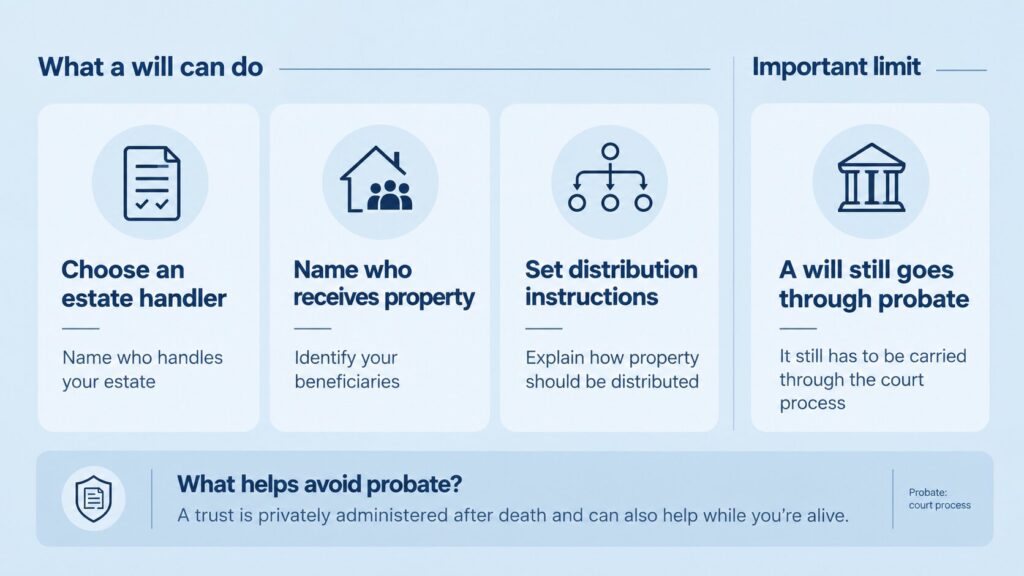
“It’s better than nothing because you have at least taken some control over where you want your stuff to go, but it doesn’t keep you out of probate. That’s where a trust comes in. Your trust is a privately administered thing after you’ve died, but it also helps you while you’re alive. So, a will is good, but it’s not going to keep you out of probate.” — Rebecca Secord, Estate Planning and Real Estate Attorney
Probate Can Become Expensive Quickly
According to Rebecca in the episode, a $1 million California estate can run around $42,000 in statutory probate fees.
She also pointed out something homeowners may overlook. Her example looked at the value of the property, even if a substantial mortgage was still attached to it.
That is why California probate became such an important part of this conversation. A homeowner may think they have already solved the problem by writing a will when the family could still face a court process.
Rebecca also stressed that an estate plan should be reviewed as life changes. Marriage, divorce, real estate purchases, children, and changes in the law can all affect whether an older plan still fits.
That brings us to one of the biggest California specific issues we discussed: inherited property.
What Proposition 19 Can Mean When My Children Inherit a California Home
For me, Proposition 19 is where estate planning becomes very real for homeowners.
Rebecca explained that under the rules she discussed, transferring a parent’s primary residence to a child does not mean the existing property tax basis simply follows the house forever.
The Child’s Use of the Home Matters
According to the California State Board of Equalization, at least one eligible child must make the inherited family home their principal residence and apply for the homeowners’ or disabled veterans’ exemption within one year of the transfer.
Her example showed how significant reassessment can be.
According to Rebecca in the episode, property taxes on a home worth about $2 million could move from roughly $1,000 per year to about $24,000 per year after reassessment in the scenario she described.
That can change whether keeping the house is financially realistic.
Multiple Children Make the Decision More Complicated
Rebecca gave another example involving three siblings.
One child lives in the house. The other two want to be bought out. Suddenly, the family is dealing with:
- Ownership percentages
- Refinancing
- Property tax reassessment
- Beneficiary buyouts
- Possible judgments or creditor problems
In the example we discussed, the sibling keeping the property could face reassessment on the portions acquired from the other siblings.
Rebecca’s advice was simple: if a beneficiary wants to buy out siblings while the property is still in a trust, stop before transferring it.
Talk to the attorney, tax adviser, and lender first.
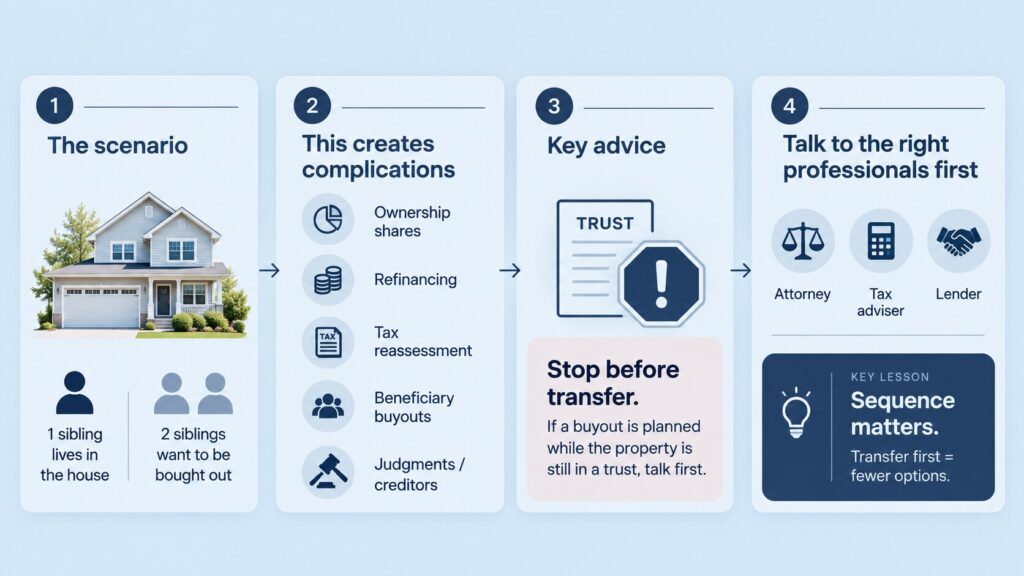
When dealing with Proposition 19 and inheritance, sequence matters. Moving the property first and figuring out the consequences later can remove options that may have existed earlier.
How I Would Choose an Estate Planning Attorney
The next issue is knowing who to call.
Legal documents can feel overwhelming, especially for someone who has never hired an attorney.
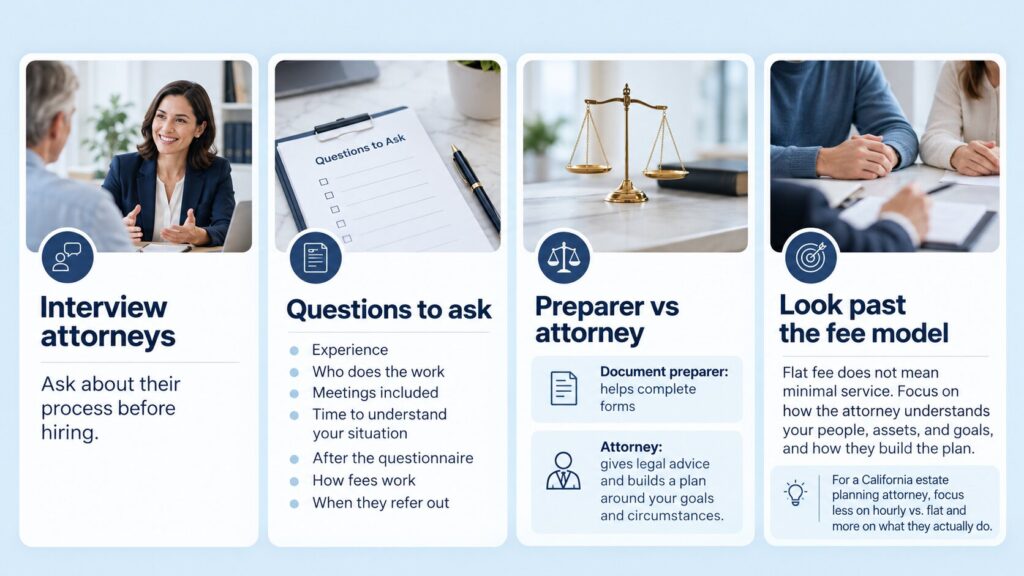
Rebecca recommended interviewing attorneys and understanding their actual process.
Questions I Would Ask Before Hiring Someone
I would want to know:
- How long have you practiced estate planning?
- Who will actually do the work?
- What meetings are included?
- How much time will you spend understanding my situation?
- What happens after I complete the questionnaire?
- How do your fees work?
- When would you refer me to another professional?
Rebecca made an important distinction between document preparation and legal advice.
A legal document preparer can help complete forms. An attorney can provide legal advice and help build a plan around the client’s actual goals and circumstances.
Flat Fee Does Not Mean Minimal Service
I initially compared a simple document process to a discount real estate service, then Rebecca stopped me because she uses a flat fee herself.
Her point was good.
The fee structure does not tell you whether the planning is comprehensive. Rebecca said she spends significant time talking with clients so she can understand their people, assets, and goals.
If I were choosing an estate planning attorney in California, I would focus less on whether the price is hourly or flat and more on what the attorney actually does to build the plan.
What Real Estate Owners Should Know About Trusts, Escrow, and Taxes
This part of the conversation brought us directly back into real estate.
Escrow May Not Need Your Entire Trust
When a property is held in a trust, someone involved in the transaction may ask for trust documents.
I initially described giving the trust to escrow. Rebecca corrected me.
She explained that a trust certificate can often establish what the relevant parties actually need to know:
- Who created the trust
- Who the trustee is
- Whether the trustee has authority to buy
- Whether the trustee has authority to sell
- Whether the trustee has authority to borrow
The rest of the trust may contain private details about beneficiaries and distributions that have nothing to do with the sale.
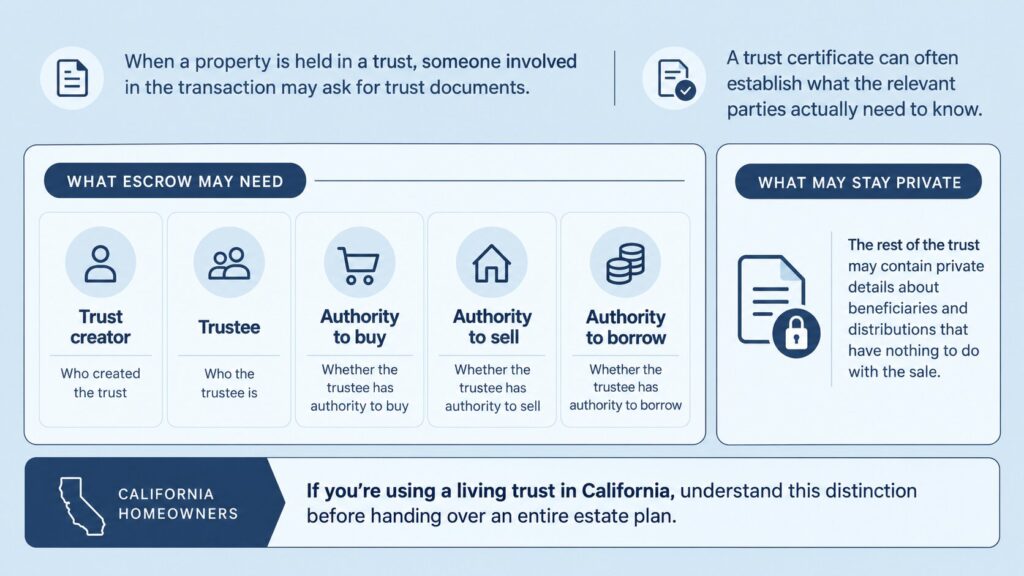
For homeowners using a living trust in California, that distinction is worth understanding before handing over an entire estate plan.
Capital Gains Deserve a Conversation Before the Sale
We also discussed longtime homeowners worried about capital gains.
Rebecca described structured installment sales as one possible tool to discuss with a tax adviser and financial adviser. She was also careful to say that she is not a tax attorney or CPA.
That is exactly the approach I like.
Know enough to see the issue. Then get the person who actually works in that area involved.
The same applies when you are preparing your La Crescenta or Shadow Hills home for sale. A tax or estate issue is much easier to address when it comes up before closing.
What Changed for Me After This Conversation
I have spent decades around homeowners and real estate. Even I tended to associate estate planning with older people, property, and substantial wealth.
Rebecca moved that starting line all the way back to 18.
“I think that 18 to 30, they think estate planning. Everybody mentally goes to house, they go to real estate, they go to lots of money. They don’t ever go to just the simple task of, God forbid, something happens to you. Everybody thinks, ‘Oh, mom and dad. I’ve got a mom and dad. They’ll just naturally take over.’ I just learned this probably within the last six months that all of this should be in place because no one talks about it.” — Robbyn Battles, Host and Broker Associate
The larger lesson for me is timing.
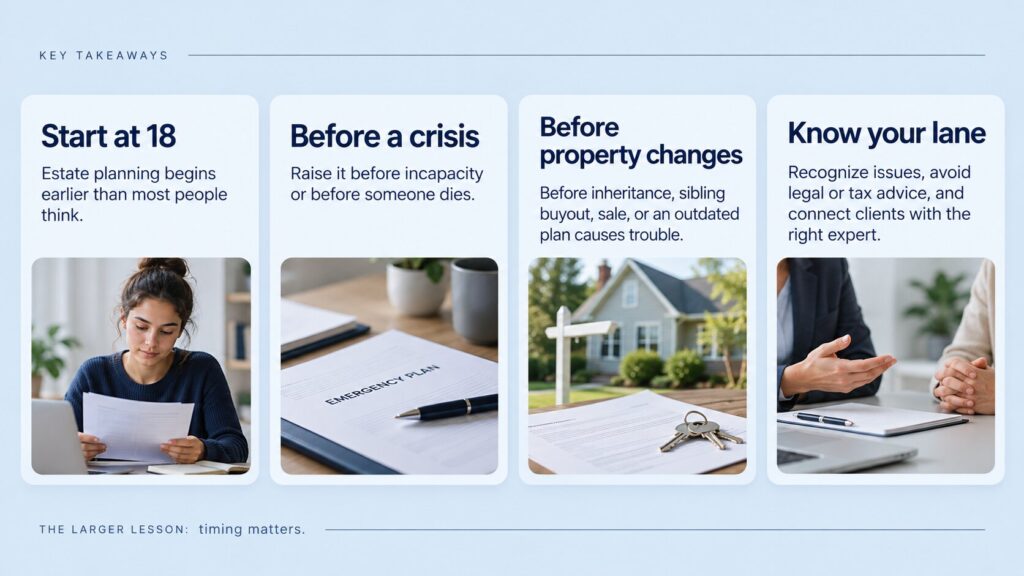
Talk about these issues:
- Before incapacity
- Before someone dies
- Before inherited property changes hands
- Before siblings complete a buyout
- Before selling a highly appreciated home
- Before an old estate plan becomes a problem
As a real estate professional, I do not need to give legal or tax advice. I do need to recognize when something is outside my lane and connect the client with someone who can answer it.
FAQ Section
Do I Need an Estate Plan if I Am 18 and Own Nothing?
Rebecca says young adults should still consider a financial power of attorney and advanced healthcare directive. The issue is who can act if you become incapacitated, not simply how much property you own.
Does a Will Keep a California Estate Out of Probate?
No. Rebecca explained that a will can state who handles your estate and who receives your property, but it still goes through probate to carry out those instructions.
What Happens if Several Siblings Inherit One Home?
The siblings can become co owners, which may create issues involving refinancing, buyouts, judgments, and reassessment. Rebecca recommended getting the appropriate legal, tax, and lending advice before moving the property out of the trust.
Does Escrow Need My Entire Trust?
Rebecca said a trust certificate can provide the information needed to establish the trustee’s identity and authority without providing the entire trust.
Keep the Conversation Going
If you want help with California estate planning, probate avoidance, or real estate legal issues, reach out to Rebecca Secord:
- Website: https://www.yourhomelegal.com/
- LinkedIn: https://www.linkedin.com/in/rebecca-secord-attorney
- Facebook: https://www.facebook.com/yourhomelegal/
- Instagram: https://www.instagram.com/yourhomelegal/
- YouTube: https://www.youtube.com/channel/UCKGo1-riFEUBpBLXITy6mcQ
You can also connect with me here:
- Website: https://www.thehouseagent.com/
- Facebook: https://www.facebook.com/RobbynBattlesTheHouseAgent
- Instagram: https://www.instagram.com/robbynbattles/
- LinkedIn: https://www.linkedin.com/in/robbynbattles/
And if you are making your own real estate decisions, I also have resources that can help:
- Explore Foothill community neighborhoods across La Cañada and Pasadena
- Follow my Southern California real estate news and foothill market updates
- Find out what your Pasadena or Montrose home is worth
- Read my guide to buying a home in Pasadena and nearby foothill communities
Apply to Be a Guest on “I’m Just Saying, Let’s Get to the Point” Podcast
This conversation with Rebecca Secord showed how much real estate can overlap with estate planning, taxes, inheritance, and the decisions families have to make long before a property changes hands.
If you work in real estate, law, lending, finance, or another area that helps people navigate those kinds of high stakes decisions, I’d love to bring your perspective to the show.