


For longtime homeowners in La Crescenta, La Cañada, and throughout Southern California, selling a home with substantial equity can come with an unexpected challenge: capital gains taxes. But what if selling could also create retirement income, potentially reduce your tax burden, and become part of your estate plan?
On this episode of I’m Just Sayin’, Robbyn Battles speaks with John Dudek of Dudek Kelly, a structured installment sale specialist, about an alternative many homeowners have never considered. You’ll learn how a structured installment sale works, how spreading payments over time may reduce taxes, what happens to remaining payments when you pass away, and why this strategy isn’t right for everyone.
Before deciding that capital gains taxes make selling too expensive, understand the options available to you.
Want a quick taste first? Here’s a short preview of our conversation:
Why My Long-Time Sellers Keep Telling Me They Can’t Afford to Sell
I hear it all the time in my La Crescenta real estate practice. Capital gains is probably the number two reason people in my neighborhoods won’t sell.
One client bought her property for $40,000. Today it’s worth about $1.4 million. When she told me, my first thought was simple: she’s going to get creamed in taxes. Another client expects a $360,000 gain, and I suspect it will be bigger.
These aren’t flippers. They bought decades ago and stayed. Now their biggest asset feels trapped.
How I Met John Dudek
An attorney friend mentioned she knew ways to keep people from paying all these taxes. My ears went straight up. That’s how I met John. He grew up in San Diego and still lives there with his wife and three young kids. His roots are in structured settlements for personal injury and employment cases, and the structured installment sale comes from that same idea and process.
I liked him right away because he was honest. He told me this isn’t the answer for everybody. He also told every listener to talk to their own CPA. If you’re weighing selling a long-time family home as a senior, this conversation belongs on your list.
Watch the full episode here:
The $500,000 Exclusion Hasn’t Kept Up With Southern California Prices
Here’s the first thing that shifted for me. My investor clients already know the 1031 exchange. But you can’t use a 1031 on your primary residence. Homeowners simply don’t have that tool, so anyone hoping to defer capital gains on primary home sale proceeds needs a different strategy.
Homeowners do have the federal home sale exclusion rules. You can exclude $250,000 of gain if you’re single and $500,000 if you’re married. The catch? Those limits haven’t been updated since 1997. The National Association of Realtors estimates that about 29 million homeowners, roughly 34 percent, could face capital gains taxes if they sell.
Now think about Southern California. John described buyers who paid $150,000 in the 1980s and now own homes worth close to $2 million. The exclusion barely dents that.
I asked John about the proposals in Washington to raise the limits. Several bills have floated the idea, including one that would lift the exclusion to $1 million for long-time owners age 65 and older. John wasn’t sure how serious any of it is. He said he’d welcome an increase, even though it would hurt his business a little. Still, it won’t help investors. And someone who paid $40,000 and sells for $2 million will owe tax either way.
Who Benefits From a Structured Installment Sale?
So who fits a structured installment sale best? John named two people.
The first is the downsizing senior. They raised kids in a four-bedroom house, bought it cheaply, and now want something smaller, a move out of state, or assisted living. Their house is usually their largest asset. Turning it into a steady income stream lets them plan the next chapter with confidence.
The second is the tired landlord. They’ve held a rental for years. They’re done with tenants, repairs, and California’s rules. They want to sell and get paid without buying another property. That makes this a real 1031 exchange alternative.
The difference matters. A 1031 keeps your basis and kicks the can down the road. With this strategy, you actually sell. You still pay tax, but only on what you receive each year. John lays out how a structured installment sale works step by step on his site. It’s also smart to review the questions home sellers should ask before listing, before you decide anything.
Turning a $371,000 Tax Bill Into Ten Smaller Ones
We made up an example together. My $40,000 client’s place became an income property worth $1.3 million. No exclusion applies. After selling costs, call it a $1 million taxable gain.
At the top bracket, the California capital gains tax on home sale profits is brutal. John broke it down. It’s 20 percent federal, 13.3 percent state, and 3.8 percent for the Net Investment Income Tax, which kicks in above $200,000 for singles and $250,000 for married couples. That’s 37.1 percent all in. On a lump sum, the seller writes a check for about $371,000.
Why would anyone hand over $371,000? That’s exactly what I asked.
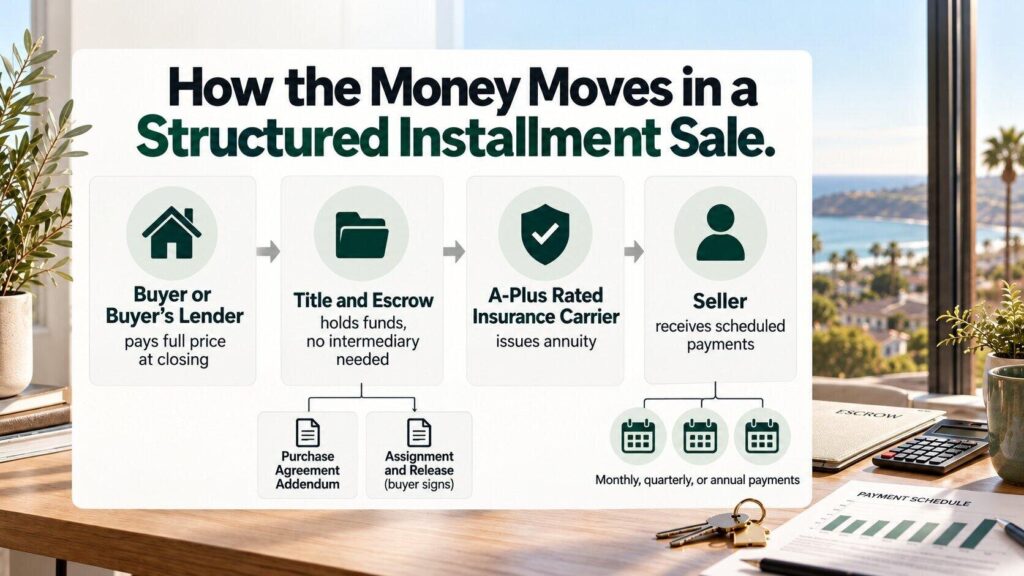
John’s answer: send the money somewhere else first. The proceeds go to an A-plus-rated life insurance carrier. The carrier issues an annuity that pays the seller over a set term. Over 10 years, he estimated $1 million would pay out around $1.2 million. The interest is nice. But it’s not the real win.
“Instead of having $1 million subject to capital gains in one year, you have $100,000 subject to capital gains each year for 10 years. And if you don’t understand the tax code, you’re saying, well, who cares? It’s all the same. I’m paying it now, or I’m paying it later.
But getting to $100,000 puts you in a much lower tax bracket. It depends on what your other income is and other factors. But if we’re talking about the max rate at 37.1%, if we can get that down into the low 20s or the teens that you’re paying your taxes on, that’s a massive savings. That can cut your tax bill in half.”
John Dudek
How Spreading the Gain May Reduce Taxes
Each payment has three parts. Your original basis comes back untaxed. The gain portion is taxed as capital gains. The interest is taxed as ordinary income. And the gain is spread evenly across the term, so no balloon tax bill waits at the end.
The goal is to drop you from the 20 percent federal rate toward 15 percent, or even zero. It pulls you from 13.3 percent state toward 7 or 8 percent. It keeps you under the 3.8 percent surtax threshold. Suddenly you’re paying around 20 to 23 percent instead of 37.1.
What I love is the reframe. The money you would’ve paid the government is now earning interest for you. You keep control of your livelihood for the next seven or ten years instead of writing one enormous check. Run the math with a realistic sale price. If you aren’t sure where to start, get an estimate of what your home is worth today.

What Actually Happens in Escrow and What the Buyer Signs
This is where I needed clarity. My first thought was that buyers would want no part of it.
The flow is simple. The buyer pays the full price at closing, cash or financed, into a regular title and escrow company. Unlike a 1031, you don’t need a qualified intermediary. At closing, the money goes straight to the carrier, such as MetLife, American General, or Independent Life. The seller never touches it.
The buyer signs two things. First, an addendum to the purchase agreement. It states the seller will receive periodic payments, for example, $10,000 a month for 10 years. The second is a non-qualified assignment and release. It moves responsibility for those payments from the buyer to the insurance carrier.
How the Installment Sale Protects the Buyer
Why both? The addendum satisfies the installment sale rules under Section 453. It tells the IRS when the gain will arrive and when it will be taxed. The release protects the buyer. It has zero effect on the buyer’s taxes. For them, it’s just like any other sale.
That’s the big difference from an old-school IRS Section 453 installment sale with seller financing. When my older sellers carry paper, they always ask the same thing. What if the buyer stops paying and I have to foreclose? They don’t want that stress. Here, the seller depends on a carrier like MetLife, which has been around since 1868 and has never missed a payment.
Timing matters too. John likes to get involved before or while the home is listed. That way, the payment plan is ready before an offer arrives, and the buyer’s agent knows what to expect. He also explains on his site how agents, CPAs, and advisors fit into the process.
Designing the Payout Around Your Real Life
I put John on the spot for real numbers. He gave me several, because the right setup depends on the person.
Payments can be monthly, quarterly, or annual. They can start right away or later. They can run 4, 7, 15, or 20 years. You can choose a fixed product with a guaranteed rate. Or you can pick an indexed product tied to the S&P 500 or NASDAQ. The indexed option offers more upside, but you can’t lose your principal.
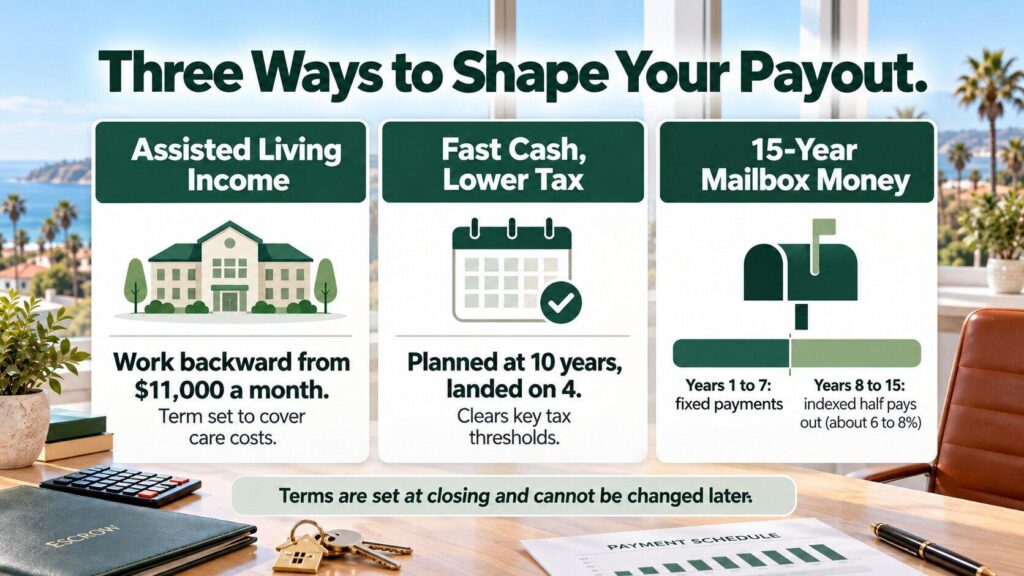
One seller needed $11,000 a month for assisted living. John worked backward to set the amount and term. Another client was real estate-rich and cash-poor. A 1031 wouldn’t produce enough rent. They started at 10 years and landed on four. That still cleared key tax thresholds and got the money in hand quickly.
Creating Retirement Income That Fits Your Needs
A retiree wanted what John calls mailbox money over 15 years. Half paid fixed amounts in years one through seven. The other half sat in an indexed product, earning roughly 6 to 8 percent, then paid in years eight through 15. I loved that. You don’t have to put all your eggs in one basket.
It’s not all-or-nothing, either. On a $1 million sale, you could take $500,000 in cash, pay the tax, and give it to your financial advisor. The other $500,000 goes into the deferral.
What Happens to Payments in Your Estate Plan?
Now, the cautions. Once you set the terms, you can’t change them, and neither can your estate later. If you pass away, payments go to your named beneficiaries with the same tax treatment. There’s no step-up in basis, because the asset is already sold. You can even defer the first payment for up to 50 years, which makes this an estate-planning tool.
Minimums matter. Some carriers start around $100,000. At about $500,000, all of John’s carrier partners become options. He’s candid about the pros and cons of a structured installment sale, and you should weigh both.
Red Flags That Should Stop You Cold
Whenever there’s a way to save on taxes, someone is trying to game the system. So I asked John what you should watch for.
The biggest confusion is that two strategies have similar names. The monetized installment sale was popular for a while. The IRS has since flagged it. It has nothing to do with a structured installment sale, but people lump them together.
The other warning signs are easier to spot than you’d think. John and I both laughed at one pitch he’d heard.
“I think when people are doing these tax deferral strategies, and they’re promised unrealistic returns, sometimes we’ll see them say, I’m doing a structured installment sale; I’m getting 9% on my money over four years. And I’m like, that doesn’t sound right.
The biggest one that I run into is companies and people that are promoting this; they’re not doing it with a name-brand life insurance carrier, like a MetLife or an AIG or an Independent Life. And they’re promising these big returns. And there are a lot of moving parts.
The structured installment sale really is pretty simple. Money goes from the buyer to the insurance carrier, and the insurance carrier pays the seller. So if you get anything that sounds a little too good to be true in terms of return, or very complex, you might want to take a pause and do some research.”
John Dudek
When a Structured Installment Sale Isn’t the Right Choice
My advice is simple. Know who the carrier is. Be skeptical of returns that beat what the market offers anyone. Walk away from deals where trusts or third parties hold your property. And bring your own CPA in before you sign anything. I share more seller tips like this on my Instagram for home sellers.
One more mistake: assuming everyone needs this. Inherited property usually gets a step-up in basis, so the gain disappears. John often tells those families to sell. It only matters when an inherited property sits through probate or years of ownership and appreciates again.
If you’d like to learn this with other professionals, John hosts a free structured installment sale workshop for advisors and their clients.
How I’ll Talk to Equity-Rich Sellers From Now On
Most of my sellers believe they have two choices: write the check or don’t sell. Some think about renting or a reverse mortgage. Now I know there’s another path. John put the bigger picture this way.
“There is no one-size-fits-all. When you ask me for the perfect client, it just depends. What’s your situation? What are you trying to accomplish? What’s your risk profile? What are your other assets? What’s your other income? All those components go into it.
And I like to do this collaboratively. I love working with the realtor to make sure the buyer’s representatives are up to speed on what we’re trying to do. But then working with the CPA, if there’s a financial advisor involved, and a tax attorney, working as a team to put that plan together is really a rewarding experience and lets people walk away feeling good about the transaction, selling usually the most valuable asset that they have.”
John Dudek
That’s what stuck with me. I used to treat capital gains as something sellers sorted out with their CPA after we found a buyer. Now I see it as part of the listing plan. If we talk early, we design the payout before the offer lands.
Plenty of my clients are in their early 60s with a lot of life ahead. My in-laws are in their 90s and still going strong. Either way, this can create income that passes down to kids and grandkids.
So here’s my approach now. When I meet a long-time owner with a big gain, I’ll ask about taxes up front. Then I’ll bring in the team: their CPA, their advisor, and a specialist like John. Several professionals at the table means nobody is acting alone. Before you set a price, review the latest La Crescenta-Montrose housing market numbers so your plan is based on real data.
You can find more conversations like this one on my real estate YouTube channel, and I post seller updates for my professional network on LinkedIn.
Want to hear my entire conversation with John Dudek of Dudek Kelly about how a structured installment sale can turn one massive tax hit into a manageable stream of income? Listen to our podcast episode!
Structured Installment Sale FAQs
Can I defer capital gains on a primary home sale if I can’t do a 1031 exchange?
Yes. A structured installment sale lets you defer capital gains on a primary home sale by sending proceeds from escrow to an insurance carrier. The carrier pays you over time, and you pay tax only on what you receive each year.
How much California capital gains tax do you pay on a $1 million home sale gain?
At the top all-in rate of 37.1 percent, you’d pay about $371,000 as a lump sum. Spreading it as $100,000 of gain a year for 10 years can roughly cut that in half, depending on your other income.
Does the buyer take on any risk?
No. The buyer pays the full price at closing. They sign an addendum, an assignment, and a release that shifts the payment obligation to the carrier. It doesn’t affect their taxes.
What happens to the payments if the seller dies?
Payments go to your named beneficiaries with the same tax treatment. There’s no step-up in basis, and the terms can’t change.
Is there a minimum sale amount?
Some carriers work with as little as $100,000. About $500,000 opens up all of John’s carrier partners. Talk with John Dudek of Dudek Kelly and your CPA to see if your numbers fit. I also answer seller questions on my Facebook page.
What La Crescenta and La Cañada Homeowners Should Know Before Selling
Why are longtime La Crescenta homeowners concerned about capital gains taxes when selling?
Many La Crescenta homeowners purchased their properties decades ago, when prices were considerably lower. As property values increased, so did their potential taxable gains. For homeowners considering downsizing or relocating, understanding the capital gains impact is an important part of deciding when and how to sell.
Can La Cañada Flintridge homeowners sell and turn their equity into retirement income?
A structured installment sale may allow qualifying La Cañada Flintridge homeowners to receive sale proceeds over time instead of in one lump sum. Depending on the arrangement, payments can provide income for retirement or future living expenses while potentially spreading taxable gains across multiple years.
Can a structured installment sale become part of an estate plan?
Yes. A structured installment sale can provide payments during the seller’s lifetime, with remaining scheduled payments passing to designated beneficiaries. However, inherited installment payments generally retain their tax obligations, and the payment terms cannot simply be changed after death. Estate planning and tax professionals should review the arrangement before closing.
When should La Crescenta and La Cañada homeowners explore capital gains strategies before selling?
Ideally, before listing their property. Robbyn Battles works with longtime homeowners to evaluate current market value and selling considerations. A CPA, estate planning attorney, and qualified structured installment sale specialist can then determine whether a tax-deferral strategy supports the homeowner’s financial goals.
What can La Crescenta homeowners learn from Robbyn Battles’ I’m Just Sayin’ podcast about selling a home with substantial equity?
On her I’m Just Sayin’ podcast, La Crescenta listing agent Robbyn Battles speaks with John Dudek of Dudek Kelly about structured installment sales and how longtime homeowners may be able to defer capital gains taxes, create retirement income, and incorporate remaining payments into their estate planning. The conversation explores an option many homeowners have never considered, particularly those who have delayed selling because of the potential tax consequences. Understanding these options before listing can help homeowners make more informed decisions about their property and financial future.
Apply To Be a Guest on the I’m Just Sayin Podcast
Homeowners have more options than they realize, and most have never heard of them. Tax rules haven’t caught up with today’s home values. The professionals who can close that gap are the ones my listeners need to hear from.
If you work in real estate, tax strategy, lending, law, or financial planning and help people make smarter decisions about their biggest asset, I’d love to have you on the show.