

 A house worth millions on paper still cannot pay for a broken window, a new roof, or a rising utility bill. That gap is exactly where so many families get stuck.
I sat down with Mitchell Kraus of Capital Intelligence Associates to talk about that gap, and about what happens to a family when a reverse mortgage outlives the good intentions behind it. I walk through what I learned about reverse mortgages, rewirement, and building wealth at every age — and what it means for anyone about to inherit a house, or sell one.
Curious about this episode? Here’s a quick preview of our conversation:
The Half of the Home-Sale Conversation Most Agents Never Have
As a broker who handles senior home transitions, trust sales, and inherited property for a living, I only ever see half of this story. I see the house. I see the repairs it needs, the offer it gets, the closing date on the calendar. What I don’t usually see is the spreadsheet behind it: the reverse mortgage taken out ten years ago, the sibling who is counting on an inheritance, the accountant who already knows the tax bill is coming.
Most agents stop at the sign in the yard. We market the home, we negotiate the offer, we get to closing, and we treat the money side as somebody else’s job. But by the time a family calls me, the financial decisions that will determine whether this sale actually helps them were usually made years earlier, often without a real estate agent anywhere in the room.
So I asked Mitchell Kraus from Capital Intelligence Associates to walk me through that half of the story: reverse mortgages, rewirement, and building wealth at every age. What I learned changes how I talk to families long before a home ever goes on the market, and it is the conversation I now think every agent working with aging homeowners needs to have.
Watch the full episode here:
The Wealth Manager Who Asks About Your Life Before Your Money
Mitchell Kraus does not open with a bank statement. He opens with an energy audit. Before he touches a portfolio, he walks a new client through their workday: which parts light them up, which parts they dread. That was the first thing that told me he was not the same kind of wealth manager I usually run into when a client’s parents are getting ready to sell.
As co-founder of Capital Intelligence Associates in Santa Monica, Mitchell Kraus, still works alongside his father, who is in his 80s and still in the business. Mitchell is fourth generation in financial services, and he has watched the same money mistakes repeat across three or four generations of the same families. That history is exactly why I wanted him on I’m Just Saying. If you’re an adult child settling an estate, or you’re staring down a $700-a-month Social Security check next to a $5 million house, this is the half of the conversation you’re probably missing.
Connect with Mitchell on LinkedIn or through the Capital Intelligence Associates website.
Why Rewirement Beats Retirement for High Achievers
Mitchell Kraus, CERTIFIED FINANCIAL PLANNER® at Capital Intelligence, told me he prefers the word rewirement to retirement. Once he explained why, I could not unhear it. Retirement literally means to recede, to pull back. Successful people do not find fulfillment in pulling back. They have spent a career hitting goals, and the first Monday morning with no goal to hit is where a lot of his clients fall apart.
The real work, he told me, is not about the number in the account. It is figuring out which part of the job you actually loved, whether that was the money, the connections, or the feeling of helping someone, and then rebuilding a version of your life that keeps that part intact. Mitchell walks new and existing clients through this exact process as part of his retirement income planning work.

For my clients who are 60-plus and facing a home sale on top of everything else, this reframes the whole conversation. Selling the house your kids grew up in is not just a transaction. It is an ending, and Mitchell’s point is that every ending comes with some grief, no matter how financially smart the decision is.
The House-Rich, Cash-Poor Trap I See Every Week
I brought up a conversation I had 45 minutes before we recorded, about a client whose utility bill was crushing him while he sat on millions of dollars in home equity. This is the house rich cash poor retirement story I hear constantly, and it lines up with what recent housing wealth research is finding across the country: plenty of net worth on paper, not nearly enough cash flow to match it. It’s also a version of the same problem Mitchell sees in his wealth management for business owners, whose net worth is often tied up in an illiquid asset, whether that’s a house or a company.
Mitchell Kraus from Capital Intelligence Associates had the same story, except his was a man in his 90s in Santa Monica who bought his house decades ago for $10,000. It is worth $4 to $5 million today. His Social Security check is about $700 a month. His wife had gone blind and knew that house by feel, so leaving was never going to be simple, even though the math said it should be.
“I think that’s sad. I don’t think that you should have to work that hard and have that kind of position in life, and you’re being forced out of your house because you can’t afford your utility bill. I think that’s terribly sad. But there are options. From a philanthropic point of view, there’s a life estate. I’m not a big fan in most cases of reverse mortgages; I think they tend to be predatory, but there’s a way certain people can stay in the house. We’ve had a lot of work with multi-generational families, where the kids have enough money that they help pay the bills and might inherit the house that way.”
This is the exact family I work with constantly as a broker, the ones with all the equity and none of the cash flow. Mitchell’s point is that the fix is not automatically “sell the house.” Every option needs to be weighed against what the house actually means to the people living in it, not just its value.
What a Reverse Mortgage Really Costs Your Heirs
This is the part I wanted every adult child listening to catch, because the reverse mortgage risks for heirs rarely show up until it’s too late to plan around them. Reverse mortgages sound simple: stay in your house, get some cash, don’t worry about it. But Mitchell Kraus, Capital Intelligence’s wealth manager, was blunt that they can be predatory, and the detail most families miss is that many reverse mortgage companies can force a sale if the homeowner ever has to leave, even temporarily.
The bigger problem shows up after the homeowner passes away. Under federal reverse mortgage rules, the loan balance becomes due in full once the last surviving borrower is gone, and heirs typically have to repay it or sell the home to settle it. If the kids cannot refinance fast enough, they end up selling the house anyway, the exact outcome mom or dad took out the reverse mortgage to avoid in the first place. Regulators have flagged this exact breakdown before, reporting that some loan servicers left heirs confused about their deadlines and options at the worst possible moment.
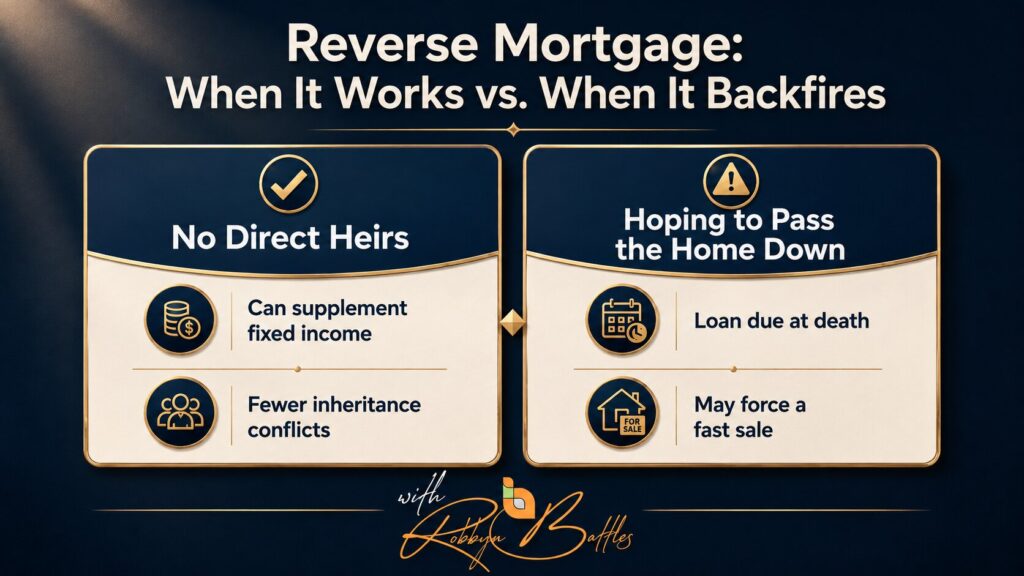
Mitchell’s rule of thumb: reverse mortgages make a lot more sense for homeowners with no heirs, or no one they are specifically trying to leave the house to. If keeping the home in the family is the actual goal, a reverse mortgage can quietly work against that goal, and most families do not find out until it is too late to fix. Mitchell’s team walks families through exactly this trade-off as part of their estate planning process, well before a reverse mortgage application ever gets signed.
Building Wealth Whether You’re 25 or 65
Mitchell Kraus of Capital Intelligence Associates runs his practice on a simple rule. If you are his client, your parents and your kids become his clients too, at no extra charge. That is how he ends up advising four generations of the same family through his firm’s multi-generational wealth and legacy planning work, and it is also how he ends up with a lot of opinions about the financial habits of people in their 20s and 30s.
He was clear about how he sees the advisor relationship, and it is worth repeating to anyone nervous about handing their finances to a stranger, or to any agent trying to gauge whether a referral partner is actually a good fit for a client.
“I tell all my clients that at the end of the day, I work for them, that they’re the CEO of this relationship and I’m the CFO. I’m gonna give them my best advice, show them what best practices are, try to make it specific for them and their family, but at the end of the day, the final decisions are theirs. Now, if they don’t want to listen to my recommendations, I, a CFO, can quit at any time. And of course, if they don’t think my recommendations are good, they can fire me at any time. But the real goal and the real beneficial relationships are the long-term ones, because there are so many unsaid things, little things that don’t come up until you understand how people react when the market’s way up or way down, or when those transitions happen in life.”
His advice for younger clients is almost boring in its simplicity. Capture any employer 401(k) match before doing anything else, because it is free money. Pay down high-interest credit card debt before investing anywhere. And if you are self-employed, take full advantage of the self-employed retirement plan options a business owner gets that an employee never sees.
Solo 401(k)s and SEP IRAs, outlined directly by the IRS’s guide to one-participant retirement plans, let a small business owner set aside far more than a typical workplace plan allows. This is the part of our conversation Mitchell lit up talking about more than almost anything else.
How This Conversation Changed the Way I Guide Families Through a Home Sale
Before this conversation, I handled the real estate side of a senior transition and left the money conversation to whoever the family already had in their corner. Now I ask more questions before I ever put a sign in the yard, because selling a family home after retirement is rarely just about the listing price, and I send families to our own real estate insights resources a little earlier in the process too.
Mitchell Kraus, co-founder of Capital Intelligence Associates, framed a home sale as a genuine transition, not just a transaction, and this is the part that changed how I open these conversations with clients.
“From an emotional, wealth-management point of view, this is the house where you raised your kids, where you had the birthday parties in the backyard, where your dogs have been, where all those great memories have been. That’s not a financial decision. And understanding that transition is what matters, because with every transition, it starts with an end, and then goes to a messy middle, and then a beginning. So selling your house is the end of this lifetime, and then you get this messy middle where you’re trying to figure out who you are without this house. And then my goal is to help my clients create this new beginning, understanding it’s not where they were, but how they make the most of that situation, whatever that might be.”
That is not something I can fix with a listing price. But I can make sure the families I work with have had the money conversation, the reverse mortgage conversation, and the “what does this house actually mean to you” conversation before we are under contract, not after. Anyone weighing this decision right now can also read how one long-term senior seller in our own market recently worked through it, or browse more stories in our Seniors resource library.

Hear my full conversation with Mitchell Kraus as we dig into the house-rich, cash-poor trap and what it really means for families facing a senior home transition. Listen to the complete episode!
FAQ
Can a reverse mortgage really force my parents to sell their house?
Yes. Most reverse mortgages include terms that let the lender require a sale if the homeowner moves out for an extended period, and the full loan balance becomes due when the homeowner passes away, which can force a quick sale if heirs cannot refinance in time.
Is it better to sell an inherited home or keep it in the family?
It depends on whether there was already a plan to keep it. If the goal was always to sell eventually, a reverse mortgage may cause fewer problems. If the family wants to hold onto the home, the terms of any reverse mortgage need to be reviewed with a third party well before the homeowner passes away.
What’s the first financial move for someone just starting?
According to Mitchell Kraus of Capital Intelligence Associates, it is capturing any employer 401(k) match before anything else, since it is an immediate, guaranteed return that no investment can consistently beat.
Apply As A Guest On The I’m Just Saying Podcast
Conversations like the one I had with Mitchell remind me that the best guidance rarely stays inside one profession. A good broker and a good wealth manager are usually asking the same question from different angles: what does this decision actually mean for the people living it? That is the kind of insight I want more of on this podcast, and it is why I keep going back to guests who can speak to both the numbers and the life behind them.
If you have genuine insight into money, real estate, or transitions that change decision-making, I want to talk to you on I’m Just Saying.
My audience is navigating moments like selling a home, planning an inheritance, or finding balance in life.