

Every family I work with eventually asks me the same question: how do we keep Mom in her house without draining every dollar she has? That question is exactly why I sat down with Christina Harmes of Barrett Financial Group’s Reverse Mortgage Division.
She hasn’t written a conventional loan in roughly a decade. That told me she would give me the mechanics instead of the marketing.
If you handle senior home transitions, trust sales, or inherited property, this conversation is what actually qualifies, what triggers a loan coming due, and where the real risk sits.
Curious about this episode? Here’s a preview of our discussion in the reverse mortgage conversation preview clip.
What Made Me Want to Sit Down With a Reverse Mortgage Expert
I’ve spent more than 38 years handling senior home transitions and inherited property sales, and I hear the same fear at almost every kitchen table. Families think a reverse mortgage means losing the house. That fear costs people options they actually have, especially when a client is choosing between staying put, selling, or moving in with an adult child.
I wanted someone who could give me the mechanics instead of the marketing. So, I brought in Christina Harmes. She is the head of the Reverse Mortgage Division at Barrett Financial Group. Christina is also one of about 200 Certified Reverse Mortgage Professionals in the country.
She’s based in San Diego; she’s spent over two decades in real estate and mortgage lending, and she hasn’t written a conventional loan in roughly a decade. What I learned from her changed how I talk to clients about their equity.
Watch the full reverse purchase mortgage conversation here.
The Loan That Changed Christina’s Whole Career
Christina didn’t start out doing reverse mortgages. She got into mortgage work at sixteen, in her stepdad’s brokerage, and spent years writing regular loans before she saw her first reverse mortgage transaction. A husband was facing a terminal diagnosis. His wife had never managed the household finances and was staring down a large IRS bill on top of losing her income when he passed.
The reverse mortgage paid off their existing mortgage, replaced part of the income they were about to lose, and set up a line of credit as a safety net. Christina told me the wife hugged her at closing with tears in her eyes, and that moment reshaped her entire business. She hasn’t written a conventional loan in roughly a decade.
That kind of story is common in this industry, according to the National Council on Aging’s guide to reverse mortgages for older adults, which notes that millions of older homeowners could benefit from tapping home equity but never explore the option because they assume it only applies to people in financial trouble.
Who Actually Qualifies for a Reverse Mortgage
I wanted a straight answer on reverse mortgage for seniors eligibility, because I get this question constantly from clients weighing whether to sell or stay. Christina explained that most borrowers need to be at least 62, though some programs allow 55 and up depending on the state. The property has to be a primary residence, and it can be a single-family home, a condo, certain manufactured homes, or a one-to-four unit building.
Here’s the number that surprised me most. Everyone assumes reverse mortgages work off a flat fifty percent of home value. Christina corrected that immediately. The real equity range runs between thirty and seventy percent, depending on the youngest borrower’s age, current interest rates, the specific program, and the home’s value. That range is consistent with what the Consumer Financial Protection Bureau’s reverse mortgage guide describes as a loan amount tied to age, rate, and appraised value rather than a single fixed percentage.
How a One-to-Four-Unit Reverse Purchase Turns Into Retirement Income
One strategy genuinely surprised me: buying a duplex, triplex, or fourplex with a one-to-four unit reverse mortgage and living in one unit while renting out the others. The buyer has to occupy one unit as a primary residence, but rental income from the other units can make qualifying easier, and there’s no required monthly mortgage payment stacked on top of it.
Christina is currently working a deal where her client sold a larger home, netted enough to buy a four-unit property, and financed part of the purchase with a reverse mortgage. When Christina asked where the client had heard about the strategy, she said she found it on Christina’s reverse mortgage videos covering the HECM for purchase program. That tells me most agents still aren’t presenting this option to downsizing clients who could genuinely use it.
Weighing a Reverse Purchase Against Paying All Cash
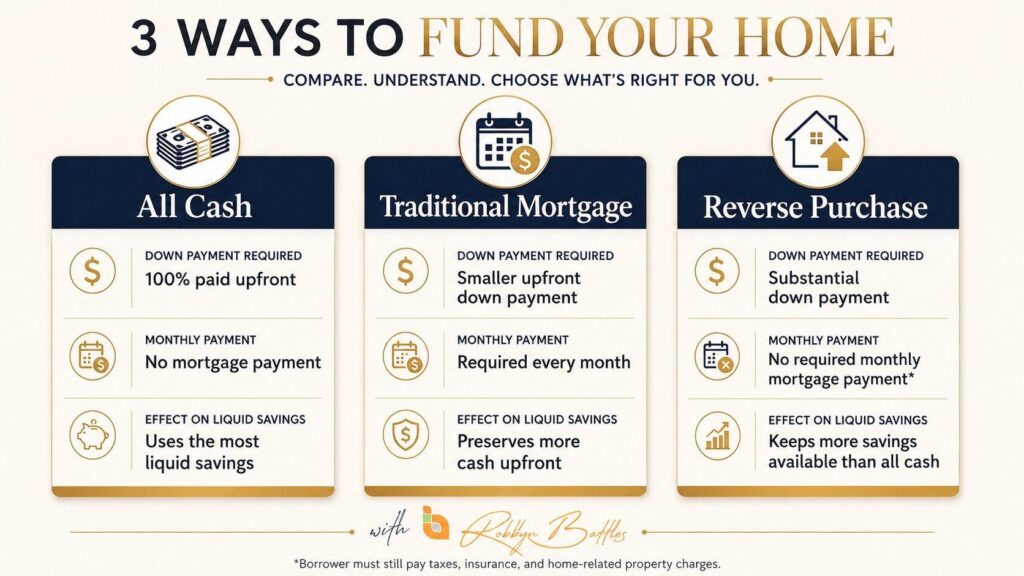
I always ask clients with plenty of cash why they’re so set on paying all cash for their next home. Christina’s answer, built around a reverse purchase mortgage strategy, is the one I now repeat to every seller who’s sitting on strong equity.
“She could put the full purchase price in cash,” Christina explained. “She has the cash; she could do that. She could get a regular mortgage, in which case she’d put some portion of cash down, and the mortgage covers another portion, and then every month she has a monthly payment for the next thirty years. Or she could do the same thing, put a portion of cash down, and have a reverse mortgage cover the rest, where there’s no required monthly payment. Now, everybody thinks a reverse mortgage number is a flat fifty percent of the home’s value, but that’s not accurate. It’s anywhere between thirty and seventy percent equity, depending on age, the youngest borrower or non-borrowing spouse’s age, the program, current interest rates, and the home’s value. And it’s actually been proven that if you do a reverse mortgage early, you can leave a larger legacy and have better retirement outcomes, because when the stock market is down, you’re not pulling from your other assets during that down market. Instead, you pull your income from the reverse mortgage, so your portfolio doesn’t get drained while it’s underwater.”
Most sellers assume a reverse mortgage only makes sense when someone is short on cash. Christina’s clients often have plenty of it, and they use the reverse purchase specifically to keep their liquidity out of the new house. When I list a downsizing client with strong equity, I now walk them through this math, including the home equity estimate that helps set the right listing price, before assuming an all-cash close is automatically the smarter move.
The Widow Stories, and the Law That Fixed Them
The resistance Christina hears most is fear of the unknown, and some of the old horror stories were real. Before 2014, lenders would sometimes put only the older spouse on the loan because the numbers worked better at an older age. When that spouse passed first, the surviving, younger spouse could lose the home because the loan became due. In 2015, federal rules changed to protect a non-borrowing spouse, even a much younger one, so they can stay in the home for life. The Consumer Financial Protection Bureau’s page on protections for reverse mortgage borrowers confirms this shift, and it’s the reason those widow stories don’t happen the same way today.
Christina also pointed out something most families overlook. The number one cause of default on a reverse mortgage isn’t a missed loan payment, since there isn’t a required one. It’s unpaid property taxes and insurance, the same obligation every homeowner has regardless of loan type.
The Life Expectancy Set Aside
That default risk is exactly what a life expectancy set aside solves. The lender calculates the borrower’s life expectancy in months, estimates future tax and insurance costs with a built-in growth factor, and withholds that amount from the loan up front. Those bills then get paid automatically for as long as the borrower lives in the home. Christina called it the most protective option available, even though some borrowers resist it because they want full access to that money right away.
This protection matters more now that insurance costs are climbing in fire-prone markets across California. When premiums double or a carrier drops coverage entirely, a borrower with a reverse mortgage and no required monthly payment is in a stronger position than a borrower carrying both a traditional mortgage payment and a rising insurance bill.
Why Retirees Should Not Rent
I brought Christina a real scenario I’d been sitting on. A couple is selling a home worth about 1.2 million with 400,000 owed, leaving a healthy chunk of equity, and moving into a rental instead of buying again. Christina’s reaction was immediate. Renting in retirement means risking a landlord’s decision to sell, a thirty-day notice, and a forced move at eighty-nine years old, or leaving a surviving spouse to face that alone. A reverse purchase lets that same couple keep their equity, buy a smaller and more affordable home, and still participate in future appreciation instead of paying rent with nothing to show for it. As she put it, most people’s net worth is tied up in homeownership, and a reverse mortgage doesn’t take that away. It lets it continue.
Protecting a Live-In Caregiver When Mom or Dad Passes
Protecting a live-in caregiver is the question I get from adult children constantly, and it’s the part of the conversation that surprised me most.
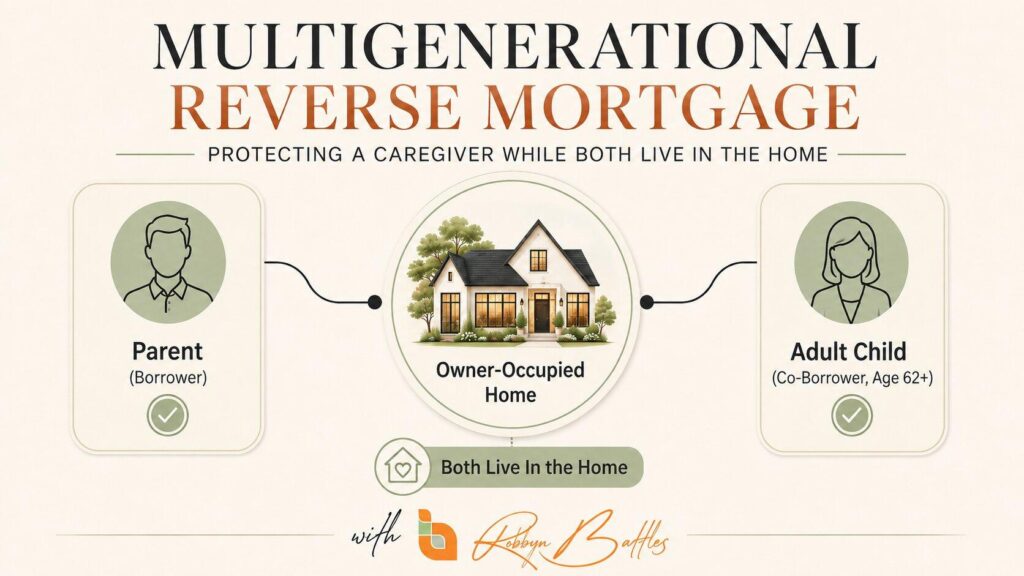
“On a reverse mortgage, it doesn’t have to be a spouse,” Christina said. “You can have multiple borrowers. I’ve had three at once, two sisters and a daughter. It’s often a mother and an adult child, where the son is over age 62, and the mother is somewhere above that. If there’s enough equity and the numbers work, we put them both on as borrowers, so that if one passes away, nothing changes for the other. All borrowers do have to live in the property, so this structure only works when the parent and the adult child are actually living there together as owner-occupants. But that’s exactly what makes multigenerational living so powerful here. I have clients who look for bigger houses specifically so they can all live together, because it solves the cash flow problem and leaves room for in-home care if something happens health-wise to the older generation.”
If an adult child has moved in to care for a parent, the first question to ask is whether that child qualifies as a co-borrower before assuming the home is at risk when the parent passes. The eligibility rule is about age and occupancy, not the family relationship, and Christina’s page on reverse mortgages and adult children covers the qualification details in full.
Seven People, One $900,000 House
Christina is currently closing a loan where a mom in her sixties is selling her home to move in with her son, his wife, and their kids, seven people under one roof. She’ll net about 700,000 from the sale, not enough for the five-bedroom house the family needs, so they’re adding a reverse purchase to bring the total purchase price to 900,000. Because the grandchildren are too young to be borrowers, the family agreed to treat the loan like a regular mortgage payment on paper, paying it down intentionally so the balance shrinks instead of growing.
That’s the part that led to a useful clarification. If a borrower chooses never to pay the accruing interest, the balance grows the way a negative amortization loan does. Christina was direct about that comparison, but she also drew the real distinction: the 2008 crash happened because adjustable rate loans with negative amortization carried a required monthly payment that borrowers couldn’t keep up with once rates adjusted. A reverse mortgage never carries that required payment, so a rate adjustment doesn’t put the borrower’s monthly budget at risk the way it did in 2008.
You Cannot Outlive the Loan
The two misconceptions Christina hears most are that the loan is due after thirty years or once the borrower turns 100. Neither is true. The loan becomes due when the last borrower or protected non-borrowing spouse passes away, moves out of the home permanently, stops paying property taxes and insurance, or stops maintaining the property to FHA health and safety standards. Technically, the note allows the loan to run until the youngest borrower’s 150th birthday, which is really just the industry’s way of saying there’s no fixed term at all.
Borrowers also stay on title the entire time. This is a lien, exactly like any other mortgage, and the difference is simply whether payments are required.
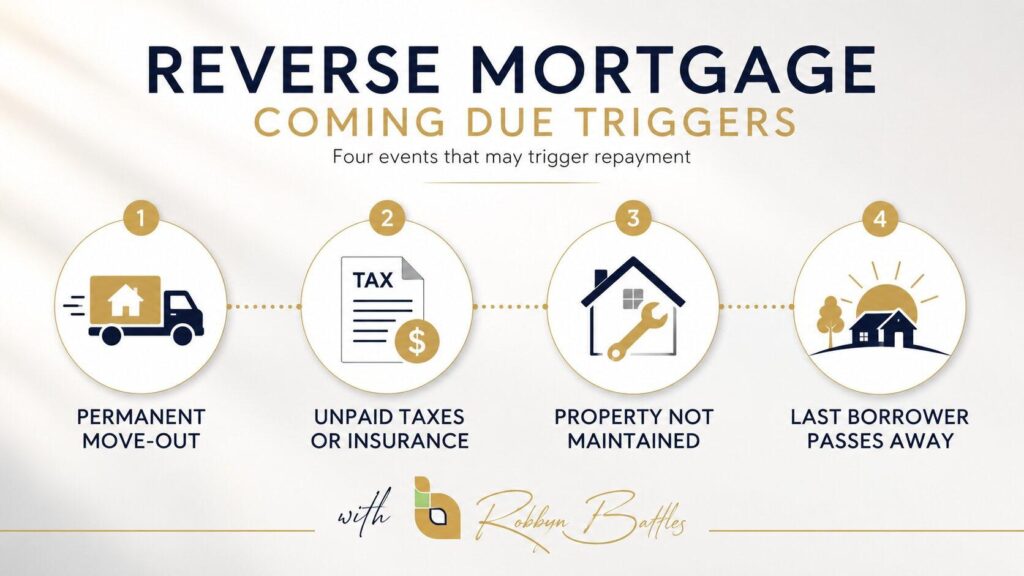
Knowing these four triggers changes how I counsel clients who are timing a move around fear of the loan instead of around their actual needs. Loan officers who don’t specialize in this product often can’t answer these questions clearly, which is part of why Christina’s reverse mortgage myths and facts resource exists in the first place.
Lump Sum or Line of Credit
I hadn’t realized how flexible the payout side of these loans could be. Some programs pay out the full amount as a lump sum. Others pay off the existing mortgage first, then leave remaining funds available as additional draws or a standing line of credit, depending on the numbers.
Christina described a client with high-interest credit card debt and a car loan, paying nearly thirty percent interest on some balances while the reverse mortgage rate sat in the low sixes. She structured his loan to pay off just enough of the high-interest debt, then set up the rest as an untouched line of credit so he isn’t paying interest on money he hasn’t used yet. He’s also expecting an inheritance down the road, and the plan is to pay the balance down to five hundred dollars once it arrives, keeping the loan open as a line of credit instead of closing it outright.
“Equity is their nest egg, which is true,” Christina told me, “but the problem is figuring out how you’re actually going to access it. People sit on this big nest egg like they’re the big mama bird about to hatch this huge egg, and it’s never going to hatch because you’re sitting on it and not accessing it. We’re not telling you to drain every ounce of equity. We’re giving you a portion of it. Maybe you just need to access a hundred thousand dollars to offset the bill that’s keeping you from staying in your house. You don’t need to take all of it out, and you don’t have to repay it unless things get better and you choose to make payments on it. If your house is rich, you are too. You just have to put the thing in place to actually access it.”
What This Conversation Changed for Me
I used to think a reverse mortgage was a last resort for clients who’d run out of options. Now I bring it up earlier, especially with clients who own a one-to-four-unit property, are weighing a reverse purchase against paying cash, or have an adult child living with them as a caregiver. Talking with Christina Harmes at Barrett Financial Group’s Reverse Mortgage Division is what finally gave me a clear, repeatable way to explain it to the families sitting across my kitchen table.
If this conversation raised questions worth exploring further, Christina’s team walks through the full reverse mortgage process step by step, and you can find her breaking down more of these strategies on her reverse mortgage YouTube channel and LinkedIn. You can also follow her updates on Facebook.
If you take one thing from this episode, let it be this: talk to Christina Harmes of Barrett Financial Group before you rule out a reverse mortgage based on a story someone told you secondhand.
Want to hear my entire conversation with Christina Harmes of Barrett Financial Group as she breaks down reverse purchases, caregiver protection, and the real mechanics behind keeping Mom in her house? Listen to our podcast episode!
Frequently Asked Questions
Can a reverse mortgage be used to buy a one-to-four-unit property?
Yes. Reverse purchase loans can finance owner-occupied properties with up to four units, as long as the borrower lives in one of them as a primary residence. Rental income from the other units doesn’t disqualify the borrower and can help with qualifying.
What actually makes a reverse mortgage come due?
The loan becomes due when the last borrower or protected non-borrowing spouse passes away, permanently moves out, stops paying property taxes or insurance, or fails to maintain the home to required standards. It is not tied to a fixed number of years or a specific age.
Can an adult child stay on title with a parent on a reverse mortgage?
Yes, if the adult child is age-eligible, generally 62 or older depending on the program, and lives in the home as an owner-occupant. Multiple non-spouse borrowers are allowed, which can protect a live-in caregiver from losing the home.
What is a life expectancy set aside?
It’s a portion of the loan the lender withholds up front to cover the borrower’s projected property tax and insurance costs for their expected lifespan, with a built-in growth factor. It automatically pays those bills so the borrower doesn’t have to.
Does a reverse mortgage affect who owns the home?
No. The borrower remains the owner on title for the life of the loan. A reverse mortgage is a lien against the property, similar to any other mortgage, with the key difference being that monthly payments are optional rather than required.
Apply To Be A Podcast Guest
Real estate is evolving, and the seniors we serve are sitting on more equity than most families realize how to access. If you work with senior home transitions, trust sales, inherited property, or reverse mortgages and have a strategy or client story worth sharing, apply as a guest on the show below.
Christina and I both learned the same lesson from this conversation: the real risk isn’t the loan itself; it’s staying quiet about it until a family runs out of options. If you can help agents and homeowners have that conversation earlier, I want to hear how you do it.