

Aging feels like decline in our culture. We see a few more wrinkles, a slower walk, a forgotten name, and we assume the worst is right around the corner. My senior clients often say, “I’m too old for that,” “My body doesn’t work like it used to,” and “This is just how it is now.”
But here is what I am learning from my own 84 year old mother and from the experts I bring on this show: so much of what we believe about aging just is not true.
On this episode of I’m Just Saying Let’s Get to the Point, I sat down with Vicki Landers from In Progress Coaching.
We examined ageism in healthcare, the Medicare Advantage trap, and how changing perspectives can improve senior care. Here is what stood out to me as a real estate professional navigating my own mother’s care.
Listen to the full episode:
Beyond the Crisis: Why I Needed This Talk Today
I invited Vicki Landers from In Progress Coaching on my show because I needed real answers. As a real estate professional with over 35 years in the business, I see senior clients every single day. They struggle with the same questions I have for my own mother. How do we know if care is good? Why does insurance fight every step? And why does everyone assume old age means decline?
Vicki Landers is the founder of In Progress Coaching. She holds a Doctor of Physical Therapy and a Master of Health Administration. That combination is rare. She understands clinical care and the broken business systems behind it. You can read more about her background in physical therapy and coaching. She also lives this reality. She is the adult primary caregiver for her 87-year-old mother, who lives in assisted living. She has moved her mother closer to her home in Kansas City, Missouri. She knows the fight firsthand.
According to a 2020 report from the National Academies of Sciences, Engineering, and Medicine, ageism in healthcare leads to poorer outcomes for older adults, including unnecessary disability and higher rates of undertreated pain. This problem sits at the intersection of geriatric care and ageism, where stereotypes about aging directly reduce the quality of treatment seniors receive.
We are not imagining this. The system pushes seniors aside. The World Health Organization global report on ageism also documents how these stereotypes directly reduce the quality of geriatric care across multiple countries.
The Hidden Crisis Inside Healthcare
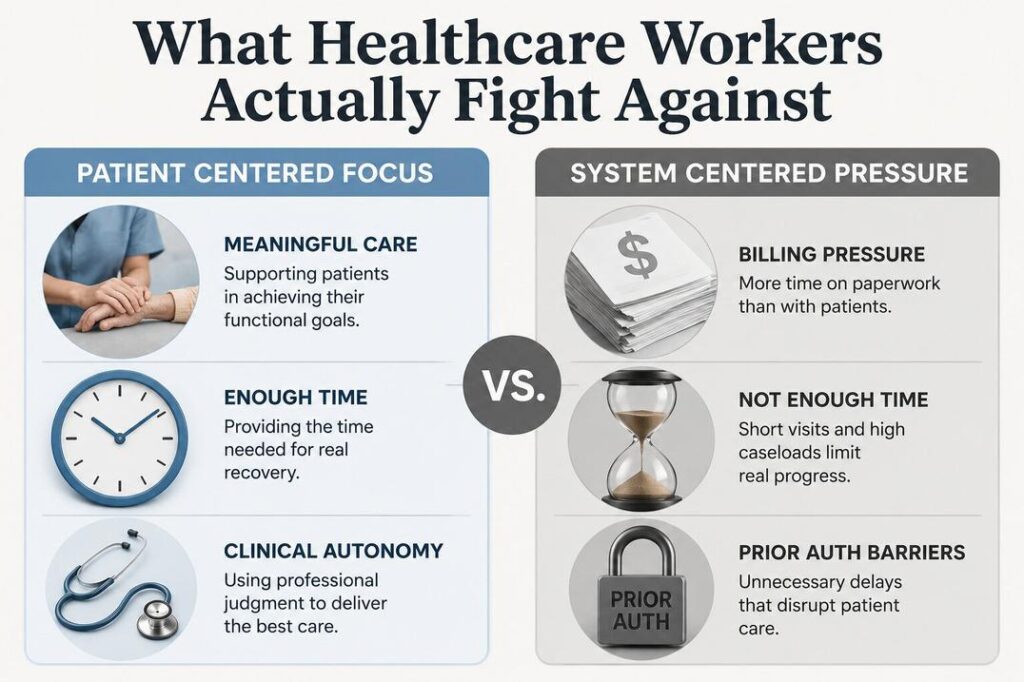
Vicki and I jumped straight into the hard truth. Healthcare feels broken because providers are buried. She told me that for many healthcare workers, actual patient care has dropped to less than half of their job. The rest is documentation, billing codes, and productivity standards.
Think about that. The person who wants to help your parent walks in the door knowing they have 15 minutes and then mountains of paperwork. That pressure does not create good care. It creates exhaustion.
Vicki’s work focuses on healthcare worker burnout solutions that go beyond surface-level wellness programs and address the root systemic pressures.
“Just from a healthcare perspective, we have insurance regulations, we have Medicare, we have Medicare Advantage plans, we have productivity standards, we have reduced time with patients, we have all of these pressures that are happening that have nothing to do with taking care of the patient. The reasons that we went into healthcare in the first place, to take care of people and to help, sometimes becomes 50 percent or less of the actual job that we’re doing. And that’s what exhausting.”
This is why you see doctors leaving private practice. This is why physical therapists burn out. According to the AMA Physician Burnout Report published February 2025, the national physician burnout rate has dropped below 50 percent for the first time in four years, falling from 53 percent to 48.5 percent.
While this improvement is encouraging, the report notes that burnout remains a crisis, and healthcare systems with robust well-being programs saw the largest reductions. The people who went into medicine to heal are drowning in administrative work.
Vicki helps healthcare workers navigate these pressures through leadership coaching for healthcare burnout that restores their sense of purpose.
The One Question That Changed My Lens
Vicki is currently building a presentation on ageism in healthcare. She challenged the most common belief about aging. We assume that once someone hits 80 or 85, they cannot get stronger. We assume frailty is inevitable. She says that is false.
“So many of the things that we believe about aging in the US are inaccurate. I’m putting together a presentation on ageism in healthcare and how we view aging adults. We can get stronger, we can get more flexible, we can get better balance up until the moment we die, as long as there’s not some sort of neurodegenerative process going on that’s impeding the actual physiologic processes within the muscle, the neuromuscular skeletal system. If we continue to be physically active for our whole lives and we don’t stop because I’m ‘too old’ for that, we can actually stay strong and vibrant and engaged in our communities for much longer than people believe.”
I saw this with my marathon training. I ignored my feet for years. I blamed my ankle, then my knee. The problem was my foot. That is the foundation of everything. Seniors are the same. Vicki agreed that many therapy visits do not spend enough time on the feet. But the bigger issue is not the therapist. It is the visit limit.
The National Institute on Aging strength training guidelines confirm that older adults can build muscle and improve balance well into their 80s and beyond. This matters for real estate professionals. When you help a senior prep a home for sale, do not assume they are incapable of physical improvement. Encourage functional staging.
This is where aging in place modifications become essential. Simple changes like grab bars in bathrooms, lever-style door handles, and removing trip hazards can keep seniors safer and more independent for years longer than people expect.
Suggest they keep walking. And when a client tells you they “just have to live with” pain, connecting them with experts like Vicki can improve their quality of life during a stressful move. You can learn more about her approach in her keynotes on ageism in healthcare.
The Medicare Trap You Cannot Ignore
I asked Vicki the question every adult child wants answered. How do we make sure our parents get real care? Her answer forced me to understand the critical differences between Medicare vs Medicare Advantage. She told me to look very closely at Medicare Advantage plans.
“When people are getting to the point where they are qualifying for Medicare, so we’re getting to the 65 years of age, I really encourage them to take a very close look at these Medicare Advantage plans that are promising them the moon. Because what happens is they promise the moon, and then as soon as you actually need care, prior authorization shows up. Limits on the number of visits show up. Limits on which physicians you can see. Procedures or medications are getting denied because it’s not on the formulary. I tend to say that Medicare traditional is going to get you better care in a more timely manner than any Medicare Advantage plan. When you actually come to needing your care, it’s too late to switch back to Medicare traditional, and you may not get what you want.”
That stopped me. My mother has private insurance, but I know so many seniors who chase the Advantage promises. Free gym memberships. Vision and dental. It sounds good. But when a hip breaks or a stroke happens, those plans fight every step. Prior authorization delays can push rehab past the critical window. By then, it is too late to switch back.
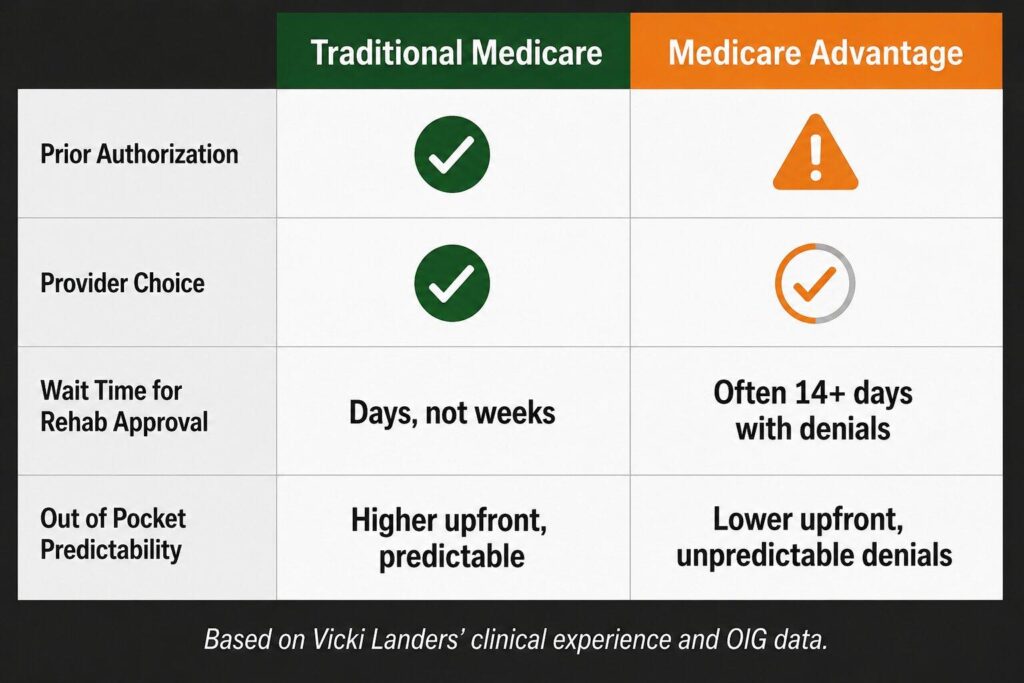
A KFF analysis from January 2026 found that Medicare Advantage plans denied 7.7 percent of prior authorization requests in 2024. More concerning, while 80.7 percent of denied requests were overturned on appeal, patients appealed only 11.5 percent of denials.
This means thousands of seniors likely received unnecessary denials without ever fighting back. For teams dealing with these systemic issues, Vicki offers a resilience and advocacy skills workshop for clinicians designed to build resilience and advocacy skills.
If you are helping a senior client navigate a home transition, community stories like these can prepare you for the real conversations that matter.
Shifting the Lens: The Real Power You Own
We talked about mindset. Vicki does not just teach exercises. She offers mindset coaching for professionals that changes how they show up to work every single day, whether they are nurses, doctors, or real estate agents.
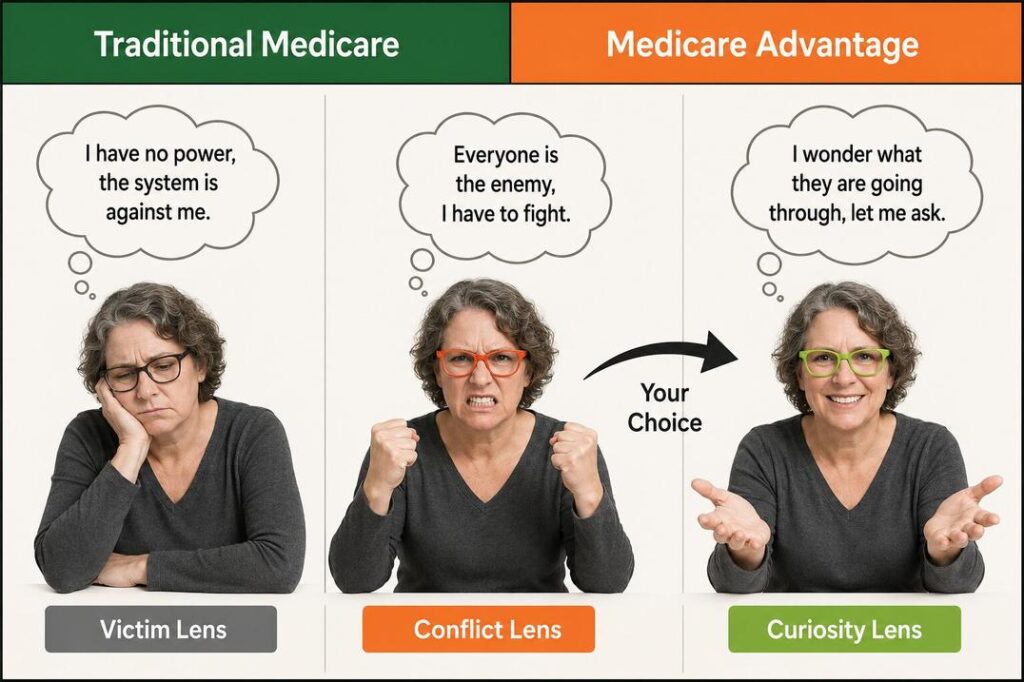
“There are lenses that we can choose that aren’t nearly as exhausting as that victim or conflict lens. It’s more of a tolerance or compassion or curiosity. Believe it or not, those lenses are our choice. We have so much more choice when we show up every single day, and this isn’t just healthcare professionals; this is everybody. If I put out anger, I’m going to get anger. If I put out curiosity, I’m much more likely to get something that’s a better experience for me and the patient or me and my coworkers. You have more power over who you are. Let’s take that back and not give it away to the insurance companies or the administration.”
This applies to real estate agents as much as nurses. When a seller is anxious, you can wear a conflict lens and fight back. Or you can wear a curiosity lens. What is really scaring them? When a buyer is demanding, you can play victim. Or you can ask what they truly need. The American Psychological Association research summary on ageism shows how age-based stereotypes reduce treatment quality and increase healthcare costs. Changing our lens changes outcomes.
Vicki referenced the work of Dr. Elizabeth Potter, a plastic surgeon, testifying before Congress to change healthcare legislation. One person cannot fix the whole system. But one person can change how they react inside it. You can connect with Vicki directly on Vicki Landers LinkedIn profile for professional coaching, where she personally responds to messages. Her mindset coaching workshops for healthcare workers are also available for groups wanting to learn these mindset shifts together.
Reclaiming My Advocacy: My Personal Pivot
I am my mother’s best advocate. But after talking to Vicki, I realized I need to advocate for her doctors, too. A simple thank-you note to a physician can change the energy of an appointment. Small gestures matter.
I am now looking for a geriatrician. That is a primary care doctor who specializes in aging adults. They look at the whole picture. They check how medications interact with an aging liver and kidneys. They are hard to find, and waiting lists are long, but they exist. Most academic medical centers have geriatrics departments.
Vicki also reminded me that real estate is not just about houses. It is about transitions. The second half of life is not about location, location, location. It is about advocacy, advocacy, advocacy. If you are wondering what your home is worth in today’s market, that is a financial question. But the deeper question is whether your home still serves your health. Stay updated on market news that affects senior clients and their families.

Want to hear my full conversation with Vicki Landers on ageism, Medicare traps, and coaching healthcare workers? Listen to the episode now.
FAQ
What is a geriatrician?
A geriatrician is a primary care physician who specializes in complex aging needs. They consider how different medications interact with an aging liver and kidneys. They focus on function, not just diagnosis.
Can you really build muscle in your 80s?
Yes. Unless a specific neurological condition blocks the process, the neuromuscular system can build strength and improve balance at any age through consistent, appropriate activity.
Why does Vicki Landers recommend Traditional Medicare?
Traditional Medicare offers more provider flexibility and avoids the prior authorization delays common with private Medicare Advantage plans. Those delays can stop urgent rehab or surgery coverage.
Final Thoughts
I walked away from this conversation with Vicki Landers feeling less alone. The system is hard. Aging is not for the faint of heart. But we have more choices than we realize. We can choose our lens. We can advocate fiercely. And we can help our senior clients do the same.
To learn more about Vicki’s work, visit her main site at In Progress Coaching for healthcare professionals or Vicki Landers professional speaking and coaching website.
Apply as a Guest Speaker
Real estate is evolving. Capital is shifting. Markets are tightening. At the heart of every transaction are families navigating complex life transitions. If you are actively working in the industry and solving real problems in construction, finance, brokerage, or development, we want to hear from you.