


A senior move rarely falls apart over boxes or bubble wrap. It falls apart over a torn recipe card, a broken hammer, or two hundred paper clips nobody can quite explain. Those are the things that stall a family for months.
I talked about exactly that with Marty Stevens-Heebner of Clear Home Solutions on my podcast, I’m Just Sayin’. Marty has spent more than a decade helping families sort through the belongings that keep a house from selling and a family from moving forward.
Curious about this episode? Here’s a quick look at our conversation:
The Personal Property Barrier Nobody Talks About
I sell real estate. I do not sell empathy training. But after this conversation, I think the two might be the same job.
Marty founded Clear Home Solutions more than 13 years ago. Her explanation of what her company does has stuck with me since we recorded. Realtors take care of the structure of the home. Marty’s team takes care of everything inside it. Most people call that stuff. Legally, it’s called tangible property. And according to Marty, it is very often the real reason a move stalls.
Watch the full episode here:
That’s not a small claim. It’s backed by an entire industry built around it. The National Association of Senior & Specialty Move Managers exists specifically because so many families hit this same wall, the wall of thousands of small decisions buried inside one house. Marty served as that organization’s president for four years.
I’ve seen this senior move manager barrier firsthand with my own clients, which is part of why I wrote about what a senior move manager actually does after watching two families handle the same transition in completely different ways.

Here’s what struck me most. Marty doesn’t walk into a home and start deciding what stays. She starts by sitting down. That single choice, to sit rather than sort, is the whole philosophy behind Clear Home Solutions’ tagline: where compassion meets know-how.
Meeting With a Move Manager Isn’t a Commitment
A lot of families avoid calling anyone for help because they assume the call itself is a commitment. Marty was clear that this isn’t true. A first meeting is a free, no-obligation consultation. Nobody is deciding anything on that call except whether they feel comfortable in the room.
That distinction matters more than it sounds. Downsizing an aging parent often stalls not because of logistics, but because families dread the first conversation more than the actual sorting. Professional organizers see this pattern often enough that their trade association, the National Association of Productivity & Organizing Professionals, has built entire certification tracks around managing exactly this kind of transition with sensitivity.
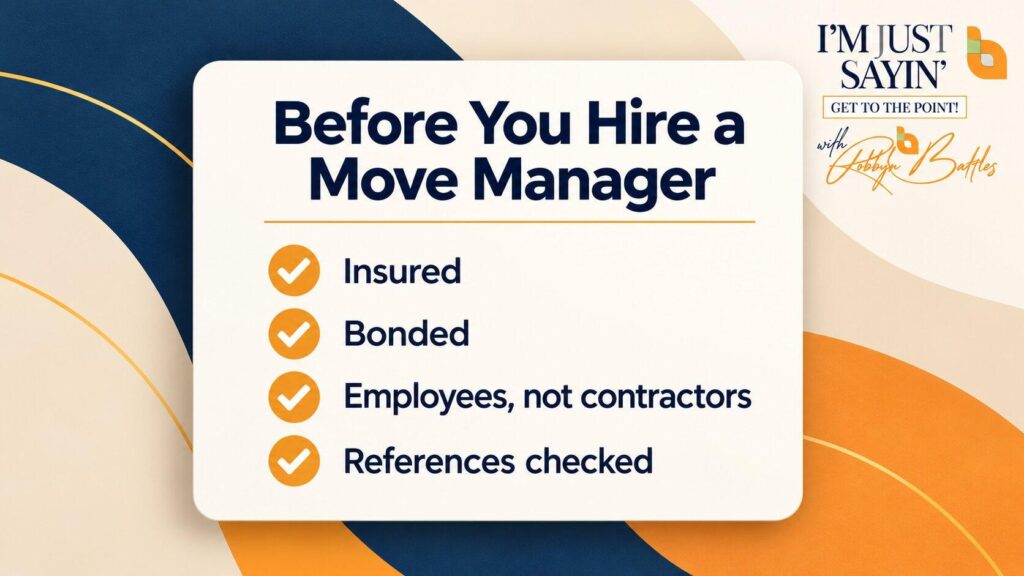
Marty’s advice for choosing help goes further than comfort, though. Meet more than one company. Check that anyone working in the home is insured and bonded. Confirm the people coming into the house are employees, not contractors, since that changes who’s covered if something goes wrong. It’s the same due diligence I recommend before hiring anyone to touch a client’s home, and it applies just as much to professional organizing services as it does to a moving crew.
The Stuff Fights Are Never Really About the Stuff
This next part of our conversation is the one I keep coming back to. Marty broke down what she calls the four pillars of an estate, and it reframed something I’d suspected for years but never heard put quite this plainly.
“There are four pillars to the estate. There’s the legal pillar, working out who gets what officially. There’s obviously the financial pillar, all the money that’s in the estate, real estate, that part of the estate, and then the tangible property part of the estate, the stuff. And people will fight over the money and things like that, but the knockdown, drag-out fights will be over that broken hammer Dad used to build my crib. It will be the torn-up recipe book that has the Christmas recipes and all this writing from either grandma or mom. It’s all those personal items that people are just loaded with emotion. The highly emotional parts of it are what trigger everybody.”
I’ve watched families argue over a coffee table and barely blink at splitting six figures. It never made sense to me until Marty explained why. Money is abstract. A torn recipe card is not. It’s proof someone existed, cooked, mattered.
This is exactly why an estate clear-out needs more patience than a checklist can offer. It’s also why I’ve written before about how California probate law can quietly complicate an estate long before anyone even gets to the boxes in the garage. The legal pillar and the emotional one are rarely separate problems. They’re the same problem wearing different clothes.
Marty mentioned that her team has built a tool, Clear Move Coach, that applies this expertise, drawing on 13 years of move management experience, so families can get answers even outside business hours.
How to Help a Parent Downsize Without Taking Over
If there’s one thing Marty said that applies far beyond moving, it’s this. The work isn’t deciding for someone. It’s asking better questions so they can decide for themselves.
She asks clients what they want their life to look like five or ten years from now. Not what they’re giving up today. What they’re moving toward. That single reframe changes the entire emotional tone of a transition, from loss to intention.
Marty was direct about the one skill she looks for above all others when hiring her own staff, and it isn’t a technical one.
“The first thing I look for when I’m hiring people for our field staff is empathy. That is the hard skill. You can learn how to code, honestly. Can you learn how to build something? I have my own power tools. You can learn all of that. You cannot learn empathy. And it is understanding where that person is coming from, being able to imagine that and understand how to speak to it, and understanding how to listen, how to discern what’s really going on with your client. No situation is the same. That whole fear, it always comes from different places and experiences in people. And letting them tell their stories- those stories are amazing, and letting them tell the stories, they love telling them. And that helps build the trust, because when we go in there, it’s not, okay, you’re going to shove me out the door. We’re going to sit here and talk with you and work gently through things to find out again what your favorite and most useful items are.”
That’s not a soft skill. It’s the entire job. Research backs this up too. A study out of Baylor University’s Keller Center on how older adult couples make downsizing decisions found that couples consistently said deciding to relocate was easier than deciding which personal items to keep. The move itself isn’t the hard part. The stuff is.

That stress isn’t anecdotal, either. Zillow’s own research on moving stress found that more than half of recent movers reported real stress and anxiety during the process, and a large share said emotional factors actually delayed their move altogether. You can follow more of Marty’s field notes on her Instagram, where she regularly shares the kind of client moments that don’t make it into a checklist.
The One-Drawer Method That Makes Downsizing Feel Possible
Here’s the part of our conversation I think every family should bookmark. Marty’s advice for actually starting isn’t complicated. It’s just counterintuitive.
“One of the things I’ve mentioned is your favorite and most useful items. For example, if you go in your clothes closet, which is probably your main bedroom, the things you wear all the time, those are going to move with you. So put those in one area of the closet. Go through them and be honest, you know, have I worn all of these in the last few months? Then with the rest, go through and ask yourself these questions. Have I worn this in the last year? Is there anything ripped or torn or in disrepair? Don’t say, ” Oh, I’ll have it fixed; it’s probably been that way for a couple of years. Let it go. If it doesn’t fit, let it go. I always say block out, especially when you’re just starting to do this, an hour of time, or just pick that one cabinet. And when you’re done, either with the cabinet or that hour, you’re done. So it’s finite. And play fun music, music that makes you move, that you really enjoy. Train your brain to think of this as, oh, this will be great, this is fine, and it’s limited. And then you see the progress, because if you’re just focused on one thing, that’s such a win.”
Most people try to tackle an entire house in one weekend. Marty’s clients tackle one drawer. The house never looks finished either way, but only one approach lets you feel the progress.
For items with real resale value, Marty mentioned partnering with online auction platforms like MaxSold to help families liquidate estate contents fairly and transparently, without the pressure of a traditional estate sale. It’s one more resource I didn’t know existed until this conversation, alongside plenty of others Marty connects families to through Clear Home Solutions’ hoarding cleanup services when a situation calls for extra care.
If your family is navigating memory loss alongside a move, I also covered a related conversation about when families wait too long to have the Alzheimer’s conversation, which touches on a lot of the same emotional terrain Marty and I discussed. You can find more of Marty’s own professional background on her LinkedIn.
What This Conversation Changed About How I Show Up for Clients
I sell houses. I don’t sit with families while they sort sixty years of photographs. But this conversation changed how I think about the houses I list.
When I walk into a home now, I try to remember it’s not square footage. It’s someone’s proof of a life. Marty said something near the end of our talk that I haven’t been able to shake. She talked about the moment right before a house sells, standing in the empty rooms one last time, letting the memories flow through you instead of fighting them. That farewell matters just as much as the paperwork.
That’s the real lesson from Marty Stevens-Heebner of Clear Home Solutions. A senior move isn’t a logistics problem wearing a moving truck. It’s a family working through grief, memory, and identity, one drawer at a time. If you’re navigating a similar transition, I’ve also written about how two retiring couples I worked with had completely different sets of questions going into the same kind of move.
You can catch more conversations like this one on my YouTube channel, or follow along on Instagram for the shorter clips between episodes.
Want to hear my entire conversation with Marty Stevens-Heebner of Clear Home Solutions about why the stuff, not the logistics, is what really slows down a senior move? Listen to our podcast episode.
FAQ
How can I help my parent sort belongings without taking their control away?
Don’t decide for them. Marty’s approach is to ask questions that help someone identify what they actually value and use, rather than handing them a checklist someone else already filled out. The control stays with them. Your job is just to ask better questions.
What should I do when downsizing feels too overwhelming to start?
Pick one cabinet, one drawer, one closet, or a single hour, and stop once that piece is done. Marty Stevens-Heebner of Clear Home Solutions points to this exact approach as the difference between visible progress and a house that never looks like it’s moving anywhere.
What should families check before hiring a senior move manager?
Meet with more than one company first. Pay attention to who you actually feel comfortable having in your home. Then confirm insurance, bonding, and whether the people working in your house are employees rather than contractors, since that changes who’s covered if something goes wrong.
Apply as a Guest on the I’m Just Sayin’ Podcast
Every home holds decisions most people never planned for, and every guest on this show brings a different way of helping families work through them. If you’re a professional who helps people navigate a move, a transition, or the emotional weight of letting go of a home, whether that’s real estate, care management, or one of the resources Marty described in this episode, I’d love to hear your story.