

Robbyn Battles The House Agent Patrick Murphy Glendale City Council Candidate I’m Just Saying Podcast
Let me tell you something I do not say lightly: this is one of the most important conversations I have had on this podcast.
Not because it was the most polished or the most rehearsed. Because everything Patrick Murphy and I talked about is happening right now, on the streets we drive every day, on the bills sitting on our kitchen counters, and inside planning documents most residents have never seen.
I have been selling real estate in the Glendale foothills for over 38 years. I know this community the way you only can when it is genuinely home. When things started not adding up, I did what I always do: I started asking questions. He has been asking the same ones, and he decided that Patrick Murphy for Glendale City Council was the only way to actually do something about it.
Why I Had This Conversation
I have lived in the foothills my whole life. I know every side street, every merchant in Montrose, and every fire road that becomes a lifeline when the hills start burning.
So when decisions started coming down from the dais that made no sense for the people actually living up here, I could not just scroll past it.
Patrick Murphy could not either. He is a 41-year commercial real estate professional who got pulled into Glendale politics through a neighborhood meeting held in someone’s front yard about the Verdugo Wash project. What he saw sitting through city council meetings after that kept him coming back.
Spending that did not add up. Projects that hurt the very communities they claimed to serve. A public kept in the dark about decisions that would reshape their neighborhoods for decades.
He is now running for a seat on the Glendale City Council representing the northern corridor, and he is the first candidate from up here in the foothills in over a decade. With the Glendale city budget crisis hitting residents from every direction, I have a responsibility to understand what is coming — and his 3 priorities to fix Glendale made it clear he does too. That is exactly why I wanted him on the show.
Here’s a quick clip from our conversation:
You can catch the full conversation on I’m Just Saying with Robbyn Battles right here:
The Budget Nobody Is Talking About
Here is the number that stopped me cold when Patrick said it out loud.
In 2020, Glendale’s budget was $840 million. By 2024, it had climbed to $1.3 billion. That is a 55% increase in four years while the city’s population actually dropped from 197,000 to 188,000.
More money. Fewer people. And a $34 million deficit this year that got patched down to $4 million but never actually went away.
The Glendale city budget crisis is not something coming down the road. It is already here, and most residents have no idea.
Patrick compared Glendale to Huntington Beach, a city with roughly the same population, the same retail square footage, and a similar footprint. Huntington Beach runs its entire city on a $500 million budget. Less than half of ours.
That comparison alone should be the talk of every neighborhood meeting in Glendale right now.
Patrick calls the spending pattern that got us here “vanity projects,” money driven by ideology rather than actual community need, the same ideology quietly driving SB 79 housing density in Glendale. The clearest example is the North Brand Boulevard bicycle demonstration project: six tenths of a mile of protected bike lanes, two traffic lanes removed, and $1.8 million spent.
The outcome was more accidents, fewer cyclists, cut-through traffic flooding residential streets, and slowed fire response times from a station that handles 36 calls per day. Fire Chief Fish came before the council and said the project had become a life safety issue.
The vote to remove it passed four to one. One council member voted to keep it.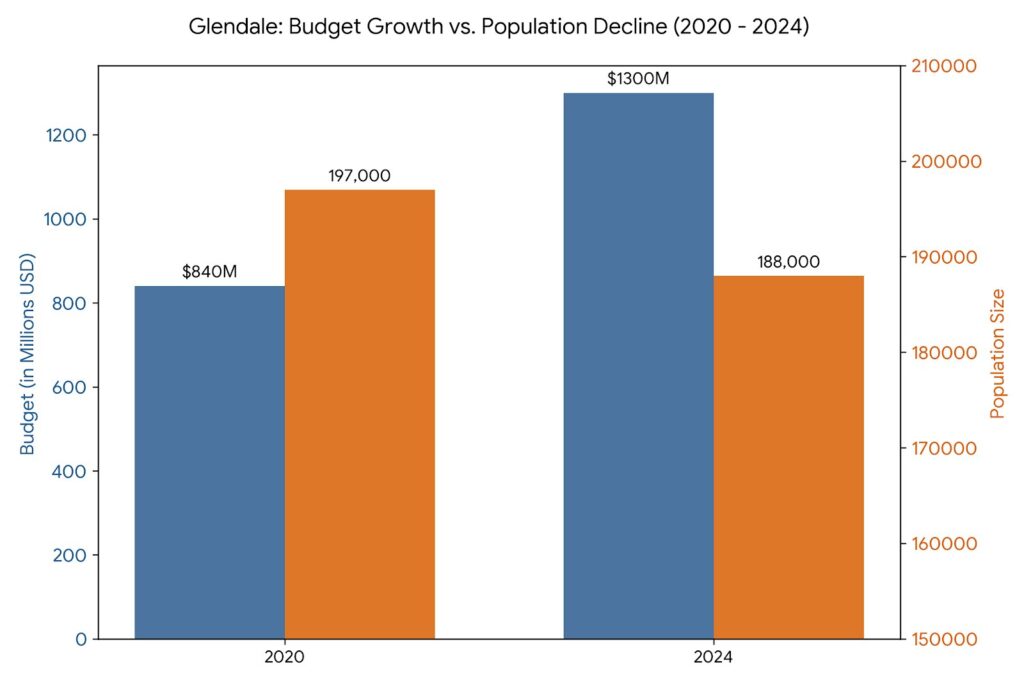
There are over 90 contracts the city signed in the last three years worth over $1 million each. Three were audited. Three.
The audit committee meant to provide oversight meets once a quarter while every other city commission meets monthly. Patrick put it best: if you are not going to take the test, why are you studying for it?
BRT and SB 79: The Existential Threat to Glendale Neighborhoods
Patrick used the words “existential threat” and I want you to understand exactly why he meant it.
Most residents have heard the term BRT bus rapid transit Glendale California floating around without fully understanding what it means for their street or their home value. Let me break it down the way Patrick broke it down for me.
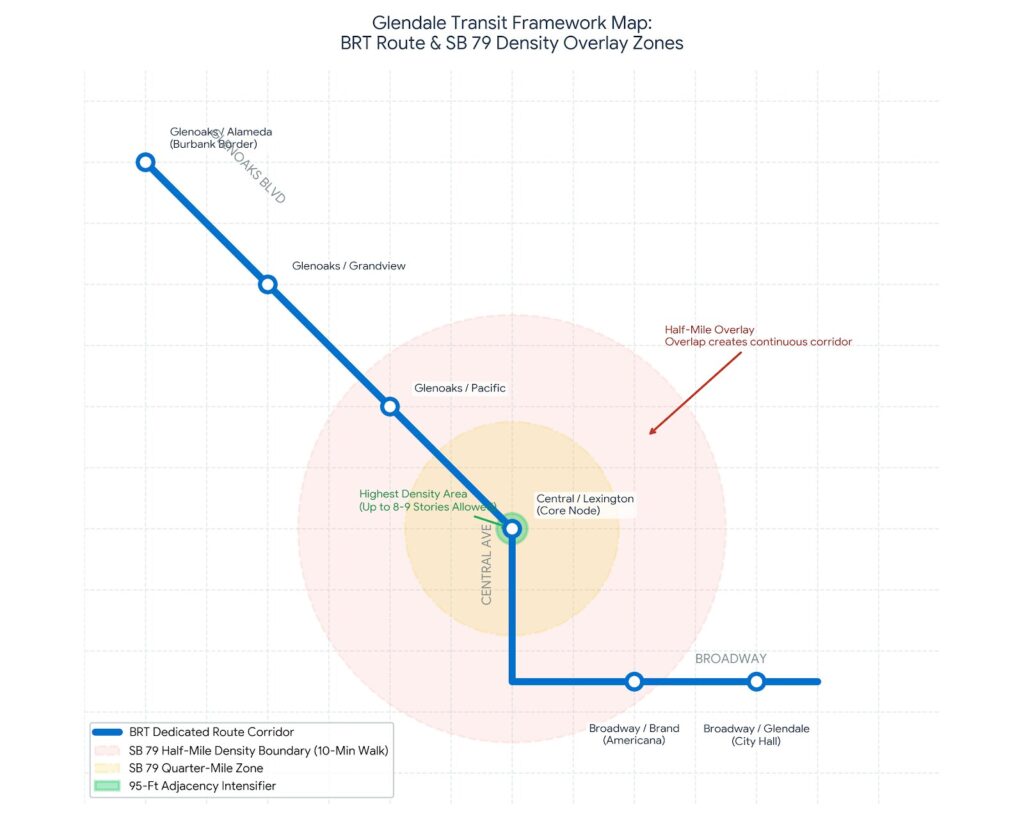
The BRT line runs from the Burbank border at Alameda and Glen Oaks, down through Central, south to the freeway, and along Broadway into Eagle Rock. It operates with dedicated bus lanes through much of that corridor, meaning existing traffic lanes are removed and handed exclusively to buses.
On its own, that is already a serious disruption. Paired with SB 79 housing density Glendale, it becomes something far more serious.
SB 79 triggers density development rights wherever a BRT bus stop exists. Within 95 feet of a stop, developers can build nine stories. Within a quarter mile, seven stories, with single-family zoning eliminated completely. Within a half mile, five stories, all with no parking requirement and density bonuses stacked on top.
“SB 79 in conjunction with the BRT is an absolute existential threat to our city, through the entire city. Wherever there is a bus stop on this BRT dedicated bus lane, SB 79 kicks in. Within 95 feet, they can build nine stories. Within a quarter mile, they can build seven stories, taking out single family residential zoning. All with no parking requirement.” — Patrick Murphy, Glendale City Council Candidate
Now picture that playing out from Glen Oaks through Central to Broadway. That corridor runs directly past the Glendale Galleria and the Americana, two of our most important sources of sales tax revenue.
Remove traffic lanes for dedicated buses, trigger nine-story no-parking towers the full length of the route, and you do not solve a housing crisis. You strangle retail, overwhelm infrastructure, and demolish neighborhoods that took generations to build.
Pasadena has zero dedicated bus lanes on the BRT route. They got involved early during the environmental review scoping process and negotiated their way out. Burbank secured a cooperative agreement with Metro that protects their cost exposure.
Glendale did neither. And Glendale has more dedicated bus lanes and more BRT stops than any other city on the line.
I will tell you what I told a client recently. She asked about a property across from the DMV on Glen Oaks Boulevard. I looked at the BRT route, looked at what SB 79 would mean for that corridor, and I told her not to buy it. That is not me being a NIMBY. That is me doing my job.
The Montrose Parking Lots and Why This Fight Is Personal
If you have ever spent a Saturday afternoon in Montrose Shopping Park, you already understand what is at stake here.
You pull into one of those big lots behind the storefronts, walk the shops, grab something to eat, and run into someone you have not seen in months. That whole experience does not happen without parking.
Right now, those lots are being targeted.
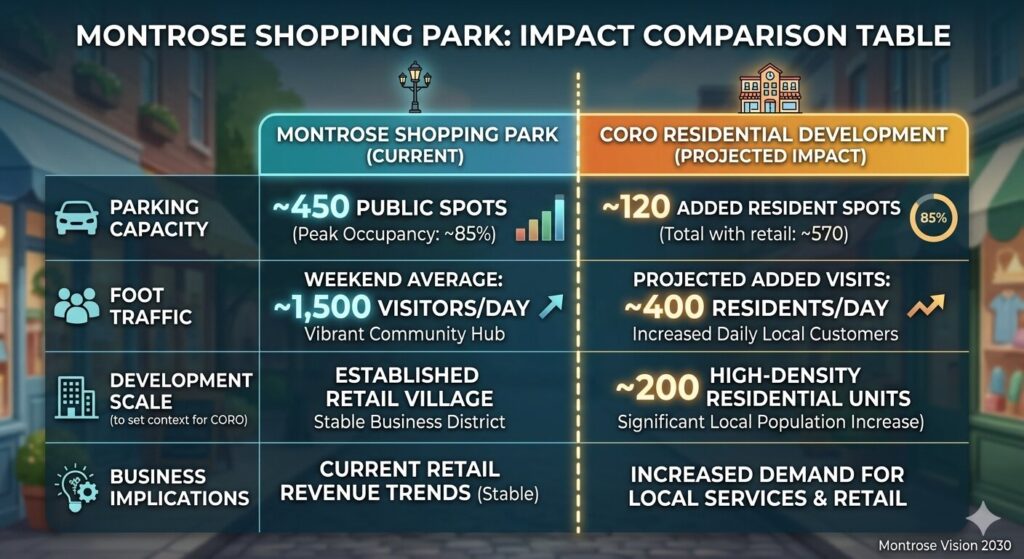
The Montrose parking lots development plan lives inside something called the CORO, or City-Owned Residential Overlay. It is buried inside the current draft 20-year land use element, and it proposes converting publicly owned parking lots in Montrose and along the Verdugo corridor into high-density multifamily residential.
The city’s argument is that selling or land-leasing these parcels will help close the budget deficit. Patrick’s counter, backed by 41 years of retail real estate experience, is that it will make the deficit worse.
Montrose’s retail drives sales tax revenue. Sales tax revenue funds city services. Remove the parking, lose the customers, erode the tax base, and the very move meant to plug the budget hole digs it deeper.
“The inverse consequence is if you take away the parking lots in Montrose and put residential on them, you’re going to lose sales tax revenue. And if you lose sales tax revenue, we’re going to be in a bigger budget hole. The merchants are absolutely opposed to this. They don’t need the housing. They need the parking.” — Patrick Murphy, Glendale City Council Candidate
The same story is playing out along the Verdugo corridor, where the city wants to place high-density residential on parking lots near Verdugo Park, the Civic Auditorium, and St. Gregory’s Church.
If you want to understand how the funding behind these projects actually works, I broke it down in detail when covering how affordable housing funding works with the Abode Communities Briggs and Foothill project. The HOAs in Rosemont Mountain and Royal Canyon have pushed back hard, and for good reason.
I grew up in Montrose. I have watched it change over the decades, and the changes that worked were the ones that understood the neighborhood. The Montrose parking lots development push is just the latest example of a decision made by people who have never spent a Saturday afternoon there.
What makes this even harder to stomach is that the same residents fighting to keep their neighborhood intact are also the ones being squeezed by Glendale electric rates. Residents up here are not dealing with one problem. They are dealing with several hitting them all at once.
Here is the number that says everything about the disconnect between this council and this community.
The city held two official meetings about their 20-year land use plan, a plan that would push Glendale’s population to 450,000 people in 31 square miles. Those two meetings drew a combined total of nine members of the public.
Patrick then worked with the Montrose Shopping Park Association and neighboring HOAs to organize one town hall at St. Gregory’s Church. Over 200 people showed up on a weeknight.
Nine versus 200. That is not apathy. That is what happens when you actually tell people what is going on.
Electric Rates and the Grayson Power Plant Decision That Cost Us Everything
I want to be clear about something before I get into this section. The Glendale electric rates residents are paying right now are not the result of bad luck or some unavoidable market force.
They are the direct result of a political decision that cost this city hundreds of millions of dollars more than it ever had to.
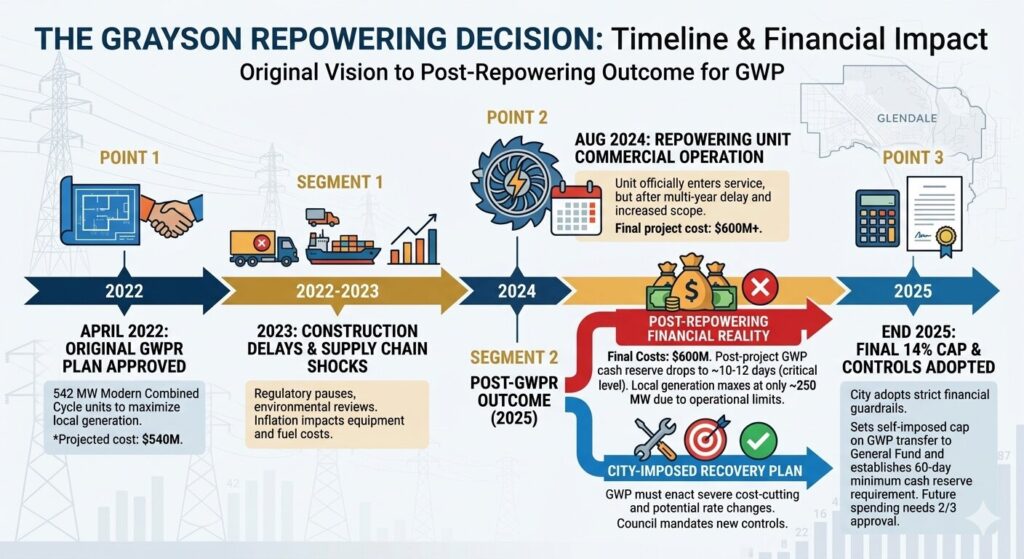
In 2022, Glendale had a solid plan. The former general manager of Glendale Water and Power developed a proposal to repower the aging Grayson plant with five Wartzilla engines, highly efficient gas burners that can be turned on and off cleanly without the pollution ramp-up of traditional turbines. The South Coast Air Quality Management District approved them to run at full capacity.
Five engines would have put Glendale over 200 megawatts of power, enough to sell surplus to neighboring cities and hold rates flat for every resident. The price tag for five engines was $493 million.
One incumbent pushed to cut the order to three. The deliberations dragged from 2022 through 2024.
During that delay, global demand for the engines spiked and bond interest rates doubled. By the time the decision was finally made, three engines cost $600 million. The city took on over $510 million in debt at twice the interest rate it would have paid if the decision had been made on time.
Then, despite the state approving the engines to run at 100% capacity, the council imposed a self-imposed 14% generation cap. They capped themselves below what the state had already reviewed and cleared, for environmental reasons the state had already signed off on.
Patrick met a Glendale teacher at a cruise night last August who was near tears. She had two young kids, a career in the school district, and an electric bill she could no longer afford. She told him she was going to have to leave the city she had served her entire career.
That story stayed with me too, and it is a big part of why I write about housing and community decisions the way I do.
What Changed for Me After This Conversation
I went into this episode already worried. I came out of it understanding the full shape of what we are actually dealing with.
This is not one bad call by one bad council member. It is a pattern, the same ideological filter applied to bike lanes, parking lots, power policy, and density targets, all compounding on top of each other while residents were never properly told it was happening.
The Glendale city budget crisis did not arrive by accident. It arrived through choices, and those choices were made without the people who would live with the consequences ever being genuinely invited into the conversation.
“When I look and when I dig, I find more and more and more. And when I talk to people in staff, I hear more and more and more. It’s like, what is going on here? We have 197,000 people in 2020, 188,000 today, and we’re spending over 50% more money. Somebody tell me why.” — Patrick Murphy, Glendale City Council Candidate
What Patrick reminded me is something I already know from decades in real estate. The people who get hurt the most by bad decisions are usually the ones who were never in the room when those decisions got made.
My job is to make sure my clients know what they are walking into. That means understanding the BRT, the CORO, the electric rates, and the 20-year land use plan. It means having conversations like this one and making sure they reach the people who need to hear them.
The town hall number stays with me. Two city meetings, nine people. One evening of real outreach, 200 people. People are not checked out. They are not apathetic. They just need someone to actually tell them what is happening.
That is what Patrick Murphy Glendale City Council represents to me. Not a politician climbing a ladder. A neighbor who started paying attention and could not stop.
Frequently Asked Questions
Who is Patrick Murphy and why is he running for Glendale City Council?
Patrick Murphy is a 41-year commercial real estate veteran who first got involved through the Verdugo Wash Neighborhoods Coalition and kept showing up as he saw more problems with how the city was being run, from budget waste to the burden of Glendale electric rates on residents. He has zero interest in higher office. His only goal is to help make Glendale better for the people who actually live here.
What is the CORO and why should Montrose residents care?
The CORO, or City-Owned Residential Overlay, proposes converting the public parking lots behind Montrose Shopping Park into high-density apartments. Patrick argues this will kill the foot traffic that drives Montrose’s sales tax revenue and make the city’s budget problem significantly worse.
What is SB 79 and how does it connect to the BRT project?
When it comes to BRT bus rapid transit Glendale California, the real danger is not just the buses. SB 79 housing density Glendale legislation allows developers to build up to nine stories with no parking requirement within 95 feet of any BRT bus stop. Glendale has more BRT stops and dedicated lanes than any other city on the line, making it the most exposed to SB 79’s neighborhood-altering density impacts.
Why are Glendale electric rates so high right now?
Political delays stretched the Grayson power plant repowering decision into 2024, allowing bond interest rates to double and engine prices to spike, costing the city hundreds of millions more than necessary. A self-imposed 14% generation cap then limited output below what the state had already approved.
What does Patrick Murphy plan to prioritize if elected?
Reducing the cost of living, keeping streets safe, working closely with police and fire, and auditing city contracts properly are all part of his plan to address the Glendale city budget crisis head on. Above all, he wants to engage residents before major decisions are made rather than after.
Where can residents learn more or get involved?
Start at Verdugo Wash Plan for Verdugo Wash Coalition resources, follow the Montrose Shopping Park Association, and connect with local HOAs like Royal Canyon and Rosemont Mountain. Showing up to city council meetings matters more than most people realize.
Want to Stay in the Loop?
This is just the beginning of the conversation. If what Patrick and I talked about hit close to home, stay connected and keep showing up for this community.
Connect with Patrick Murphy:
🌐 Website → https://www.patrickmurphyforglendale.com/issues
📘 Facebook → https://www.facebook.com/p/Patrick-Murphy-for-Glendale-City-Council-61579555117735/
📸 Instagram → https://www.instagram.com/patrickforglendale/
Follow Robbyn Battles:
🌐 Website → https://www.thehouseagent.com/
▶️Youtube → https://www.youtube.com/@RobbynBattles
📸 Instagram → https://www.instagram.com/robbynbattles/
Apply as a Guest on the I’m Just Saying with Robbyn Battles Podcast
Glendale is at a turning point, and the people who feel it most are the ones living it every day. The business owners, the longtime residents, the families quietly doing the math on whether they can afford to stay.
If you have something real to say about what is happening in this community, whether you are a local advocate, a merchant, a real estate professional, a first responder, or just someone who genuinely cares about where you live, I want to hear from you. This podcast exists for exactly these conversations.