


A cut-down kitchen pot holder reached a mother that four years of children’s toys could not. That single moment, not a boardroom, is where a whole product line was born.
On my podcast, I’m Just Sayin’, I talked with Angela Fairhurst of Geri-Gadgets about the dementia sensory kits she built out of that kitchen moment, why silence does not always mean someone is gone, and what finally got Stanford to sign on to help her prove it.
Curious what this looked like in the room? Here’s a preview of our conversation:
A Television Producer’s Detour Into Dementia Care
Angela spent years in music variety television, working her way up from an intern on the Grammy Awards to an executive in charge of production. That job was really about solving problems. Staffing, schedules, budgets, whatever broke that day.
Then her mom got dementia, and the job changed. Not the title. The mission.
I have sat across the table from a lot of families going through something similar. It usually starts small. A missed pill. A confused phone call. Then suddenly the house, the finances, and the care all need answers at once. I wrote about that exact moment. There are conversations that families wait too long to have, and Angela’s story starts in that same place. A daughter trying to solve a problem nobody prepared her for.
According to the National Institute on Aging’s official guidance on communicating with someone who has Alzheimer’s disease, correcting or arguing with a person who has memory loss rarely helps. Angela learned that the hard way, in her own kitchen, before anyone handed her a pamphlet.
Watch the full conversation here:
Why Every Toy She Tried Failed First
Angela brought her mom children’s toys first. It seemed reasonable. It did not work.
The toys felt infantilizing. Some were too complicated for hands that had lost their fine motor control. Worse, some were dangerous. A crayon, harmless to most people, became a tube of lipstick in her mother’s mind. Dementia does not just take memory. It changes how a person perceives the world in front of them.
Nothing was dishwasher safe either. And her mom was agitated, kicking and biting at her care community, behavior everyone else called “bad” but Angela recognized as something else entirely. A person who cannot speak still has something to say.
That gap between what looked like a behavior problem and what was actually unmet sensory need is where Angela’s entire product line, the silicone sensory engagement kits now sold under Geri-Gadgets, took shape. You can see the full lineup on Geri-Gadgets’ website.

The Kitchen Pot Holder That Became a Business
Angela did not set out to build a company. She cut down a square silicone pot holder because food-grade silicone does not hold smell, heat, or cold. She brought it to her mom, who patted it, then threw it back and forth like a Frisbee.
For the first time in four years, her mother was present.
Getting that mat into stores took longer than the idea itself. Angela had no background in manufacturing, shipping, or liability insurance. She learned all of it the slow way, through networking, not funding.
“Well, everything takes time. Everyone said, ‘Oh, it takes, you know, at least one to three years for brand recognition.’ And it depends on how much money you have. If you can flood the market with a lot of money, you can be recognized sooner. Well, I’m a grassroots, you know, self-invested human here. And I’ve done a lot of it through networking. So linking in and going to these networking meetings and meeting people who want you to meet other people and just talking about it and learning how to talk about what it is that I do and how they’re working and what their problems are in those communities or home or just daycares and all the schools to be able to offer the solutions that I have.”
That patience is something I recognize in my own work. Selling a longtime family home, especially one tied to a parent’s declining health, rarely moves fast either. That timeline can play out very differently family to family, as I mentioned when comparing how two retiring sellers approached the same decision.
You can browse the full Geri-Gadgets kit lineup directly on Shopify, at the same price as everywhere else.
Why There Is No Red Anywhere in the Product Line
Look closely at any Geri-Gadgets kit, and you will notice something missing. No red. That is not an accident.
People living with dementia often lose their sense of taste, smell, and appetite early in the disease process. Red visually signals food and appetite, so Angela deliberately left it out of every kit. Brightness stays, though, because aging eyes and conditions like cataracts need contrast. Without it, the world starts to look beige.
As dementia progresses, it does not just take memory. It narrows perception across every sense: color, taste, even the ability to register temperature or texture the way they once did. Touch is one of the last senses to go, which is part of why these kits work at all.
You can watch how this plays out in real sessions on Geri-Gadgets’ Instagram, where Angela shares footage of people engaging with the kits for the first time.
For families weighing what comes next for a parent’s home during this stage, I wrote about some of the questions senior home sellers often forget to ask before they are ready to move.
The Four Words That Change How You Talk to Someone Who Repeats Themselves
Short-term memory in dementia can last as little as thirty seconds. That single fact explains so much of what frustrates caregivers.
Angela uses an acronym she calls the DARE caregiver communication method. Don’t argue, react, or explain. The goal is not to win a conversation. It is to meet someone exactly where they are.
“Well, they don’t know. They don’t know that they did that. That’s the problem right there, right? They don’t know. So why are we being impatient? …there’s an acronym I like to use, DARE. Don’t argue, react, or explain. We do not need to be right. We just have to meet someone where they are. What’s the point of explaining something that they’re not going to remember 30 seconds later anyway?”
Angela shared a story about a woman whose mother believes it is her birthday every single day. Her advice was simple. Tell her happy birthday. It is her birthday every day she is alive.
The Family Caregiver Alliance’s ten tips for communicating with a person with dementia echo this same approach, favoring redirection over correction in nearly every scenario.
What a Silent Man in a Wheelchair Taught Her About Engagement
One of Angela’s earliest visits to a memory care community involved a man who had gone nonverbal. His head was down. He was not moving.
She placed his hands on one of her silicone shapes and waited. Five minutes passed before he started pulling on it himself. His head came up. Then he started to talk.
Nobody could understand what he said, and it did not matter. He had not spoken in longer than anyone at that facility could remember, and this small object brought him back for a moment.

Little moments like this are why I keep coming back to the idea of a senior move manager for families navigating a parent’s transition. Sometimes the smallest interventions carry the most weight, whether that is a silicone shape in someone’s hands or a person who knows exactly how to pack up fifty years of a home with care.
You can see more of these moments documented on Geri-Gadgets’ Facebook page.
Twelve Sites, One Pilot, and a Call From Stanford
Hospital systems move slowly. Angela described eighteen-month buying cycles and layers of decision makers before anything gets approved. So she started smaller.
Geri-Gadgets kits are now part of a New York State Office for the Aging pilot across twelve adult day and disability service centers. If it goes well this year, the plan is to expand into other systems those centers support.
The bigger win came the day before we recorded this episode. Stanford signed on as a university partner to study the physiology behind why these kits work, tracking blood pressure, heart rate, and facial expression before and after engagement. Angela found the right researchers by asking an AI tool for the top ten universities capable of that kind of study, then wrote personal emails to each one.
This work matters more every year. Census Bureau projections show that by 2030, all baby boomers will be older than 65, and older adults are expected to outnumber children in the U.S. for the first time in history shortly after. The population Angela is building for is only getting bigger.
You can follow Geri-Gadgets’ progress and partnership updates on LinkedIn.
Why I Think Every Family Facing a Decline Needs to Hear This
The moment that stayed with me most from this conversation was not about products at all. It was about presence.
“I also want people to realize that they are there. So a lot of people will talk like the person isn’t there or not, or take them out of the decision-making. Now even if they can’t make the decision, they should be talked to like they’re still adults. They are. They don’t become babies just because they have to wear a diaper or don’t have language skills anymore and can’t feed themselves. They’re still adults, and I promise you that they are there. They might not be able to identify who you are, but they know who you are.”
I think about this constantly in my own work with senior home transitions. Families sometimes stop including a declining parent in decisions about their own home, assuming it is kinder. Angela’s story suggests the opposite might be true.
If your family is facing decisions about a trust or an inherited property alongside a parent’s decline, I wrote about protecting families from California probate traps that can complicate an already difficult season.
The Alzheimer’s Association’s caregiving resources offer similar guidance on preserving a person’s dignity and involvement, even as their communication changes. You can also see more demonstrations of the kits themselves on Geri-Gadgets’ YouTube channel.
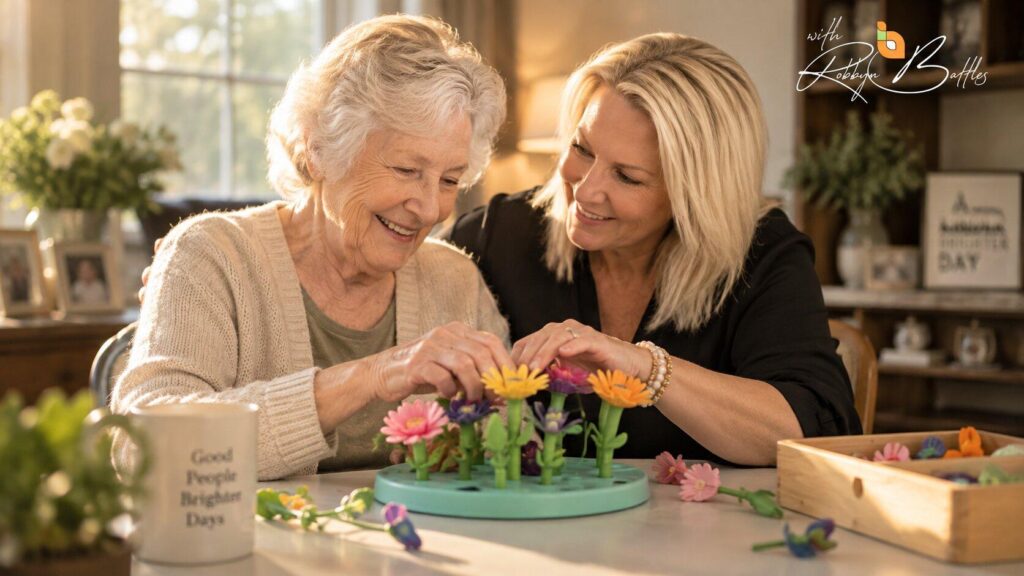
If you want to keep up with more conversations like this one, you can find me on Instagram and Facebook, or connect professionally on LinkedIn.
Want to hear my entire conversation with Angela Fairhurst of Geri-Gadgets about how she reached her mother through touch when words had already disappeared? Listen to our full podcast episode to hear how sensory engagement is transforming dementia care across the country.
FAQ Section
What are Geri-Gadgets used for?
Geri-Gadgets are dishwasher-safe, food-grade silicone sensory engagement kits designed to calm and connect people living with dementia, Alzheimer’s, ADHD, autism, and related conditions.
Why don’t Geri-Gadgets include the color red?
Dementia suppresses taste and appetite perception, and red visually signals appetite. Angela deliberately left it out of the entire product line for that reason.
What does DARE stand for in dementia caregiving?
DARE stands for Don’t Argue, React, or Explain. It’s a communication approach that focuses on meeting someone where they are instead of correcting them.
Apply As A Guest Speaker on the I’m Just Sayin’ Podcast
Real estate does not happen in a vacuum. Behind almost every senior home sale is a family navigating something like this. Angela built a business out of refusing to let her mother go unseen, and that same instinct shows up every time I help a family figure out what happens to a parent’s home.
If you are working in the industry, or in caregiving, healthcare, or elder services, and solving real problems for families in transition, I would love to hear your story.